Athens · The weekend · 12 min
Walking the Marble Track at Athens' Panathenaic Stadium
€12 gets you into the only marble stadium on earth. What the ticket covers, when the running track reopens, and how to build a half-day around it in Pangrati.
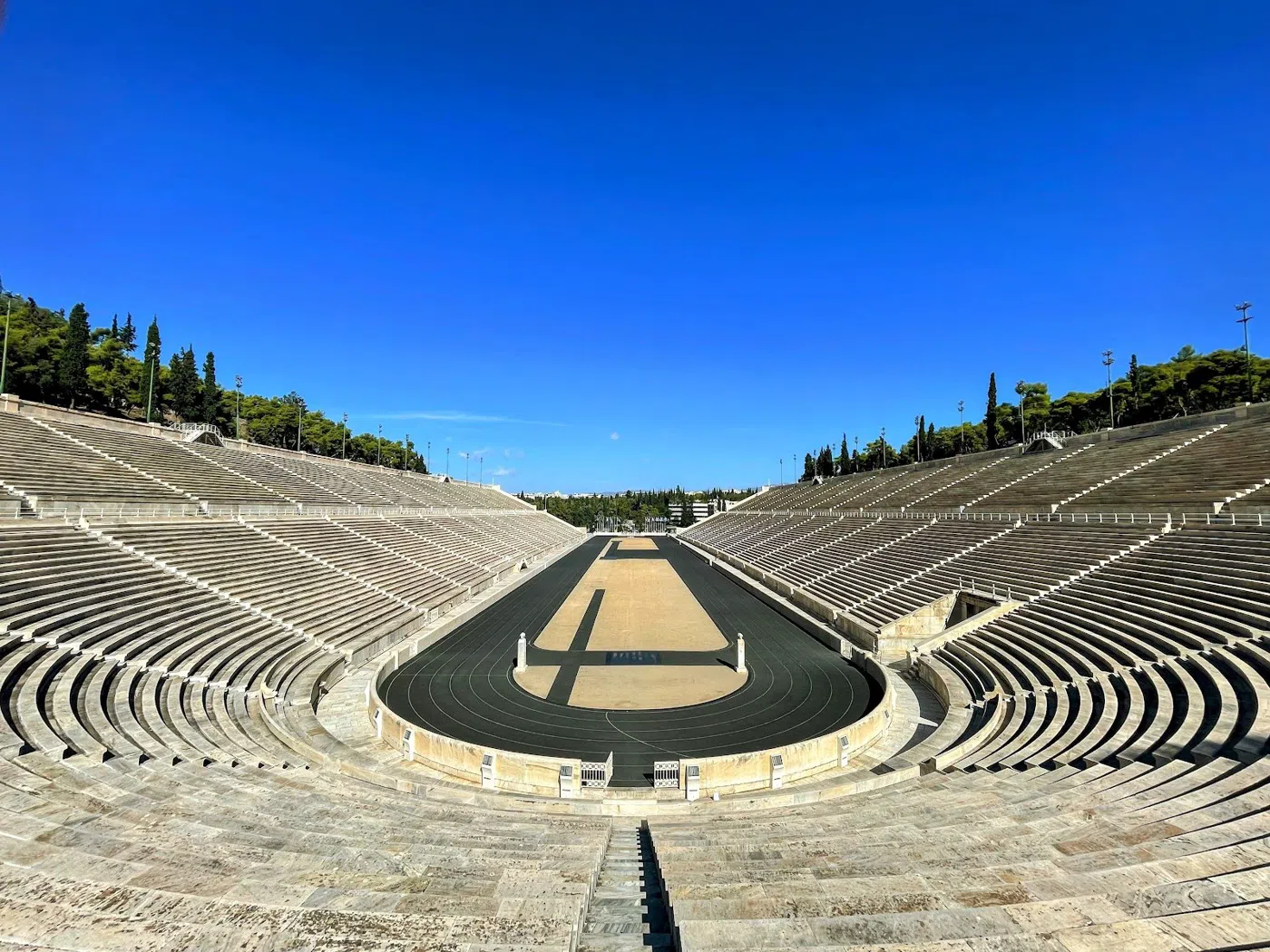
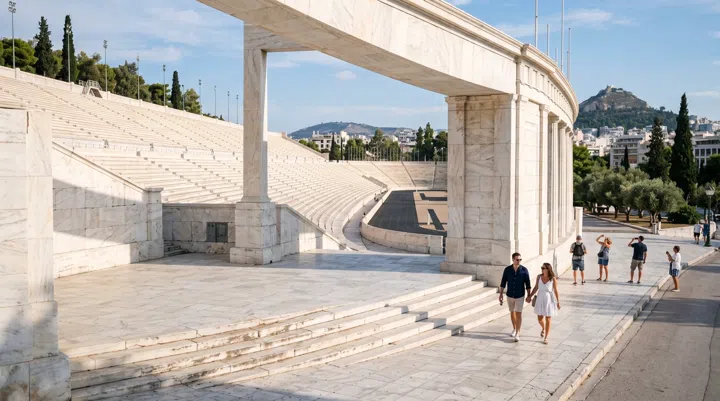
Tier after tier of white Pentelic marble, folded into a horseshoe at the foot of a pine hill. This is the only stadium on earth built entirely of marble, and the one monument in Athens where you sit exactly where spectators sat in the second century AD and again in 1896. Most visitors shoot it through the railings on Vasileos Konstantinou and keep walking. The ticket is €12 and it buys the tunnel, the top tier and a straight view back at the Acropolis.
What the €12 actually buys
Panathenaic Stadium (Kallimarmaro) is at the eastern edge of Pangrati, where Vasileos Konstantinou meets the foot of Ardittos. General admission is €12, reduced €6 for students, a rate in force since October 2025. Under-6s go free, as do disabled visitors plus one companion, and teachers escorting an educational visit. Restrooms cost €1.50 separately, so carry a couple of coins; the ticket desks take cards but the toilet turnstile is its own small transaction.
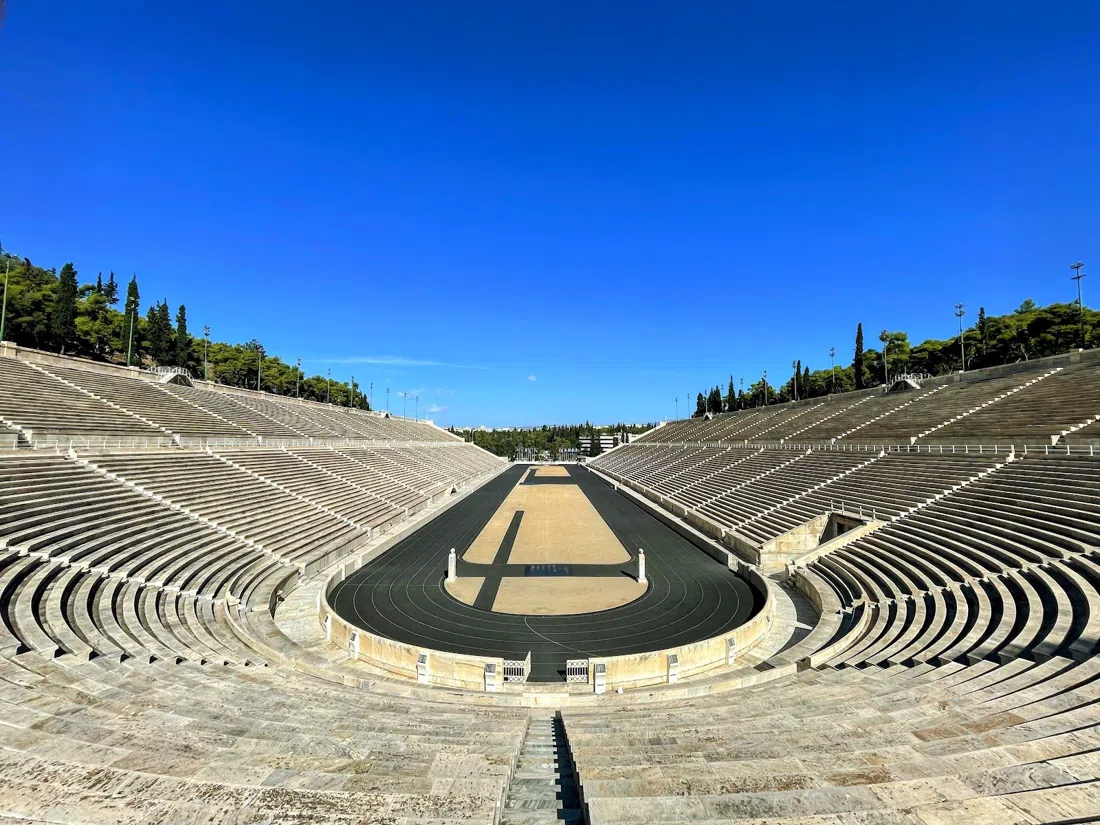
The ticket covers four things. The marble seating, which you can climb to the top row on either flank. The vaulted athletes' tunnel under the bend, cool and low, and the part people remember. The Atrium exhibition, which holds Olympic torches and Games posters from 1896 onward, one per edition, and takes about fifteen minutes if you read them. And a 30-minute automatic audio guide in 11 languages, handed over at the desk, which triggers by location rather than by keypad.
There is no timed entry and no pre-booked slot. You walk up, you pay, you go in. Groups are taken freely. Private guides and school parties are routine here, and nobody will ask you to split into tens at the door.
The marble track and the 16 September reopening
The running track itself has been closed to visitors and reopens on 16 September 2026. Until that date you get the seating, the tunnel, the sphendone at the closed end and the Atrium: everything except setting foot on the surface. Still worth the €12, but you are not walking the lap.
Once the track is open again, do it properly. Start in the tunnel, come out where the athletes come out, and walk the full horseshoe anticlockwise. The lap is shorter than a modern 400-metre oval and the bends are close to hairpins. That geometry is why 1896 finishing times look slow on paper, and you feel it in your knees on the turn. Ten minutes at a walk, including stopping. Then climb. The top tier on the western flank is the photograph: marble in the foreground, the pines of Ardittos to your right, the Acropolis rock over the far rim.
Two things regularly shorten the visiting day: concerts staged in the bowl, and the Authentic Athens Marathon, which finishes here. On those days the site closes early or entirely. Check on the morning rather than assuming.
How long it takes, and when to arrive
Budget 60 to 90 minutes. That is the tunnel, a lap, a climb to the top, the Atrium and the audio guide. Rush it and 40 minutes will do; sit on the marble and read the posters and you can burn two hours without noticing.
Opening hours shift with the season, longer in summer and an early close in winter, and the hours that count are the ones on the desk that morning, not the ones cached in a search result. Be at the entrance when the desks open. The bowl faces the morning sun, the marble throws heat back at you from about 11:00 in July and August, and there is no shade anywhere inside except the tunnel. First entry also means an empty top tier, which matters more than it sounds: the stadium looks enormous with nobody in it and ordinary with two hundred people scattered across the seats.
Second-best is the last 90 minutes before closing. The light goes warm on the marble and the coach traffic has moved on.
Queues, door tickets and guided options
The queue at Kallimarmaro is not an Acropolis queue. There is no bottleneck of timed slots, two desks work the window, and even in August you are looking at a short wait rather than an hour. Turning up without a ticket is a reasonable plan here.
Booking a guided visit buys you commentary and sequencing, not a shorter queue. The stadium is a single object with almost no signage inside, so the guide is where the 1,800 years of story come from: Herodes Atticus rebuilding it in marble, the excavation, Georgios Averoff paying for the restoration in time for 1896, the torch relay arriving here before every modern Games. Guided half-days that take in the stadium run seven days a week, start from around 47 USD per person, and carry 16,287 traveller reviews between them, with the strongest rated 4.9 out of 5 from 5,971 reviews. If you want one on a specific date, book early. Dates in the next 90 days are already sold out, including 12 to 17 September 2026 and more beyond that.
For group organisers: a private guide is the sane choice, because inside the bowl a raised voice carries across the whole horseshoe and you will be competing with your own echo.
Access and the rules that catch people out
The lower seating and the track surface are level and reachable; the upper tiers are marble steps with no handrail, tall risers and no alternative route. If steps are a problem, you still get the tunnel, the field-level view and the Atrium, which is most of the value.
Wear shoes with grip. Polished marble plus dust is a slick combination and the steps have been worn into shallow dishes by two millennia of feet. No shade means a hat and water in summer; there is a small kiosk but not a café. Drone flying is not a thing you do here. And nobody is running training laps in shorts: the track, when open, is for walking.
The free view from Ardittos Hill
Ardittos Hill Park, the pine-covered rise directly behind the stadium in Mets, is open public parkland with no door policy and no ticket. It is the one place you can photograph the whole bowl from above for nothing: the full horseshoe, the marble, and the city behind it in one frame.
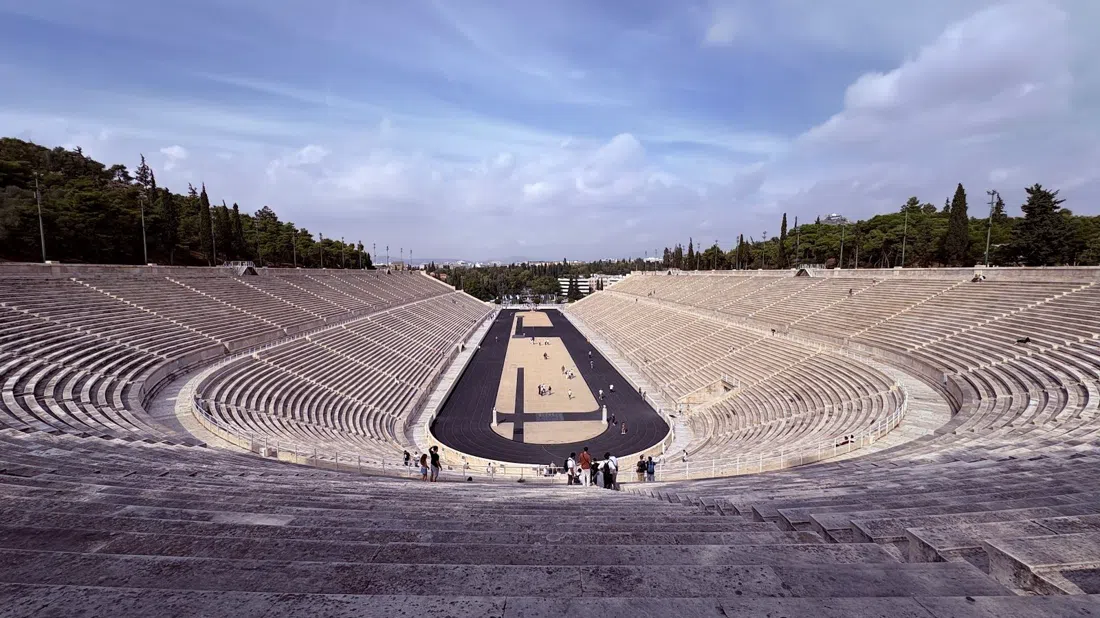
Pair it with the paid visit rather than using it as a substitute; from up there you cannot see the tunnel, the Atrium or the texture of the stone. Go an hour before sunset. The hill has no shade and the paths are narrow dirt tracks, which is why guides usually split parties larger than about fifteen before starting up. Ten minutes of climbing, decent shoes, no facilities.
Eight minutes west to Hadrian's Athens
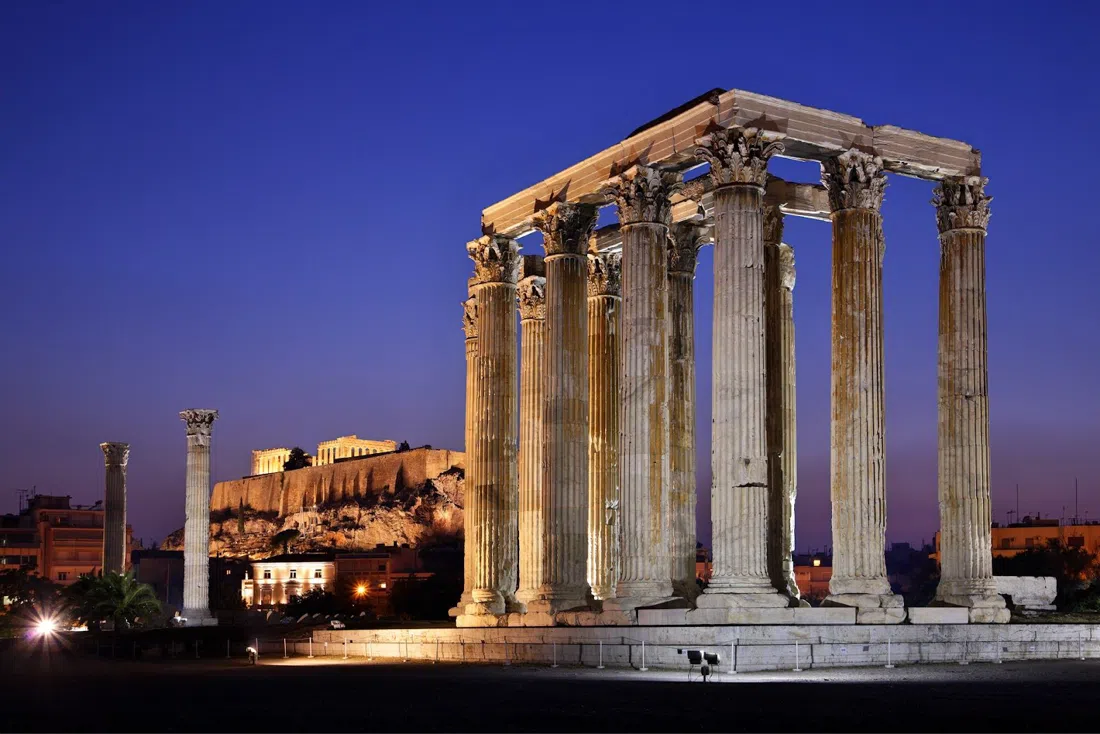
The Temple of Olympian Zeus (Olympieion) is eight minutes' walk from the stadium, entrance on Vasilissis Olgas. €8 adult, €4 reduced, and it is included in the €30 multi-site Acropolis combined ticket, which is the cheaper route if you are doing the big sites anyway. Sixteen columns standing out of an original 104, and Hadrian's Arch sitting just outside the fence where you can see it for nothing. Winter closing at 15:00 catches people out constantly, so do not leave it until after a late lunch between November and March. Coach groups and private guides are fine here, but a licensed guide is required to give commentary to a group inside the fence.
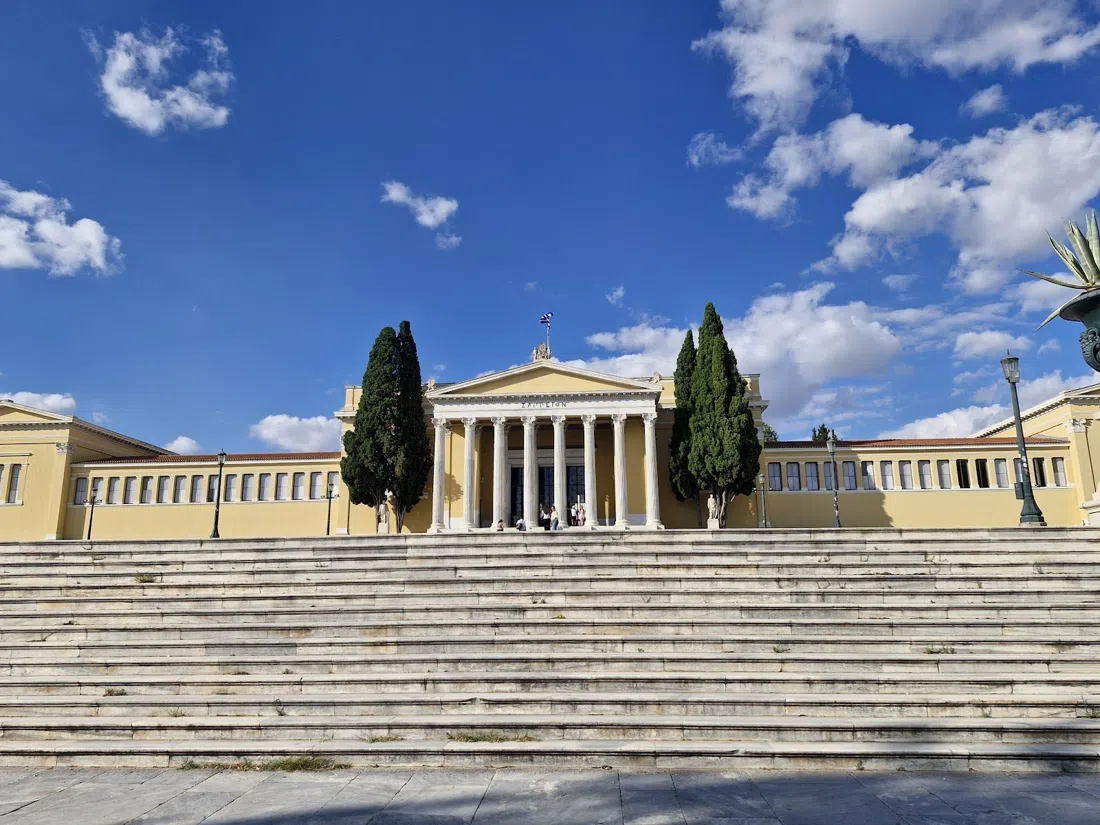
Zappeion Hall and Gardens, at the top of the same green strip, is the link most people miss. Evangelos Zappas funded the revival of the Olympic idea decades before 1896, and this is his building. The gardens and the portico are free and unrestricted; the hall itself is a working conference centre, so assume the interior is closed and that you are looking at the outside. Set that expectation with a group before you walk them over.
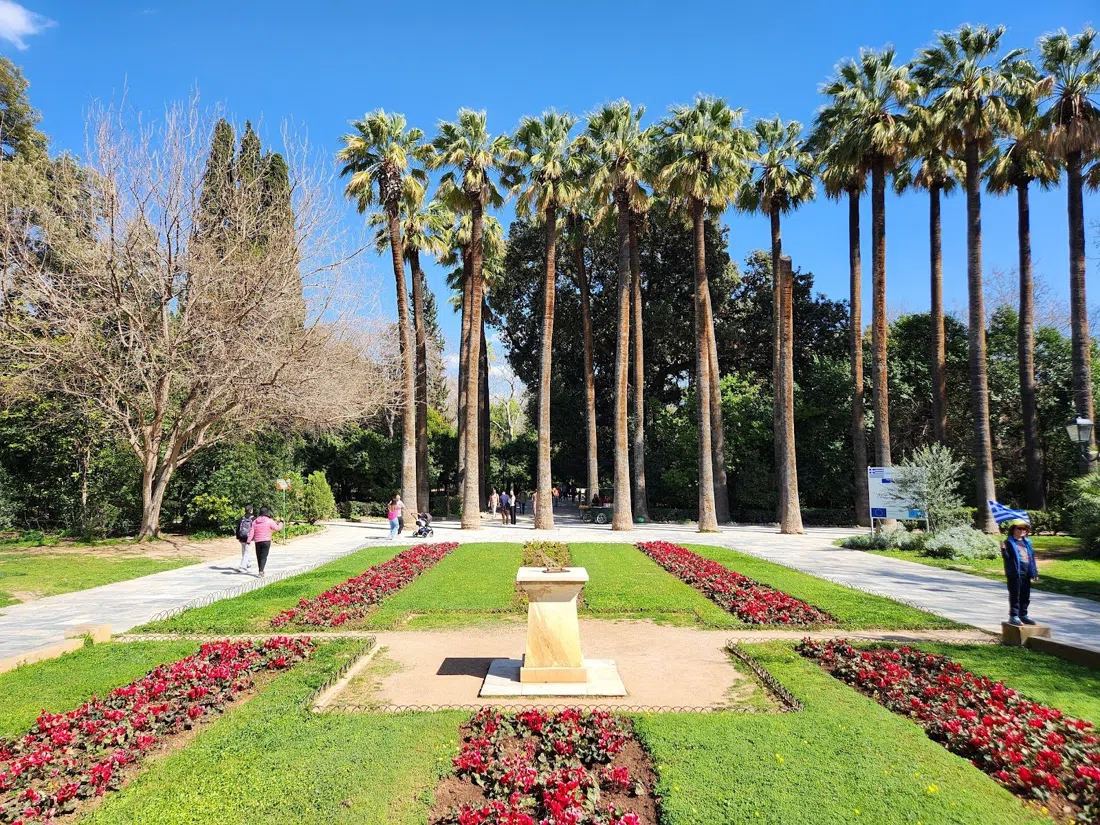
The National Garden of Athens connects all of it: free, sunrise to sunset, seven gates including Vasilissis Sofias, Amalias and three on Irodou Attikou, so a group can go in and come out without bunching at a single entrance. In July it is the only sensible way to cross this part of the city on foot. It closes at dusk, so treat it as a morning or late-afternoon link, never an evening one.
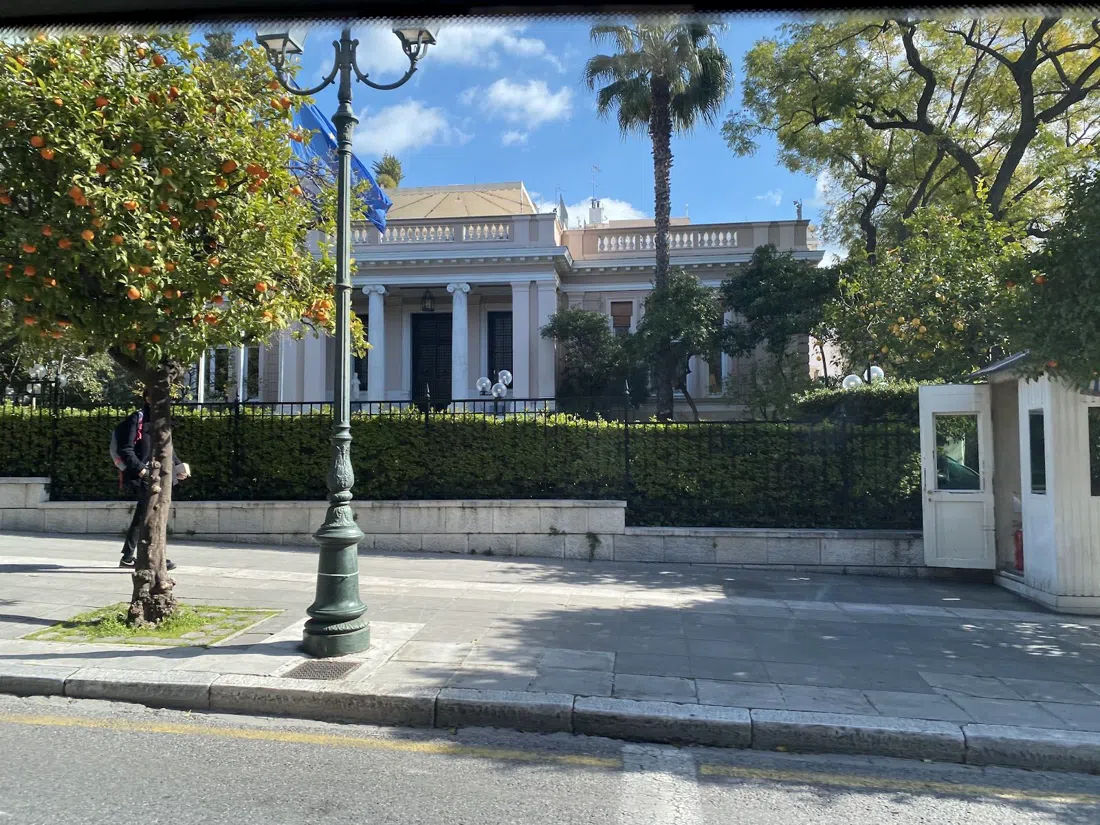
On Irodou Attikou, a few minutes from the stadium, the Presidential Guard (Evzones) at the Presidential Mansion change on the hour, round the clock, with no ticket and no barrier. The full company with its band marches to Syntagma every Sunday at 11:00. If you want the Sunday set-piece, be in place early. That one draws a crowd, and a group arriving at 10:55 will be watching the backs of other people's heads.
Indoors within ten minutes
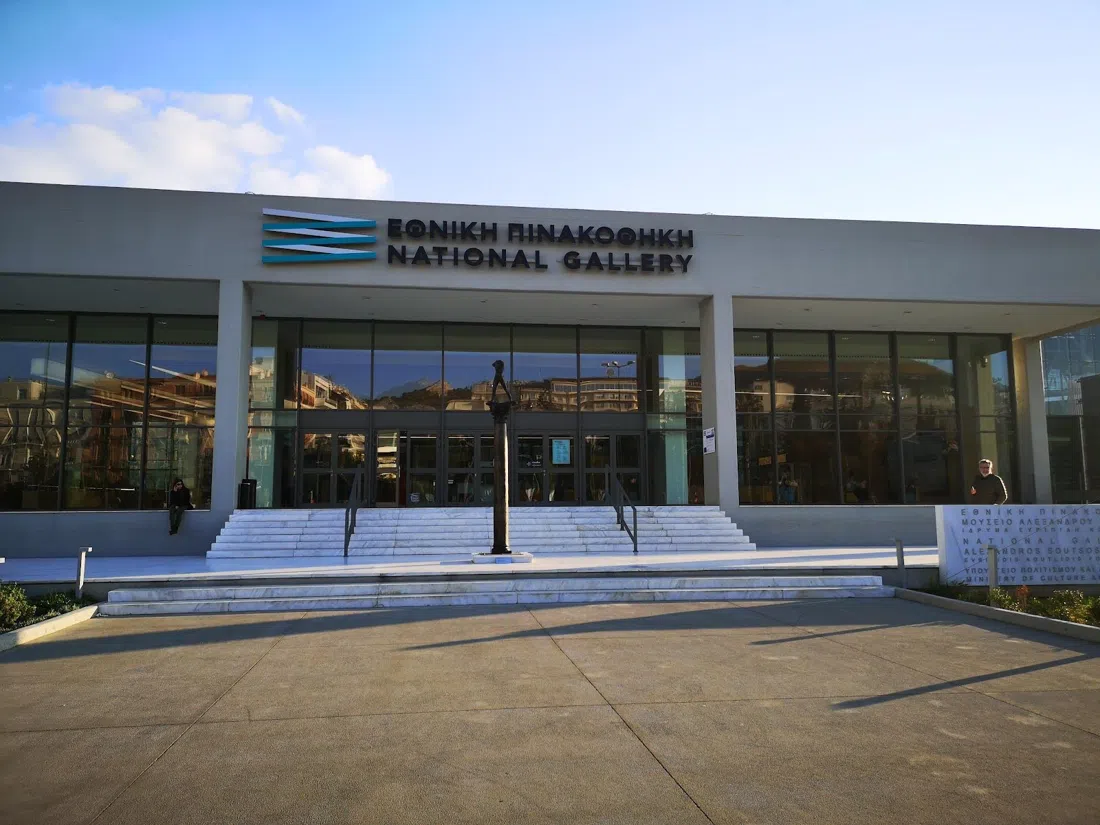
The National Gallery – Alexandros Soutsos Museum is directly across Vasileos Konstantinou from the stadium, rebuilt and reopened in full. Around €10 general, roughly €5 reduced, free on the first Sunday of the month. It holds the 1821 revolution paintings, which is the context for why a marble stadium mattered so much to this country in 1896. Closed Tuesdays; open late to 22:00 on Wednesdays, which is the best slot in the week.
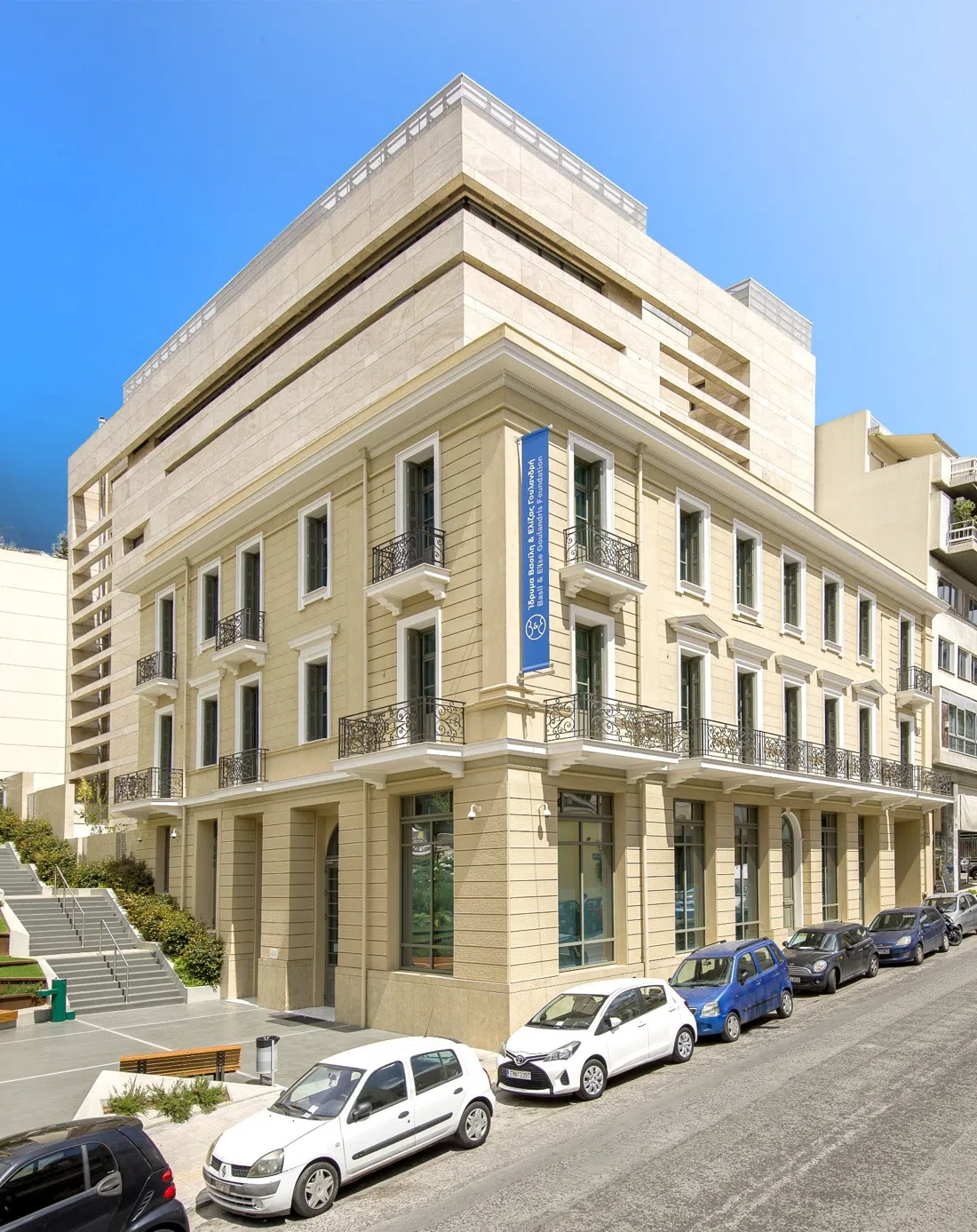
The Basil & Elise Goulandris Foundation in Pangrati is seven minutes' walk and the strongest bad-weather or mid-afternoon-heat option in the area: Van Gogh, Picasso, Cézanne and Giacometti alongside the best Greek modernists, and rarely crowded. €12 for the permanent collection, €16 including the temporary show, €9 and €13 concessions, under-12s free. Wheelchair accessible throughout with lifts and loan chairs. Groups over 10 need an advance request to [email protected]. Closed Tuesdays.
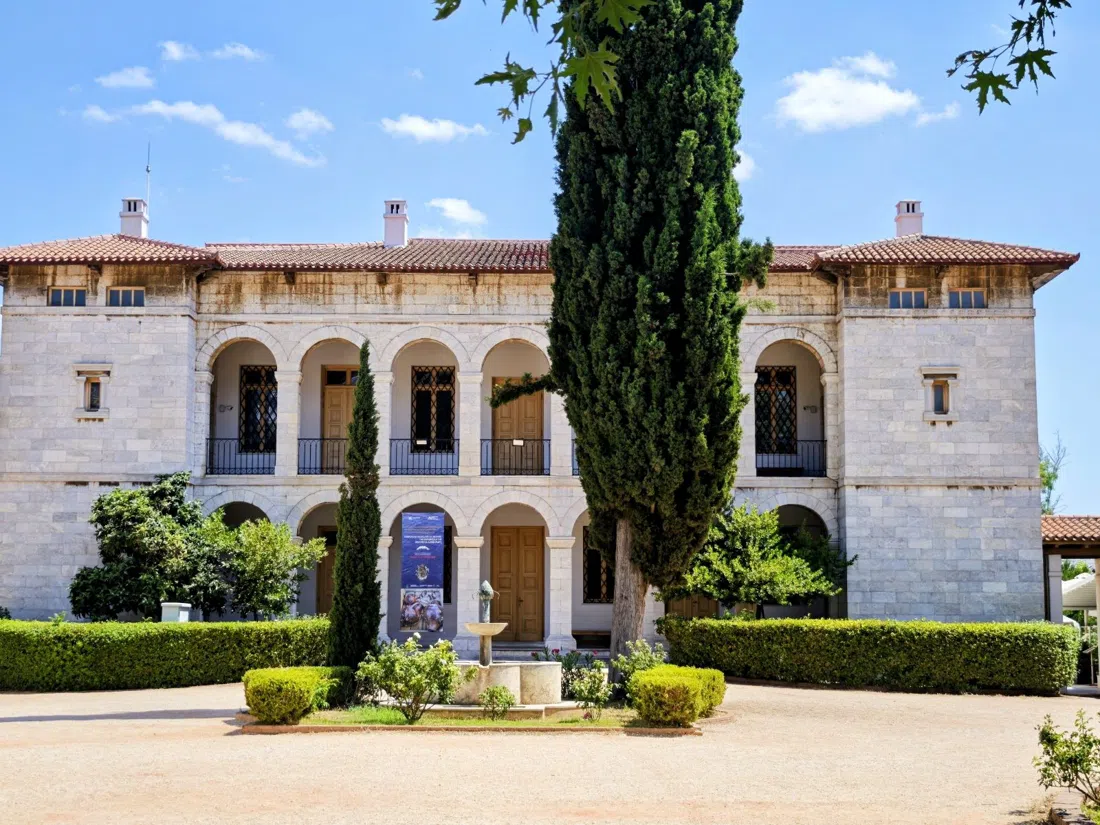
Twelve minutes up Vasilissis Sofias, the Byzantine and Christian Museum fills the gap between the ancient stadium and the modern city: icons, mosaics and church silver in a courtyard villa. €8 in summer, €4 in winter, half for reduced, and EU under-25s free with ID. Partly below ground with lift access, and the courtyard is a natural place to assemble a group.
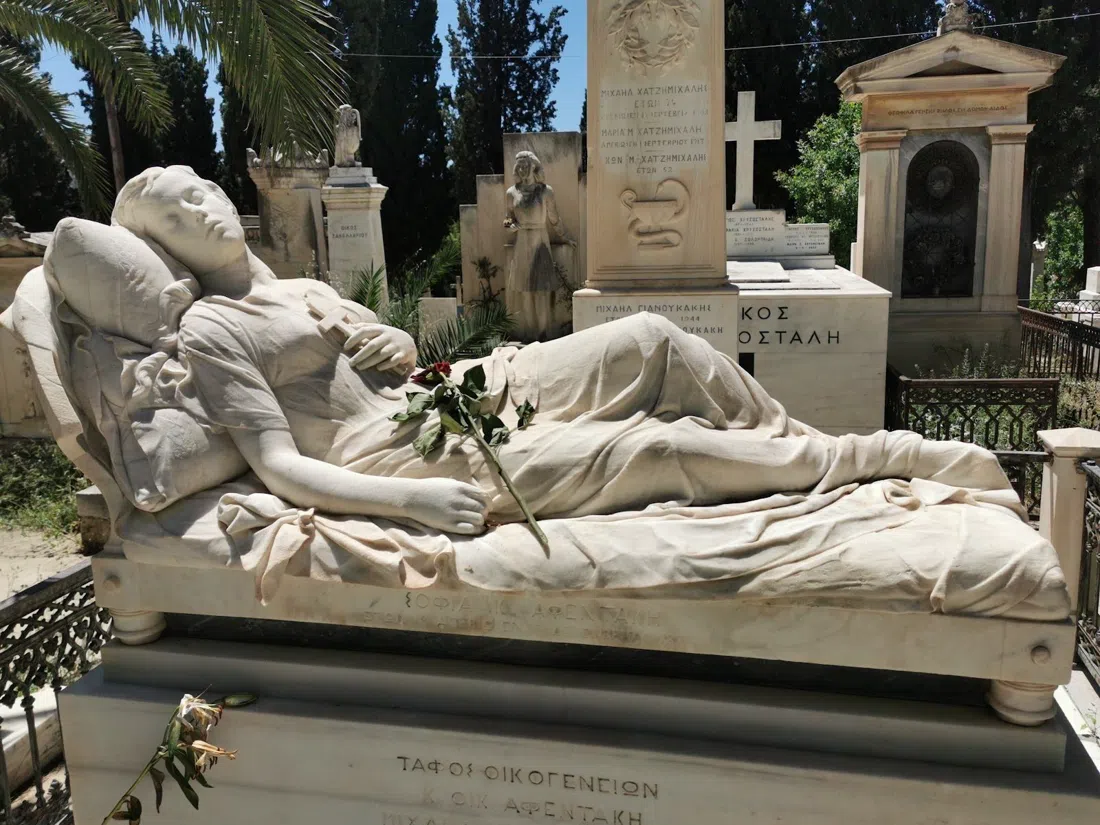
Five minutes uphill into Mets is the First Cemetery of Athens, free and almost empty of visitors. Halepas's Sleeping Maiden is one of the finest 19th-century sculptures in Greece. It is also a working burial ground with funerals happening while you are there, so keep the party small, keep voices down, and dress like you would at home.
Eating in Pangrati afterwards
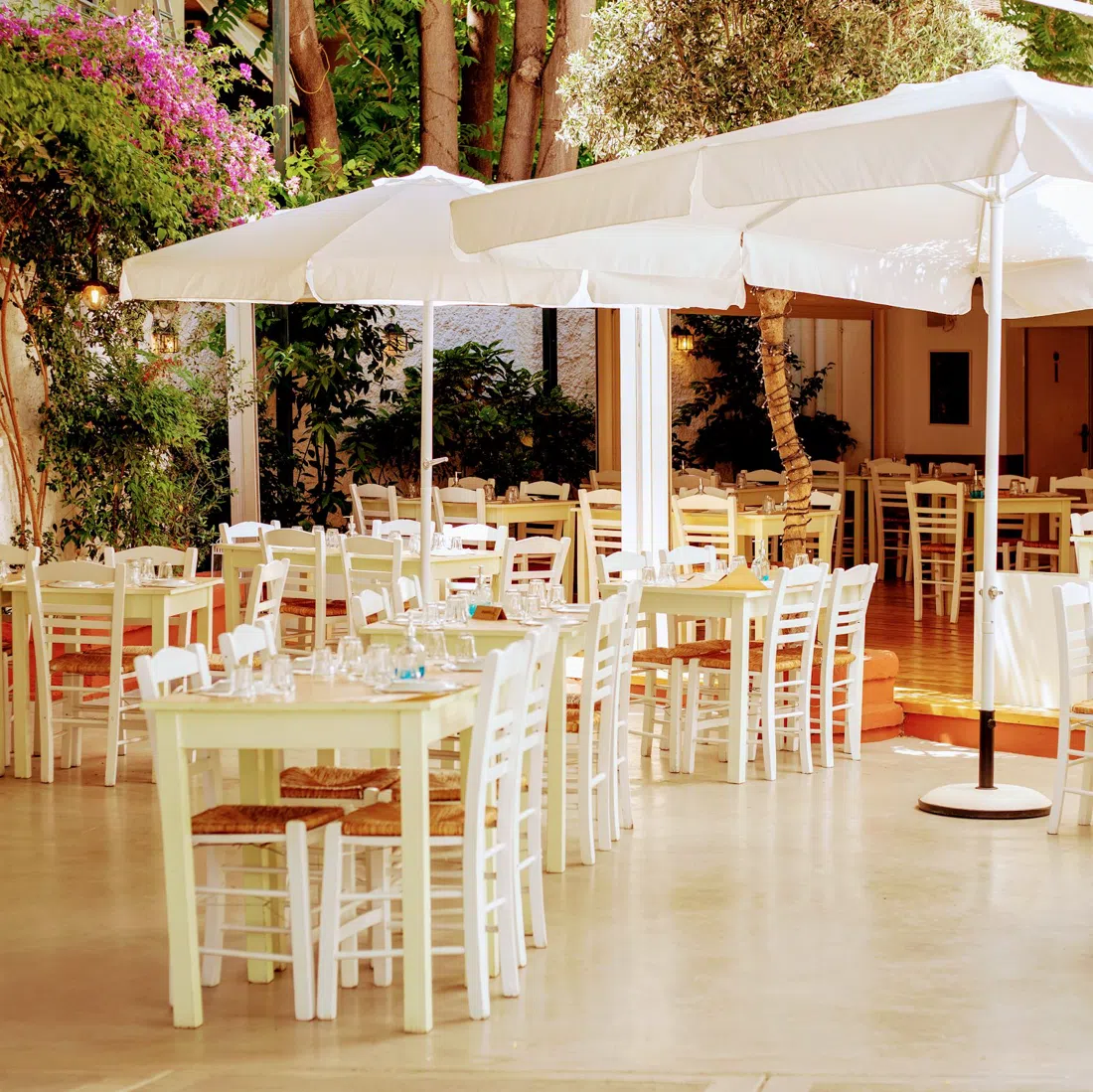
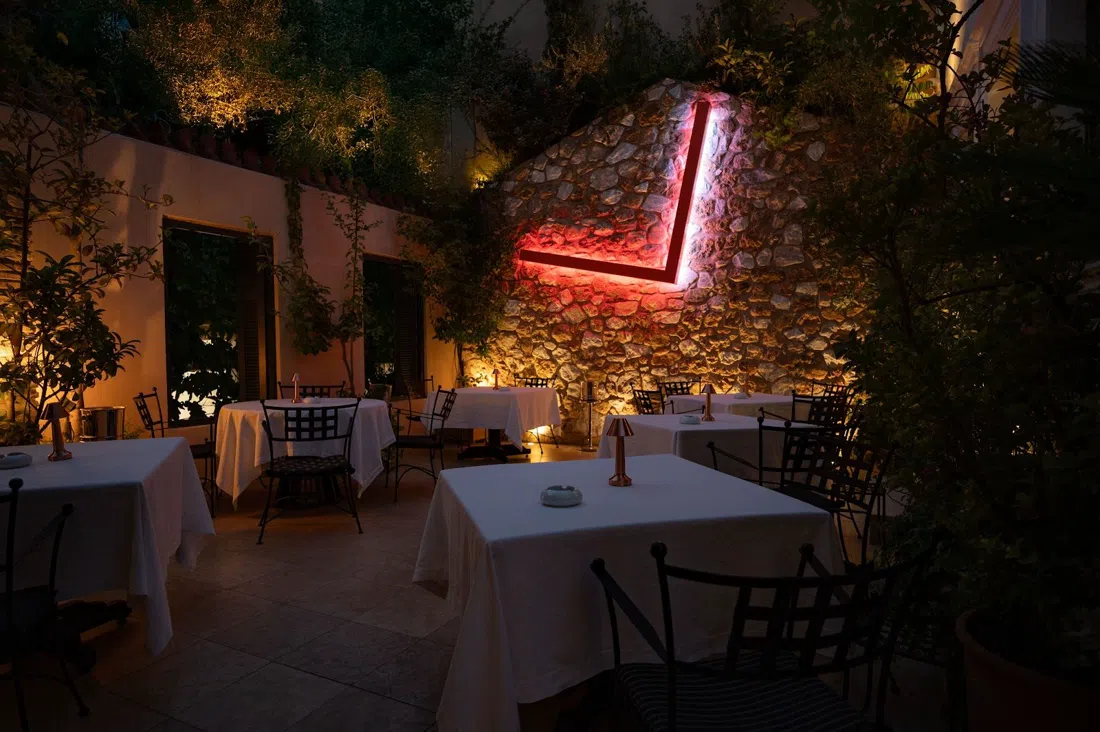
Vyrinis, on Archimidous, is literally behind the marble: a family taverna running since 1940, now third generation, genuinely cheap by central Athens standards. Call if you want the garden for a group; a coachload is too much for it. This is the honest lunch after a morning of monuments.
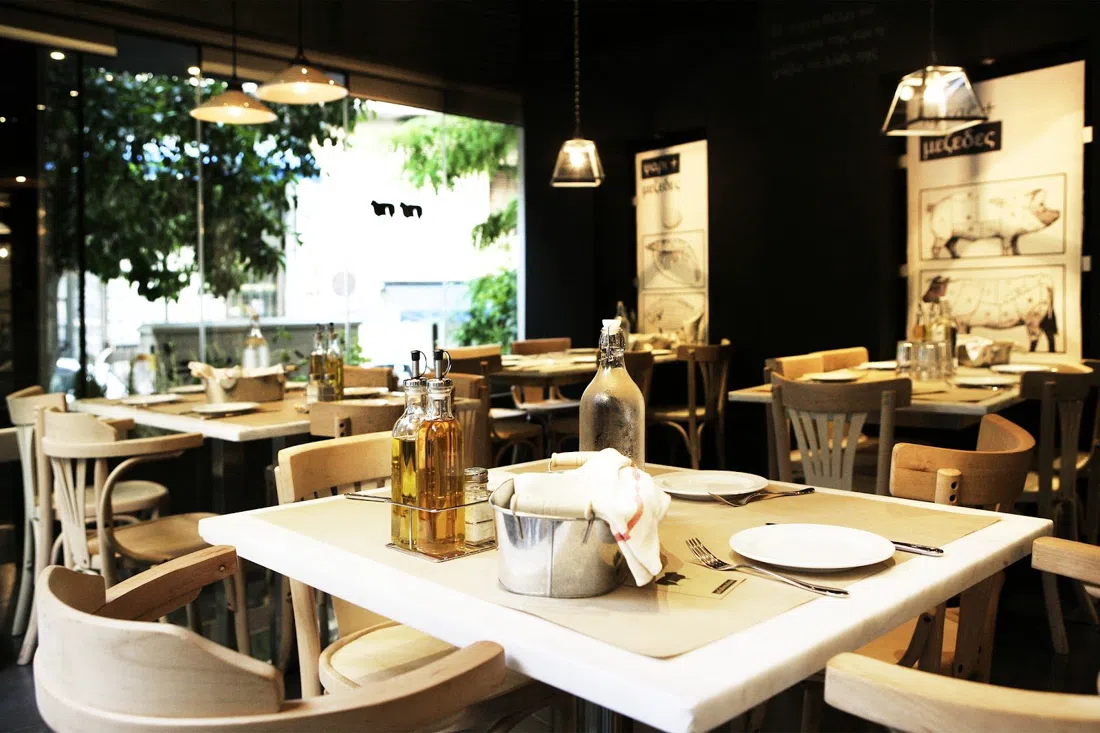
To Mavro Provato at Arrianou 31-33 is the benchmark modern mezedopoleio in the area, ten minutes from the stadium, open Mon-Sat 13:00-24:00 and Sun 13:00-19:00. It is also the hardest table to get around here. Phone +30 21 0722 3466 and book; turning up unbooked at 21:00 on a Friday will not work.
Spondi, a few streets behind the stadium in Pangrati, is the city's longest-running Michelin-starred kitchen, now under chef Dimitrios Trastelis. Tasting menus run well into three figures per head, the rooms are small, walk-ins are unrealistic, and a private group has to be arranged directly weeks out. It is the right end-of-day booking for the private-tour audience and the only place on this page where no reservation means no table.
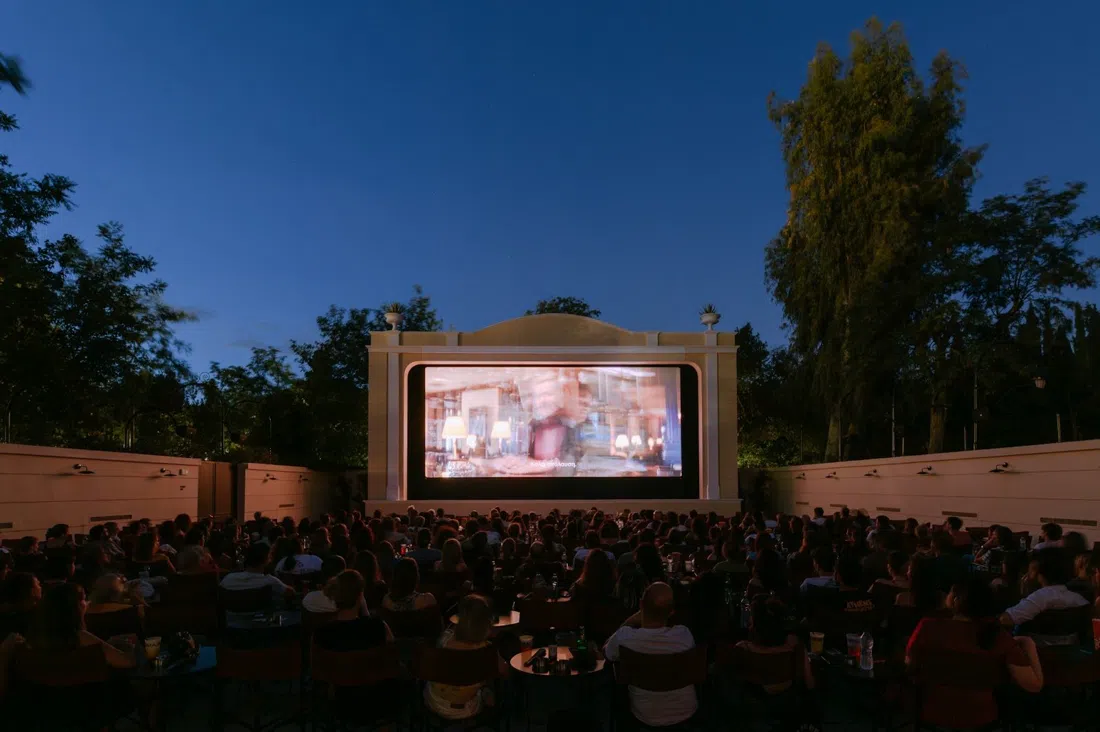
Between May and October, finish at Aigli Zappeiou in the Zappeion gardens, one of the oldest open-air cinemas in Europe, films in the original language with Greek subtitles, tickets around €10-12. The bar-restaurant runs from noon to midnight and seats large parties; reserve cinema tables ahead in high season. For the local version of an evening, Superfly Café on Empedokleous by Varnava Square is Pangrati as residents use it. It opens 17:00 on weekdays and 09:00 at weekends, so it is not a midweek morning stop.
Is it worth it
Yes, at €12, for almost everyone. It is the cheapest major monument in central Athens, it takes an hour, and it is the only one you are allowed to walk into rather than look at from behind rope. Couples and solo travellers can do it entirely unplanned. Families do well because children can climb and run. Groups are easy because the site absorbs them without a booking system.
Who should skip it: anyone who only has two days and no interest in the Olympic thread, and anyone who cannot manage marble steps and would be paying €12 for the lower tier alone. If you are on the fence, walk up Ardittos first, look at the bowl for free, and decide from there.
One caveat: until the track reopens on 16 September 2026, you are buying the seating and the tunnel, not the walk on the surface. If the lap is the reason you came, time your trip after that date.
Best time to go
Best hour: the first hour after the desks open. Empty seating, workable light, and the marble has not started radiating heat yet. Second best: the last 90 minutes before close, for warm light on white stone.
Best day: a weekday. Sunday morning pulls people toward the 11:00 guard march on Irodou Attikou, and the streets between Syntagma and the stadium clog with it. Tuesday is the day to do the stadium and Ardittos rather than the museums, because both the National Gallery and the Goulandris are closed.
Best season: late March to early June, and late September through November. Comfortable walking temperatures, long daylight, and the Olympieion still open past 15:00. July and August work only if you are at the entrance early, because there is genuinely no shade in the bowl. Winter is quiet and clear, but plan around the 15:00 closures nearby and the shorter day.
Avoid: any day with a concert in the stadium or the Authentic Athens Marathon, both of which shorten or cancel the visiting day.
Practical notes
Getting there: Metro Line 2 to Akropoli or Syntagma, then 10 to 15 minutes on foot. The walk from Syntagma through the National Garden and out at Irodou Attikou is shaded and pleasant. Trolleybus routes run along Vasileos Konstantinou and stop opposite. Taxis are cheap by European standards and drop you at the entrance.
Cash: cards work at the stadium desks and the museums. Carry coins for the €1.50 restrooms, and small notes for tavernas, because Vyrinis is the kind of place where cash is simply easier.
Timing a half-day: stadium at opening (90 minutes) → National Garden or the guard change (30) → Olympieion and Hadrian's Arch (45) → Zappeion portico (15) → lunch in Pangrati. That is a comfortable morning with slack in it.
Budget per person: stadium €12, Olympieion €8 or the €30 combined ticket, one museum around €10-12, lunch at a taverna €15-25, cinema €10-12. Ardittos, the National Garden, the Zappeion gardens, the Evzones and the First Cemetery cost nothing, which means a full day here can be done for under €40 including food.
Where to stay: Pangrati and Mets put you within ten minutes of everything on this page and out of the worst of the tourist churn. Compare rates with an Athens hotel search before defaulting to Plaka. For the rest of the city, start with the Athens guide.
12 September 2026 · a first week before the flat: the Athens hotel directory