Cologne · The weekend · 11 min
Cologne Day Trips to Castles, Forests and the Rhine
Eleven trips out of the city: a Rococo palace twenty minutes south, a cogwheel railway to a ruined keep, a cable car over the Rhine gorge, 5.4 km of level beech forest. Fares, opening dates and what groups need to know.
Cologne sits within half an hour of three landscapes, and all of them are reachable on a regional train before the cathedral square has filled up. Twenty minutes south there is a Rococo palace with gardens you can walk for nothing; an hour upriver the Rhine narrows into its gorge and the hill castles begin; west of the city the beech woods of the Eifel run on toward the Belgian border. Almost none of it needs a car, and several of the better days out cost nothing at the gate.
Twenty minutes south to Brühl
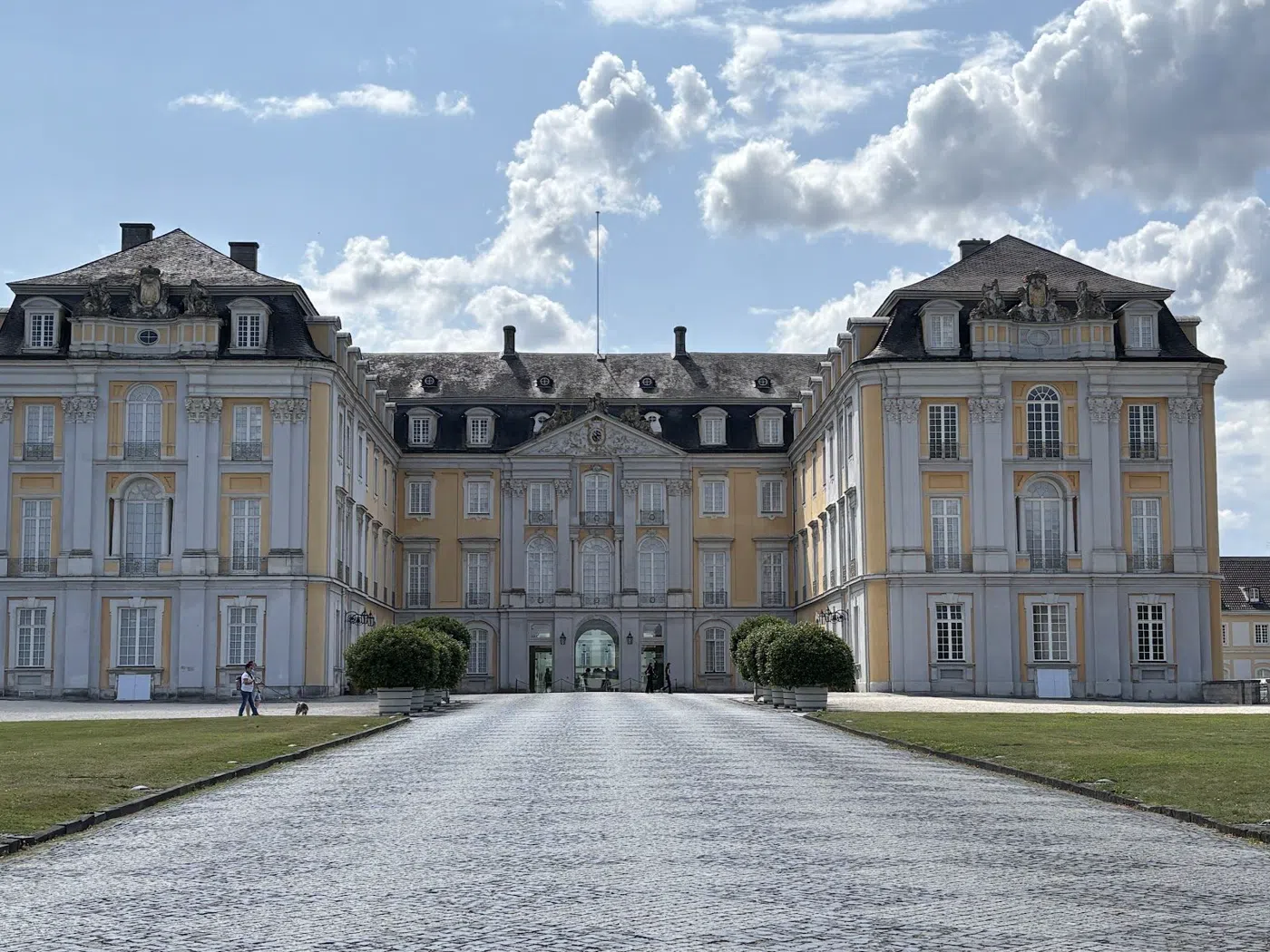
Augustusburg Palace and Falkenlust Hunting Lodge, in Brühl, is the shortest serious trip from the city and the one to take if you have a single spare morning. The main palace can be seen on a guided tour only, with audio guides in fifteen languages; Falkenlust, the hunting lodge set in the same park, you walk at your own pace. Entry is €11 for Augustusburg and €17 for the combined ticket, and the gardens are free, which makes the formal parterre a decent picnic in its own right.
Two things decide the day. Both buildings close entirely through December, January and February, so a winter visit is a walk in the grounds and nothing else. Part of the wooded palace park is also shut at present because of branch-fall risk, so don't build the afternoon around a long walk under the trees. Because everything inside Augustusburg is tour-led, parties of more than a dozen should reserve a slot by phone or email rather than turning up and hoping; an unbooked group at midday can wait a long time for space on a tour.
The cogwheel railway at Königswinter
Drachenfelsbahn and the Drachenfels summit, at Königswinter on the right bank, has been running since 1883, which makes it the oldest cogwheel railway in Germany, and it departs every thirty minutes from March to October. A return is €14 for adults, €12 one-way, €7 for a child, and a family card costs €35 bought on site. At the top there is a ruined keep and the long view down the Rhine that most people came for; the walk up is possible, but the railway exists for a reason.
This is one of the easiest trips to run with a crowd. Published rates start at €12 return for parties of 25 or more, with separate school and kindergarten rates, and advance registration is required, so turning up as a coachload without warning will not work.
Halfway up the same hill, Schloss Drachenburg, also Königswinter, is a separate site with its own ticket, and it deserves the stop rather than a glance from the train window. It is a nineteenth-century villa dressed as a castle, open daily year-round: 11:00 to 18:00 from March to 1 November, 12:00 to 17:00 in winter, with a handful of December closure dates. Adult entry runs roughly €10 to €12; check the online shop, which is also where tickets are sold. Groups arrange tours by phone on 02223-90197-0 or by email. Between the two sites and lunch, Königswinter absorbs a full day without effort.
Where the gorge begins, above Koblenz
Ehrenbreitstein Fortress and the Koblenz Cable Car is the clearest introduction to the Rhine gorge, because the 890-metre crossing does the sightseeing for you before you have walked a step. The combined cable car and fortress ticket is €21.90 for adults and €8.90 for children aged 7 to 17, with under-sevens free. On top there are museums, restaurants and a great deal of open rampart, which is enough for a slow afternoon rather than a quick look.
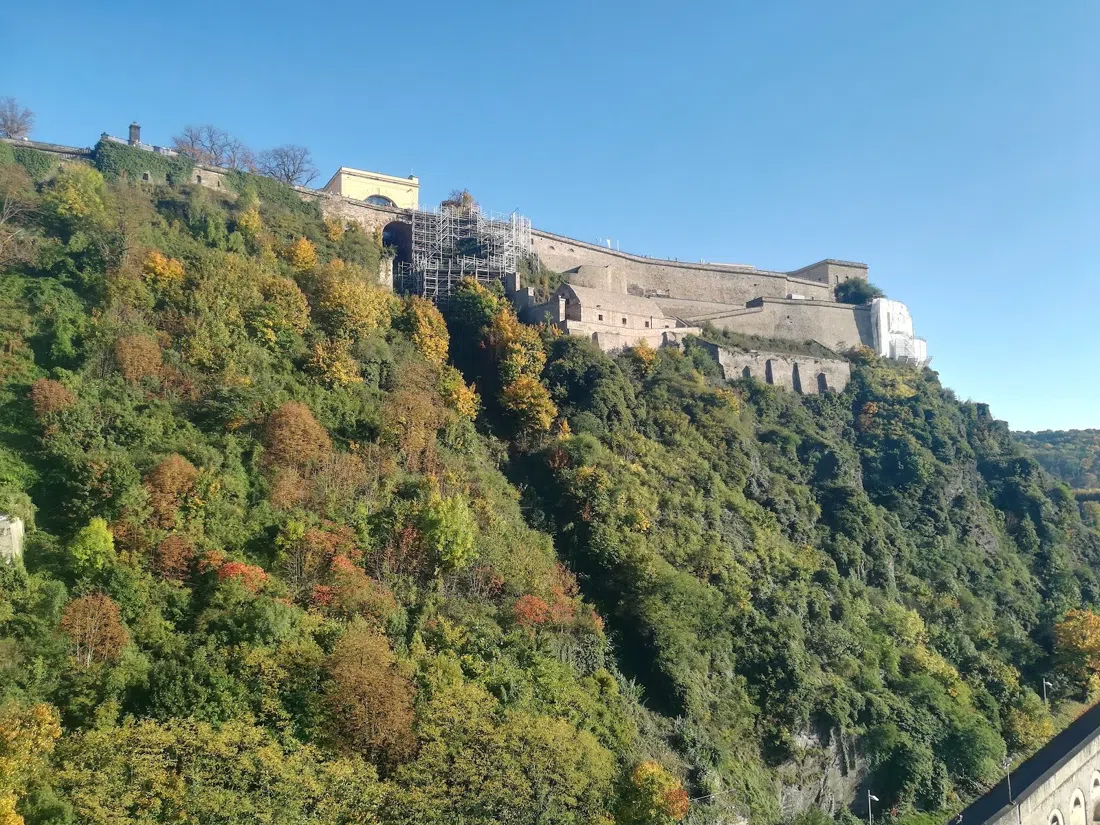
It is also the most group-tolerant thing on this list. The gondolas are high-capacity, group rates exist, two accompanying adults travel free with school groups, and both the cabins and the fortress grounds are wheelchair and pram accessible, which is worth knowing if anyone in the party would struggle with the climbs the other castles demand.
Boats on the Middle Rhine
Köln-Düsseldorfer (KD) Rhine cruises run the scheduled service on the Middle Rhine, and the sensible way to use them is one leg by water and the return by train. High season runs 25 April to 4 October 2026, with up to four daily Boppard–Loreley round trips and five daily Boppard–St. Goar sailings. Expect roughly €20 to €40 per leg depending on the route. There is a charter and group booking desk, wide open decks and catering on board; in high season book ahead, because the popular midday departures fill.
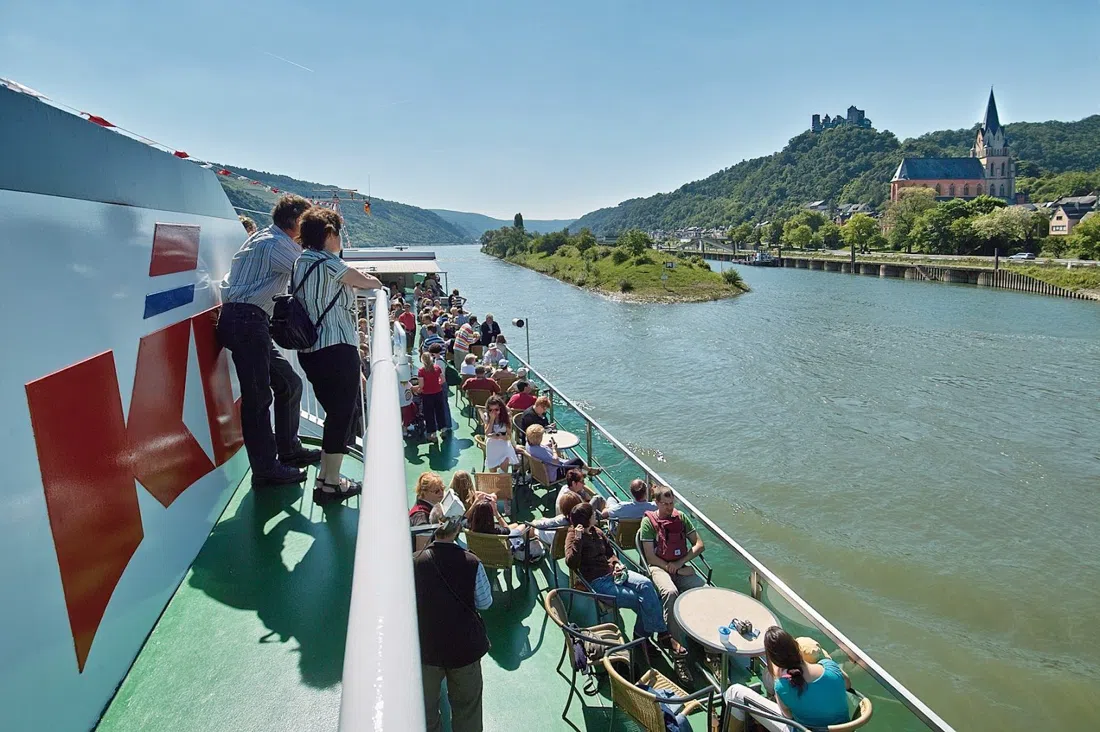
The pattern that works: sail one stretch, step off at a castle village, walk up to the castle, then take the regional train back down the valley. It gives you the river from the water without committing the whole day to a deck chair.
The chairlift above Boppard
Sesselbahn Boppard, running up to the Gedeonseck and the Vierseenblick, gets you to the best Rhine viewpoint that requires no hiking at all. The Vierseenblick is an optical trick, a 180-degree loop of the river that reads as four separate lakes, and the ride up takes about twenty minutes. Fares start at €9.50 for adults and €5 for children, and it runs daily from 10:00, April to October, closed in winter.
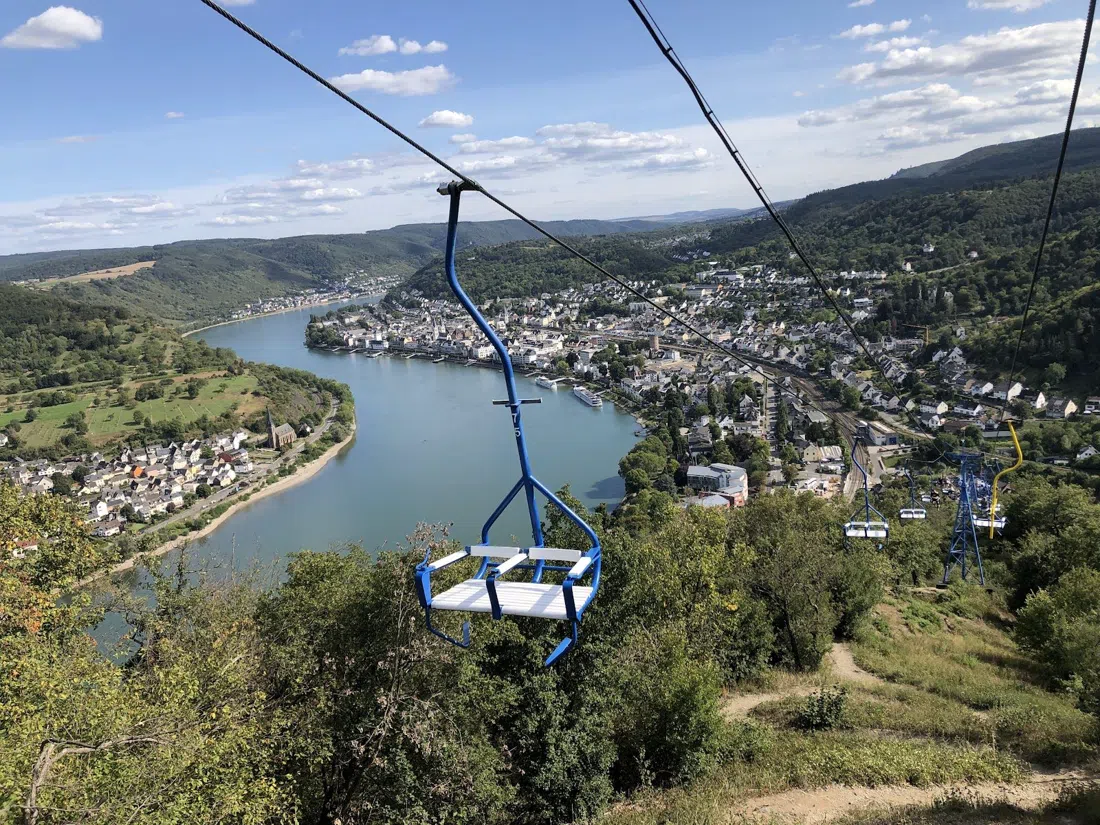
The practical catch is the loading: two people at a time. A party of twenty will be strung out along the wire over the best part of half an hour, so agree a meeting point at the top before anyone boards. The restaurant at the Gedeonseck is cash only, which surprises people who have paid contactless for everything else that day.
Four castles that justify the journey
Marksburg, above Braubach, is the only hill castle on the Middle Rhine never destroyed, so the interiors are the genuine article rather than a Romantic-era reconstruction. The kitchen, the armoury and the rock-cut approach have been in place continuously rather than imagined in the 1800s. The whole visit is a guided walk-round of about fifty minutes, €14 for adults with the tour included. German tours run roughly hourly, English tours in summer, and multilingual booklets fill the gap otherwise. It opens daily except 24 and 25 December. Because the visit is a walking tour by design, groups fit naturally.
Burg Rheinfels, at St. Goar, is the largest fortress ruin on the river and the cheapest thing here for what it is: €6 adult, €3 for children 6 to 14, €13 for a family. The vaults, the museum and the ramparts you roam on your own; the mine passages and lower castle need a guide, and guided tours can be booked. A shuttle runs from the town up to the castle for anyone who won't manage the climb. It opens daily March to November; in winter it is weekends only, by pre-booked tour.
Burg Stahleck, above Bacharach, is a working castle you can sleep in, with 178 beds, meeting rooms and family or group accommodation, and beds at roughly €30 to €45 a night. Day visitors can walk up to the terrace and viewpoint for nothing. It stays open all year apart from Christmas, and it is the natural base for the Rheinburgenweg, the ridge trail that passes some forty castles between Bingen and Koblenz.
Burg Eltz, at Wierschem, is the longest trip in this piece and the one with the strongest payoff. Take the train to Moselkern, then walk up the valley or use the shuttle. The same family has owned it for more than 800 years and it was never sacked, which is why it looks the way it does in the photographs. Tours run at regular intervals from 09:30 and last 35 to 40 minutes, in English and French as well as German. Entry is €14 adult, €7 child or student, €34 family. Two hard rules: it opens 29 March to 1 November 2026 only, and tickets are sold at the gate. There are no reservations for individuals, though walk-up groups are accommodated.
West into the Eifel
Eifel National Park, and specifically the Wilder Kermeter with its Wilder Weg trail, is the forest half of any week here and the most accessible piece of it. The 5.4 km circuit is level barrier-free gravel through one of the finest beech woods in the Eifel, with ten interactive stations and a 250-metre elevated boardwalk that puts you at canopy height. It costs nothing beyond the regional transport ticket to reach it, and it has its own step-free bus stop, Schleiden Wolfgarten Wilder Kermeter. Groups of any size are fine, since the paths are wide enough that nobody walks single file. The park centre at Vogelsang IP adds an exhibition and a hard-edged documentation of the site's NS-era past, which is not a light hour and should not be treated as one.

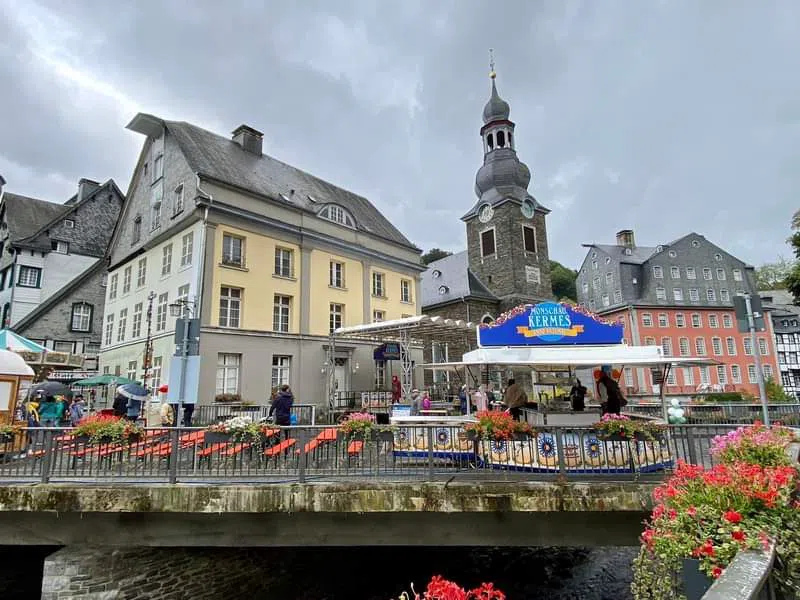
Monschau, further west in the same hills, escaped serious war damage, so the townscape is intact rather than rebuilt: half-timbered houses stacked in a narrow river valley, and streets laid out for the cloth trade. Walking it is free. The Rotes Haus, a cloth-merchant's house of the 1760s, costs €5 and explains where the money came from, in Rococo rooms with marbled walls and crystal chandeliers. It is a small museum, so a large party should split into waves or book ahead rather than arriving all at once.
An hour west for Carolingian work
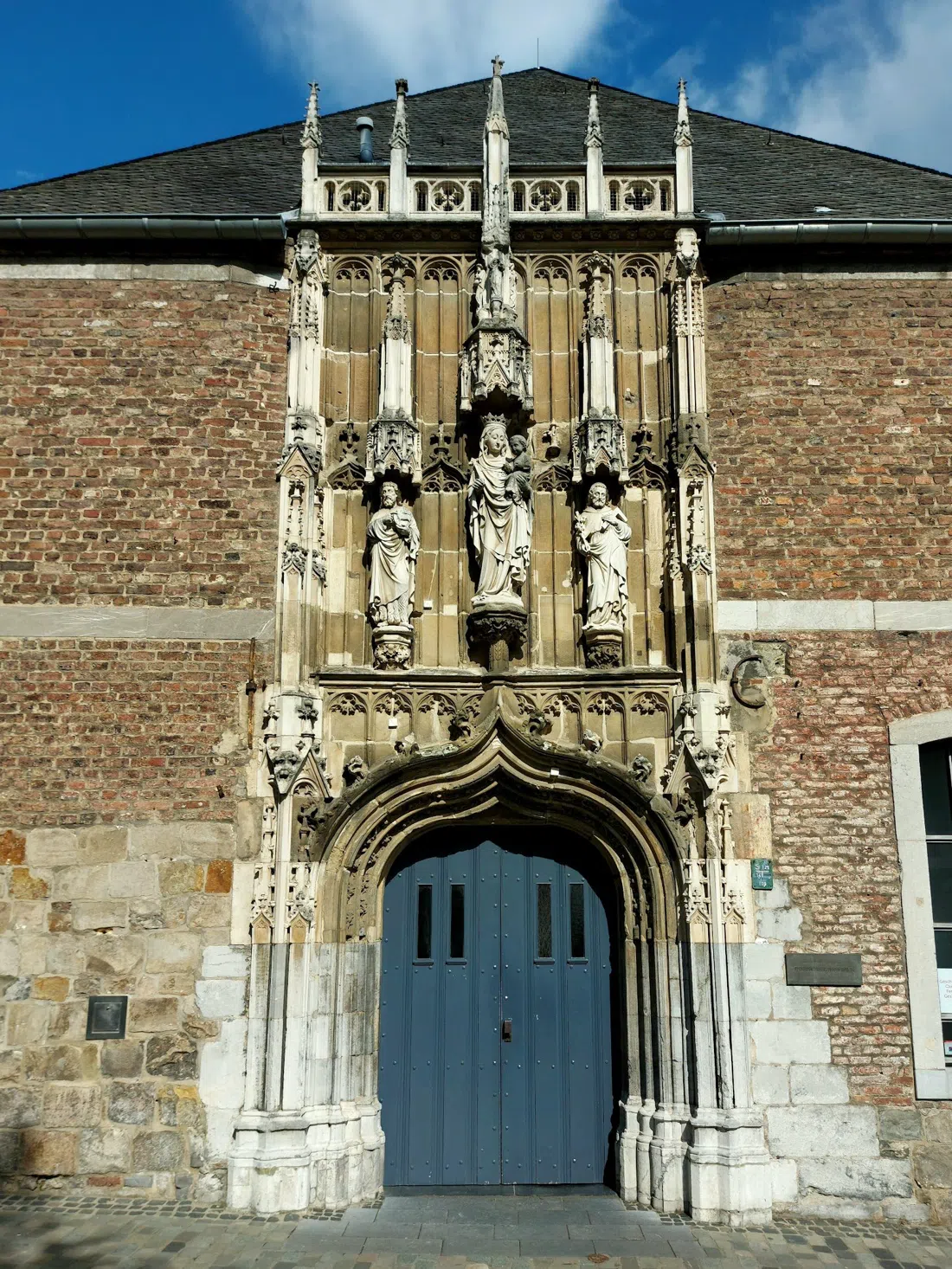
Aachen Cathedral and the Cathedral Treasury sits under an hour from the city and was Germany's first UNESCO World Heritage site. The cathedral tour is €7, or €5 reduced; the treasury tour is €8, or €7 reduced, and the treasury is the stronger half, with 600 square metres of Carolingian, Ottonian and Gothic metalwork, a density of early medieval material you will not find elsewhere in the region. Treasury tours run on Saturdays from 11:00 to 11:45, with tickets sold at the desk and no reservations, so arrive with time in hand. The Dominformation is open Tuesday to Sunday, 10:00 to 18:00. Group tours are priced plainly at €100 for up to ten adults, or €50 for children and young people.
Three short trips on the doorstep
Schloss Burg, at Solingen in the Bergisches Land, is the answer when the Rhine valley is heaving. Castle, museum and beech-wood ridge walks come as one outing, and a cable car handles the climb for an extra fare. Entry is €6 adult, €4.50 concession, €3 for children 3 to 15, and €2 a head for school groups, with day tickets bookable online. It closes on Mondays. Note that the German Castle Con takes over the whole site on 5 and 6 September, which is excellent if that is what you came for and no use at all if it isn't.
Altenberger Dom, in Odenthal, is half an hour out and free to enter: a Cistercian abbey church standing alone in a wooded valley, holding one of the largest medieval stained-glass windows in Germany. It is step-free, and large enough that groups cause no problem; guided tours are priced on request, with regular Saturday tours from 11:00 to 12:00. At weekends from mid-March to 1 November the Bergische WanderBus runs there directly, which pairs the church with a valley walk neatly.
Feste Zons, at Dormagen, is the closest of all these and the most overlooked: a fully preserved fourteenth-century customs fortification standing directly on the Rhine. Walking the walls and the streets costs nothing; the KreisMuseum in the old castle is about €5 if the weather turns. Half a day on foot or by bike is the right measure.
Matching the trip to the party
Couples and pairs get the most out of Burg Eltz, Marksburg and Monschau, where the pleasure is in slow looking and the small rooms are not built for crowds. Larger groups should steer toward Ehrenbreitstein, the Drachenfelsbahn, the Wilder Kermeter and Altenberger Dom, all of which are set up for numbers and priced for them. The two pinch points to plan around are the Rotes Haus in Monschau, which is genuinely small, and the Boppard chairlift, which loads two at a time. If anyone in the party has limited mobility, the Wilder Weg, the Koblenz cable car, Altenberger Dom and the Rheinfels shuttle are the four that will not let you down.
What to sort before you go
All of this runs on regional trains out of the main station, and a day ticket covering the wider region is nearly always cheaper than singles. Buy it before you board rather than on the platform in a hurry. Take cash: the Gedeonseck restaurant is cash only, several castle gates and small museums prefer it, and the treasury and Burg Eltz both sell tickets at the desk rather than online.
Timing is the thing most people get wrong. Brühl closes December to February, Burg Eltz opens 29 March to 1 November 2026 only, the Boppard chairlift and the Drachenfelsbahn stop for winter, and Burg Rheinfels drops to pre-booked weekend tours. From late March to the end of October everything on this page is running; outside that window, plan around Schloss Drachenburg, Marksburg, Burg Stahleck, Altenberger Dom, Feste Zons and the Eifel forest, all of which hold up in the cold.
Budget roughly €15 to €25 a head for entry on a castle day, plus €20 to €40 if you add a boat leg, and nothing at all for Feste Zons, the Wilder Weg, Altenberger Dom or the Brühl gardens. Two of these trips a week is a comfortable pace alongside the city itself; three is a forced march. If you are still fixing the base, the Cologne hotel search is worth doing before you book anything out of town, since a room near the main station shortens every one of these mornings by fifteen minutes. The Cologne guide covers what to do on the days you stay put.
10 September 2026 · a first week before the flat: the Cologne hotel directory