Izmir · The weekend · 10 min
The Lifts and Stairways That Get You Up Izmir
Two working cable cars, one well-known elevator and a free fortress at the top. Then there is the hill nobody ever mechanised, which explains the rest.
Izmir does not ease into its hills. Two streets back from the water the ground tilts up and keeps tilting, and for a century and a half the city has answered that slope in one of two ways: cut a stairway into it, or build a machine to skip the stairway. Ride the machines and you understand exactly what they are saving you. Walk one unmechanised hill instead and you feel it in the backs of your legs for a day afterwards.
The old elevator in Karataş gets the visitors and the photographs, and it deserves them. It is not the only vertical shortcut here, and on a hot afternoon it is not even the most useful one. What follows is the rest of the system: the working cable cars, the fortress every stairway in the city is aiming at, the Roman floor it all stands on, and one stepped hill that was never given a lift at all. That last one is the best argument for the others.
Start on the ground floor of a vertical city
Smyrna Agora Archaeological Site (İzmir Agorası, Namazgâh, sitting directly below the castle hill) is the right first stop because it is the flat piece of the puzzle. This was the civic centre rebuilt under Marcus Aurelius after the earthquake of 178 AD, and standing in it you can see the whole logic of the place: commerce and administration on the level ground, defence up on the rock, housing scrambling up the slope in between.
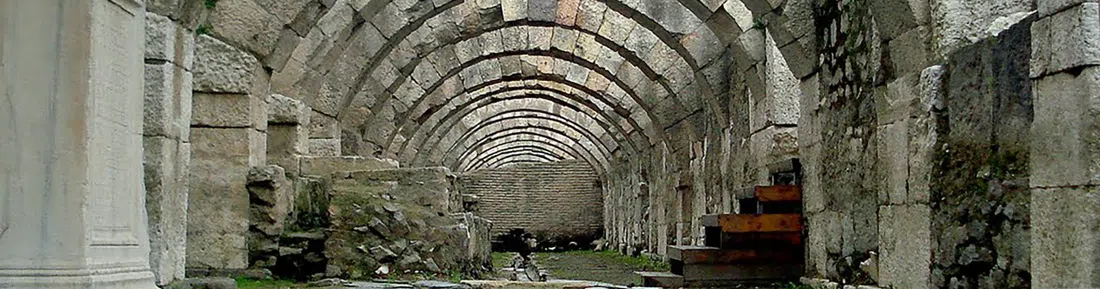
The part most visitors walk past is the vaulted basement. Above ground you are largely reading foundations and interpretation panels, which takes patience. Underneath, the arched galleries are intact, cool in August, and structurally legible in a way the surface is not. You are inside a Roman building rather than looking at its outline. Go down there first, then come back up and the surface makes sense.
Entry runs about 25 TL for an adult and is free with a Müzekart. It opens daily and takes guided groups as a matter of routine, so expect a coach party to fill the basement for ten minutes at a stretch; wait them out rather than following them round. Thirty to forty minutes covers it unless you intend to read everything. Then look up. The hill behind the site is Kadifekale, and the stairway neighbourhoods begin more or less where the excavation fence ends.
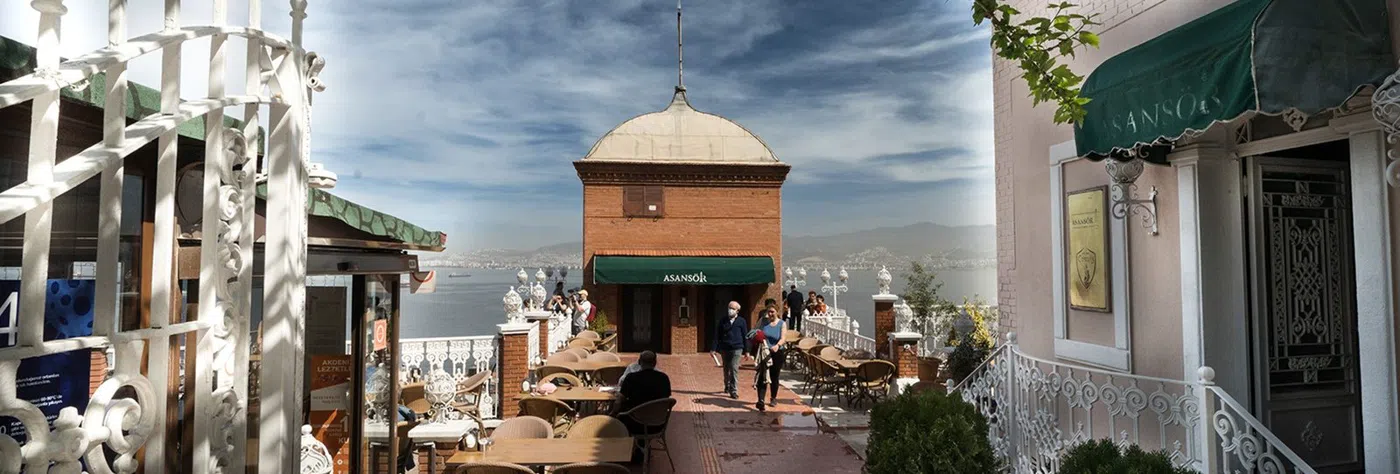
The lift in Karataş and the terrace sitting on top of it
The historic elevator in Karataş is a public right of way. It is free, it runs under the municipality, and it exists to move residents between a lower street and an upper street that are separated by a cliff. Ride it for that reason alone and you have understood the city.
What sits on top is a separate business. Tarihi Asansör Restoran & Teras Kafe (Karataş, at the head of the lift) is operated by the Grand Plaza group under the municipality's roof, which catches people out. The lift being free tells you nothing about the prices upstairs. There are three distinct rooms: the Asansör Restoran seating around 110, the Teras Kafe at around 80, and the Ceneviz Salonu at around 70. They take set menus and private functions, and dinner is reservation-only rather than walk-in.
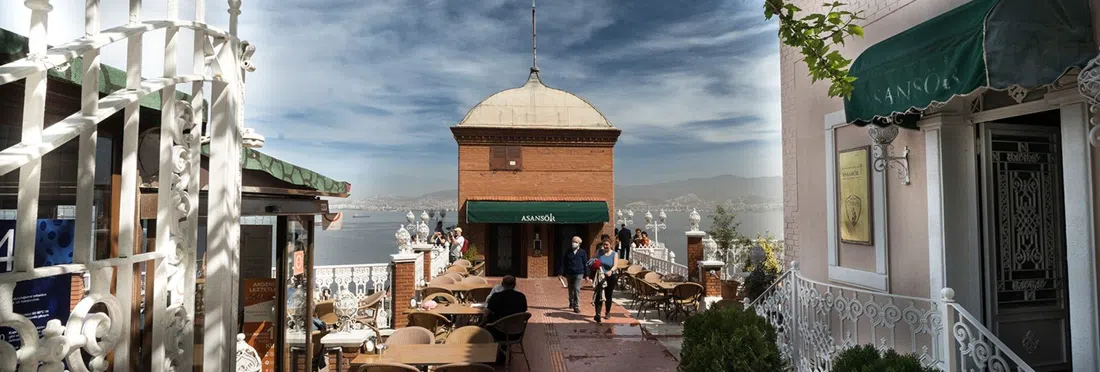
The verdict here is about where you sit, not whether you go. The tables on the terrace rail have the view: the gulf, the sweep of the corniche, the light going flat orange behind the water. The tables set back from the rail cost the same money for roughly half of that. If the booking you are offered is a set-back table on a clear evening, take breakfast or an afternoon coffee at the Teras Kafe instead, which is mid-range and pleasant, and spend the dinner budget somewhere without a view premium. À la carte dinner here sits in the city's sunset-premium bracket and you should only pay it with a rail table confirmed.
For couples, that means booking well ahead for a clear-weather weekend and asking specifically for the rail, not just for the terrace. For groups, this is one of the few places in the article genuinely built for you. The Ceneviz Salonu and the set-menu arrangement handle a party of twenty without drama, and nobody will be squeezed onto a corner table.
Balçova does the hard work in two minutes and forty-two seconds
Balçova Teleferik (Balçova, on the flank of Dede Mountain) is the city's working aerial shortcut rather than a ride laid on for visitors. It is Türkiye's second-oldest cable car, opened in 1974, rebuilt from scratch and running again since 2015 under the municipal operator İZULAŞ. The trip up takes two minutes and forty-two seconds and replaces a walk that is genuinely punishing in summer heat: steep, long, and with very little to look at on the way.
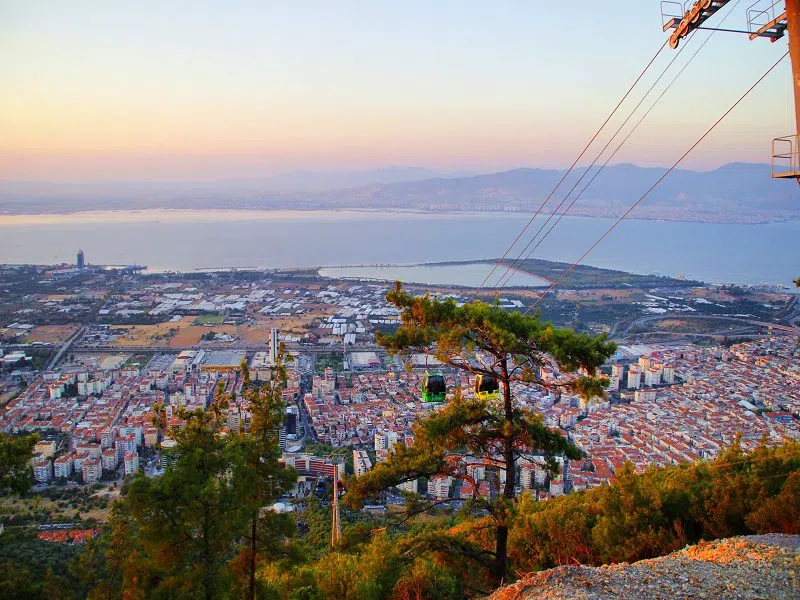
Throughput is the reason it never feels like a queueing exercise: twenty cabins moving around 1,200 riders an hour. A coach group clears in a few cycles. The ticket is a single cheap municipal fare, in the same bracket as a bus journey rather than an attraction price, so there is no case for walking up to save money.
Two things will ruin the trip if you do not check them. The ticket office closes at 18:00, which is earlier than the light in summer and earlier than most people assume from a place billed as a viewpoint. And the whole system shuts on Mondays for maintenance. Turning up on a Monday afternoon means the punishing walk or nothing, and I would not do the walk. Aim for mid-to-late afternoon on any other day, allow time to come back down before the last cabins, and treat the top as an hour rather than an evening.
Kadifekale is what every stairway is aiming at
Kadifekale (the Mount Pagos fortress, on the summit above the Agora) is the destination the whole vertical city points towards. It is an unenclosed site, open all day, and free: no ticket office, no turnstile, and nobody to tell you when to leave. The metropolitan municipality has restored it and keeps it open daily. Coaches and minibuses can reach the top, so groups arrive without a climb, and there is no advantage in walking if the weather is against you.
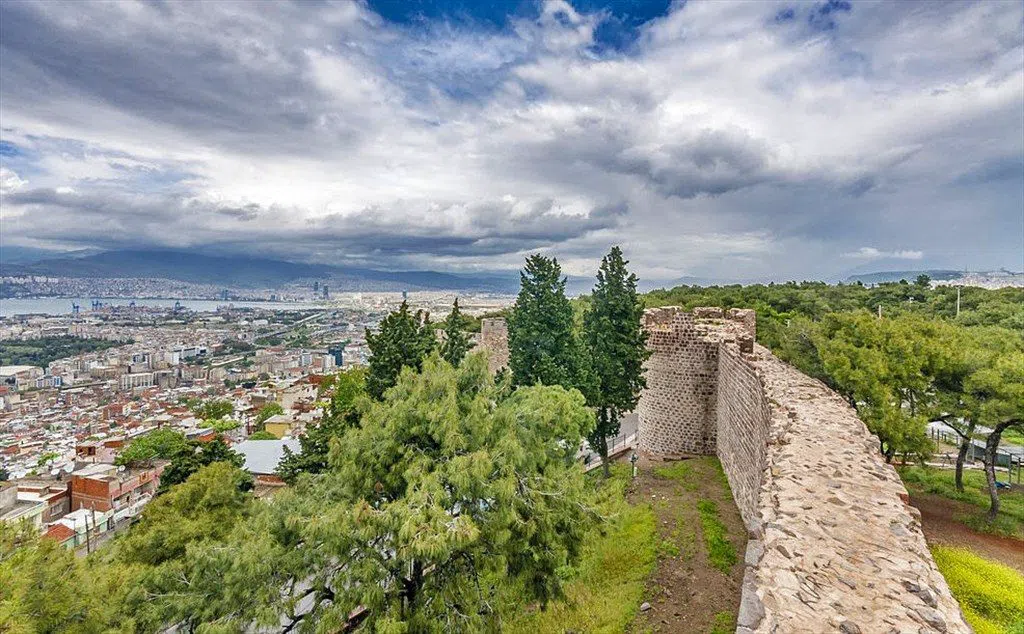
Be realistic about the walls. The fabric is patchier than the postcards suggest, with long restored stretches, some sections that are little more than a line on the ground, and a castle interior that rewards twenty minutes rather than an afternoon of archaeological study. The view is not overstated. From up here the gulf, the grid of the lower city and the terraced housing between the two read as one continuous piece of geography, and the late-afternoon light is when it is at its best. Come at midday and you get haze and heat with almost no shade.
The stairways are the other half of the experience. The slopes below the summit are threaded with public steps that are the ordinary commuting route for people who live on them. They are not a heritage trail, nothing is signposted for visitors, and they are steep enough that locals use them as a fitness benchmark. Walking a flight or two is worth doing precisely because it shows you what the machines elsewhere in this article exist to remove. Walking the whole way up in August is a different proposition; take a taxi or minibus to the top, then walk down if you want the stairways in your legs.
Bergama's cable car lands you at the gate
Up in the north of İzmir province, Bergama Akropolis Teleferik (Bergama) is the clearest case anywhere here of a lift replacing a climb. The acropolis sits at the top of a steep hill, and the alternative to the cable car is roughly 300 metres of vertical switchback. The cabin puts you down at the site gate. That is the entire proposition, and it is a good one.
It was built for tour traffic and it shows: continuous loading, coach groups handled as routine, no real bottleneck. It is sold as a return ticket only, around 200 TL for an adult and about 100 TL for a student, with under-sixes free. A Müzekart is not valid on the cable car even though it works at the archaeological site, which catches out people who have used the card free of charge all week.
The timing trap is specific. Site hours run roughly 08:30 to 19:00 in summer and 08:30 to 17:30 in winter, and the cable car stops before the site does. If you time your visit to the site's closing hour you will be walking down that switchback in the dark. Work backwards from the last cabin, not from the last admission, and give yourself a clear margin. Two to three hours on the acropolis is a comfortable visit; if you arrive late in the afternoon in winter, it is better to come back the next morning than to rush it.
Ayasuluk Hill shows you what the lifts replaced
Ayasuluk Hill (Selçuk, in the south of the province) carries the St John Basilica on its lower level and the castle on its upper one, and it is the counter-example that makes sense of everything above. One hill, two levels, and a stepped climb from gate to castle that was never given a machine. The climb is short, but it is continuous and completely unshaded, which is a different kind of short at two in the afternoon in July.
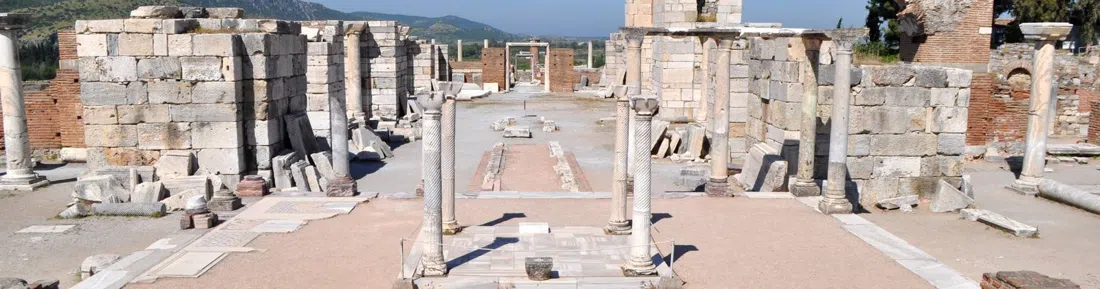
The site is ticketed at roughly €6 for foreign visitors, with a Müzekart valid, and opens around 08:00 to 19:00 in summer and shorter hours in winter. Guides are permitted and it handles groups without difficulty. The paths are wide and the basilica level is broadly flat, so a mixed-ability party can stop there while the fitter half carries on up to the castle. That split is worth planning rather than improvising.
Wear proper shoes. Not sandals: the steps and paths are uneven, and the descent is where people turn ankles. Bring water from the bottom. And go early or late, because the middle of the day here is the one stretch of this itinerary with no way to buy your way out of the heat. Fifteen minutes up this hill will tell you more about why the Karataş lift and the Balçova cable car were built than any amount of reading.
Choosing between them
If you have one afternoon, do the Agora and Kadifekale as a pair. They are the same hill, bottom and top, and they explain each other. If you have an evening and want the view without the effort, the Karataş terrace with a rail table booked is the straightforward answer. If it is hot and you want a ride that is genuinely a shortcut rather than a sightseeing lap, Balçova, on any day but Monday.
Bergama and Ayasuluk are day trips out of the city rather than add-ons. Treat each as a full outing, and do not attempt both in one day. Couples will get more out of the Karataş terrace and a late Kadifekale; groups are better served by Bergama and Ayasuluk, where the infrastructure is built for coaches and the Agora's guided-group rhythm is already the norm. Full background on the rest of the city is in our Izmir guide.
Practical notes
Transport. The Balçova cable car is a municipal service reached easily by metro and a short local connection, and the fare is a standard city ticket. Get a rechargeable transport card on arrival and it covers metro, bus, ferry and the cable car without fumbling for change. Kadifekale is served by minibus and taxi; the fortress car park takes coaches. Bergama and Selçuk are both reachable by intercity bus, and both are long enough journeys to warrant leaving early.
Cash. Carry Turkish lira in small notes. Site entries (around 25 TL at the Agora, roughly €6-equivalent at Ayasuluk, about 200 TL return on the Bergama cable car) are straightforward, but kiosks, minibuses and the smaller ticket windows are not reliably card-friendly. A Müzekart pays for itself across the ticketed sites here, but remember it does not cover the Bergama cable car.
Timing. Mondays break the Balçova plan entirely. The Balçova ticket office closes at 18:00 and the Bergama cable car stops before its site closes, both earlier than you would guess. Kadifekale has no closing time and no staff, so bring water and a torch if you stay for the last of the light.
Budget. Excluding the terrace restaurant, a full day of this costs very little: the Karataş lift is free, Kadifekale is free, the cable car fare is a bus fare, and the Agora is pocket change. The single decision that moves your budget is dinner at the terrace, which is the city's sunset-premium bracket and only worth it with a rail table. For beds near the lift and the hill, start with our Izmir hotel search and stay in or near Karataş if the vertical city is what you came for.
28 September 2026 · a first week before the flat: the Izmir hotel directory