Chicago · The weekend · 10 min
How Lincoln Park Zoo Became Chicago's Free Backyard
Chicago's 158-year-old zoo has never charged admission, and the greenbelt around it (market, beach, bird sanctuary, architects' cemetery) costs nothing either. Here is how locals actually use it.

The zoo has no gate, no ticket window and no turnstile to justify. That one fact rearranges a day in Chicago more than any attraction pass will: you can walk in at ten past eight with a coffee, stand in front of the lions for six minutes, and leave without the nagging sense that you owe the place another three hours. The neighbourhood does not visit it so much as walk through it on the way to something else.
Free since 1868 and never once ticketed
Lincoln Park Zoo (Lincoln Park, a few miles north of downtown) has been letting people in for nothing since 1868, which makes it one of the very few free zoos left in the United States and by some distance the most convincing argument that the model works. Forty-nine acres, more than 170 species, open 365 days a year. The grounds unlock at 8am; the indoor buildings (the ape house, the big cats, the small mammal and reptile house) run 10am to 5pm. Nothing is reserved, nothing is timed, and there is no ticket for any size of party. You arrive. That is the whole procedure.

Geography explains the character of the place better than any list of animals. The zoo sits inside Lincoln Park itself, the long green strip that runs north along the lake from the edge of downtown, and it is not walled off from it. You are on a public path beside joggers, then you are beside a pond with pelicans on it, and the transition is so soft that first-time visitors often ask a keeper whether they have actually entered yet. That porousness is the point. A ticketed zoo asks you to commit a morning. This one lets you spend eleven minutes and feel you got something.
The hour locals use is the one before the buildings open. Between 8 and 10 the outdoor habitats are awake, the seals, the zebras, the red pandas and the African penguins in their newer and considerably better home, the light is low and sideways, and the paths belong to people pushing prams and people walking to work who have decided to take the long way. If you want the indoor houses, come back at ten and accept that you are now sharing them with everyone else.
The Nature Boardwalk is the half-mile loop around South Pond at the south end of the campus, and skipping it is the common mistake. It is free, it is part of the same zoo grounds rather than a separate attraction, and it is where the skyline finally lines up behind a screen of prairie grass and cattails. Herons stalk the shallows, turtles pile onto logs like badly stacked crockery, and in June the pond is loud with frogs. Twenty minutes at a stroll, and the most photographed thing in the park for good reason.
Free admission is not the same as a free day out. The zoo makes its money elsewhere, and parking is where it starts: $35 to $45 a day in the lot, with only the first 30 minutes free, which is enough time to be annoying and not enough to be useful. Take the 151 or the 22 bus instead. Both run down Clark Street and the lakefront and drop you within a couple of minutes of the gates, and you will spend the difference on lunch with change left over. Paid education and field-trip programmes exist for schools and groups, but they are optional extras, not a back door you are being nudged towards.
The market that opens two hours before the buildings
If you are here on a Wednesday or a Saturday, start earlier and start with food. Green City Market (Lincoln Park, 1817 N Clark St) runs 7am to 1pm on both days through 21 November 2026, with roughly 65 vendors laid out in the open air on the south end of the park. It is free to browse and snacks and pastries land somewhere between $4 and $15, which for a market that sells itself on Midwestern farms and small producers is unusually reasonable.

The surrounding blocks genuinely buy their tomatoes and their eggs here, which is why the useful advice is to go before 9am. After that the aisles thicken with dogs, prams and people who have all arrived at once, and a stall you wanted to look at properly becomes a queue you shuffle past. Early, you can talk to growers, taste things, and be finished in forty minutes. The winter arrangement is worth knowing too: from late November the Saturday market moves indoors to the Peggy Notebaert Nature Museum building a short walk north, so the season does not simply stop.
The route that falls naturally out of this: market at quarter to eight, coffee and something baked while you walk, through the zoo gates by nine, the Nature Boardwalk at half past, and out at the lake by eleven. That is a very good half-day in a major city for the price of breakfast.
The lake edge and the ten minutes inland
North Avenue Beach (Lincoln Park lakefront, a five-minute walk east of the zoo) is open 6am to 11pm year-round and is free and unrestricted, which in a city this dense is a small miracle. It also holds what is, flatly, the best free view of Chicago there is: stand on the sand and look south, and the towers stack up along the shoreline in the order the city built them, with the lake doing the work a good foreground normally has to be paid for.
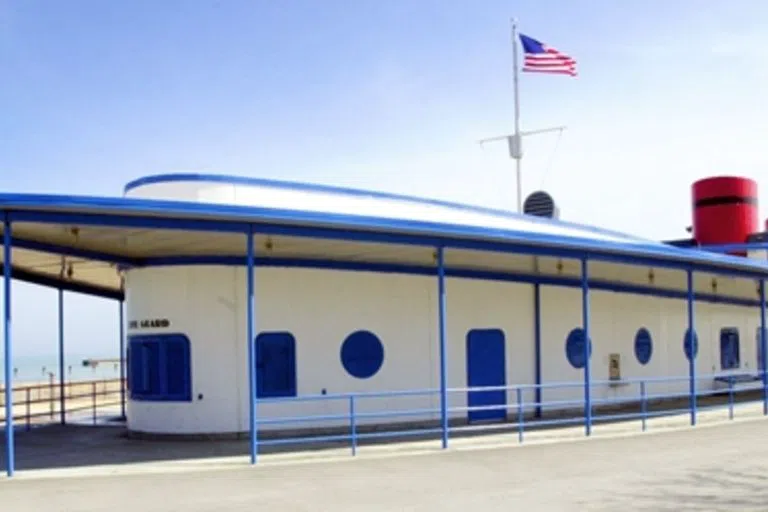
People get the swimming wrong, so be precise about it. Lifeguards are on duty 11am to 7pm from the Friday before Memorial Day through Labor Day, and swimming is only permitted in those hours, in that season. Outside it, this is a windswept walk with very cold water beside it, bracing in October, punishing in February, and still worth the detour for the view. Volleyball courts, kayaks and chairs are rentable in season, and the courts can be booked in advance, which is the one piece of lakefront a large group can actually reserve.
Ten minutes inland, away from the water entirely, Oz Park (Lincoln Park, west of the zoo past the brownstones) is the neighbourhood's other default. Fourteen acres, open 6am to 11pm, named for L. Frank Baum, who wrote the Oz books while living in Chicago. Four bronzes installed between 1995 and 2007 (the Tin Man, the Scarecrow, the Cowardly Lion, and Dorothy with Toto) are scattered across the grounds, and they are better than that premise deserves: properly cast, properly sited, and enough to turn what would otherwise be a filler green space into a stop with a reason. Ball fields and tennis courts are permit-bookable if you are a larger group wanting to play something rather than sit. Families with small children often find this the easier hour of the day, with fewer people, more grass and nothing to queue for.

North along the same greenbelt
The green strip does not end at the zoo. Push north and it keeps going for miles, and two of the best free hours in Chicago sit at the top of it.
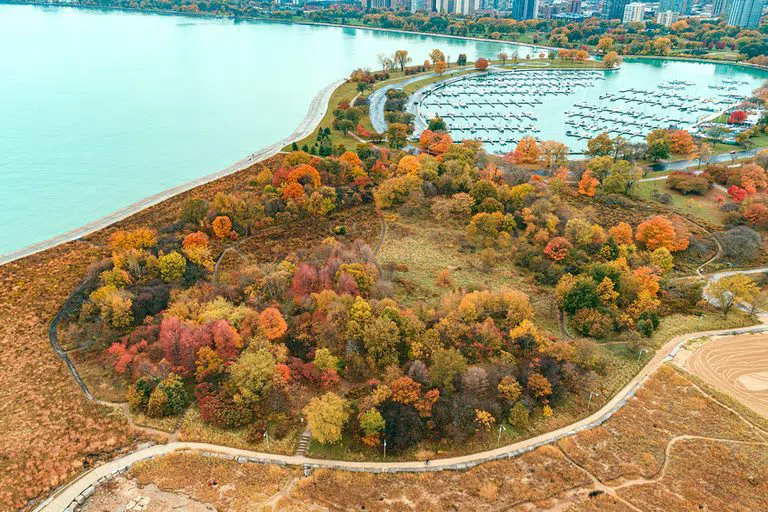
Montrose Point Bird Sanctuary (Uptown, on the peninsula at Montrose Harbour) is a scrubby hook of land jutting into the lake with 349 recorded species, making it the top eBird hotspot in Illinois. It is open dawn to dusk, free, and, rarely for the lakefront, the parking on the peninsula drive is free as well. The reason it works is pure geography: migrating birds tracking the shoreline hit this patch of cover first, and in May and September the hedge fills with warblers and the people watching them outnumber the joggers. Volunteer stewardship days and free beginner bird walks actively welcome people who have never held binoculars, which is not something most reserves can say. In fairness, on a flat afternoon in July there is not much happening. It is a pleasant, empty, slightly wild walk, and if you came for a spectacle you came in the wrong month.
A short ride inland from there, Graceland Cemetery and Arboretum (Uptown, at Clark Street and Irving Park Road) is the closest thing the city has to a free outdoor museum of its own architecture. One hundred and twenty-one acres of mature trees and monuments, holding Mies van der Rohe, Louis Sullivan, Daniel Burnham, George Pullman and Potter Palmer, which is to say the men who designed Chicago, the man who planned it, and the industrialists whose money and labour disputes shaped it, all within a walk of each other. Sullivan's Getty tomb alone repays the trip. Free self-guided maps are available from the main office; opening hours are Monday to Friday 8am to 4pm, extending to 6pm in summer, and weekends 9am to 4pm.
Two rules, and they are not decorative. This is a working burial ground with funerals taking place, so keep your voice down and stay off the graves. And tour groups must register with the cemetery office in advance; turning up with fifteen people unannounced is the fastest way to be asked to leave. Guided tours run by third parties are charged separately. Walking it yourself with the map costs nothing and takes about ninety minutes.
Where to go when the wind wins
Chicago weather will eventually decide your itinerary for you, and the free city has answers indoors and downtown.
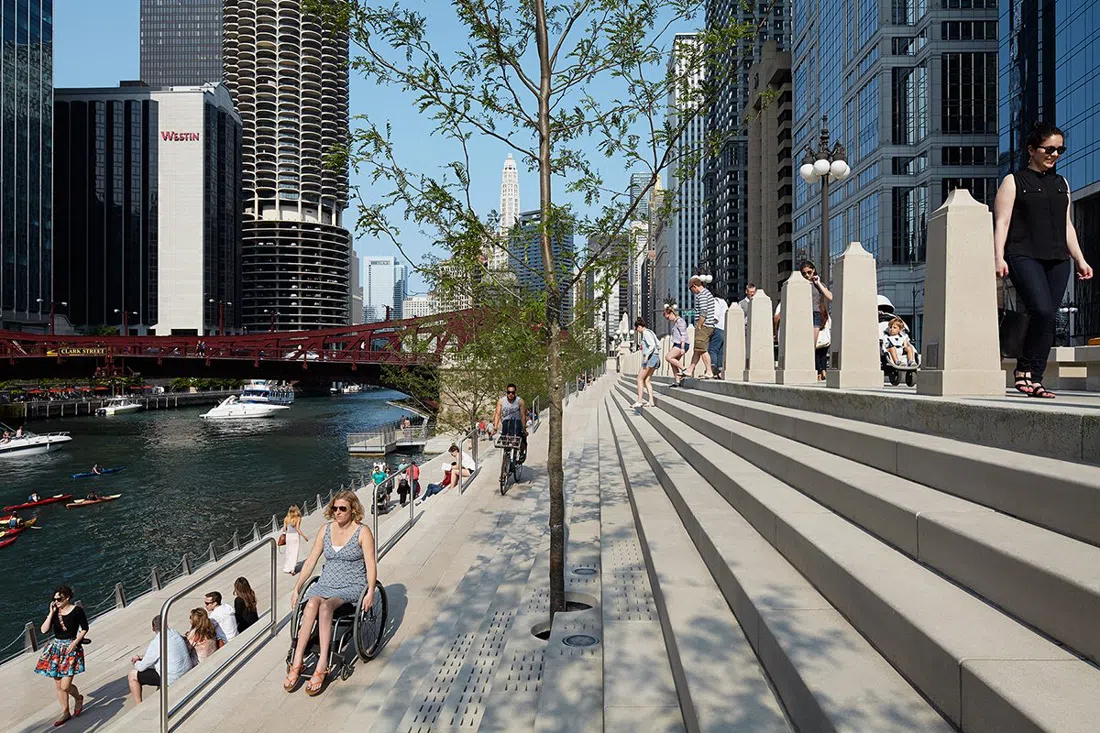
The Chicago Riverwalk (the Loop, along the south bank of the main branch) runs 1.25 continuous miles from Lake Shore Drive west to Lake Street, open 6am to 11pm and free throughout. It is the cheapest way to see the city's architecture from the angle the architects designed it for: from the water, looking up, with the bridges framing everything. Bars, kayak hire and the water taxi cost extra and mostly shut down from late autumn to early spring, but the walk itself stays open all year and is arguably better empty. It is wide enough for a group, though the underpasses beneath each bridge pinch badly at rush hour, so a party of ten will end up single file whether they like it or not.
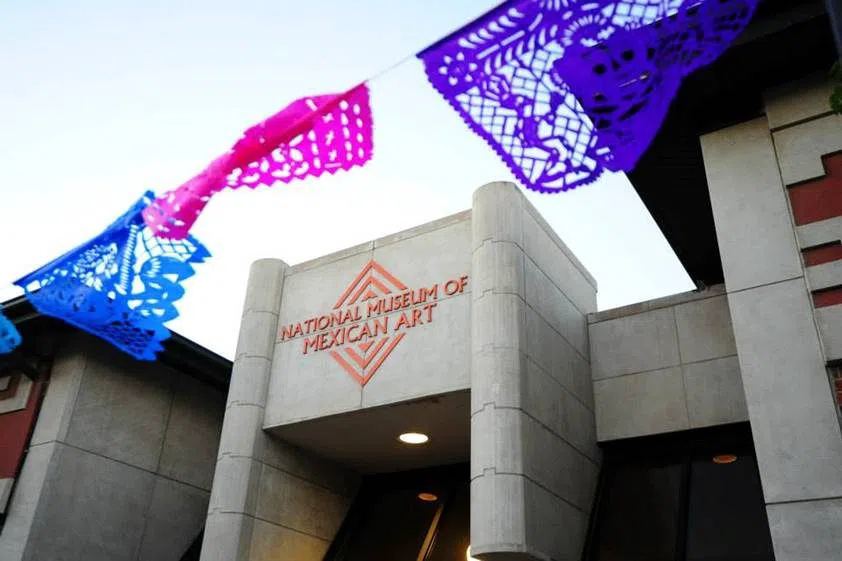
For an hour properly indoors, the National Museum of Mexican Art (Pilsen, on 19th Street in Harrison Park) is free every single day of the year and is the largest Latino cultural institution in the United States, covering 3,600 years of Mexican art from pre-Columbian work to contemporary Chicago artists. Time a trip around the autumn Día de Muertos exhibition if you can. It is the show the museum is known for and it is exceptional. Walk in via the 16th Street murals, a long stretch of commissioned wall art along the rail embankment, and you have effectively doubled the visit. Group and school visits should book ahead through the education department; two or three people can simply walk in.
Which of these suits a group and which does not
Worth saying plainly, because the answer is not uniform. The zoo, the beach, Oz Park and the Riverwalk absorb a crowd without complaint, and the zoo in particular takes any size of party with no notice at all, which makes it the easiest anchor for a family reunion or a wedding-weekend morning. Green City Market technically accommodates everyone but practically rewards small, early groups; a party of eight arriving at eleven will spend the visit apologising.
Graceland and Montrose Point run the other way. Both reward two people moving quietly and slowly, and both require restraint from groups, Graceland by registration, Montrose by simple courtesy, since a loud dozen will clear the hedge of exactly the birds everyone came to see. The museum sits in the middle: fine for a handful, a phone call in advance for anything organised.
Practicalities
Skip the car. The 151 and 22 buses connect downtown to the zoo directly; the Red and Brown lines cover the northward run to Montrose and Graceland with a short walk at each end. Load a Ventra card or use a contactless card or phone at the reader. Single rides run around $2.25 on the bus and $2.50 on the train, and a one-day pass at $5 pays for itself on the third journey. The full greenbelt from the zoo to Montrose Point is also a flat, uninterrupted walk or cycle of roughly five miles along the lakefront trail.
Almost everything here is card-first, but bring $20 to $40 in small notes for the market, where some smaller producers still prefer it, and for tipping.
Gates at 8am, buildings at 10am, market Wednesdays and Saturdays 7am to 1pm until 21 November 2026. May and September are the best all-round months: migration at Montrose, workable lake weather, no August crowds. Winter is legitimate rather than a consolation, since the zoo stays open every day of the year and is close to empty in January.
A full day across the zoo, the boardwalk, the beach and Oz Park costs nothing but transport. Add roughly $15 to $25 a head for market breakfast and a coffee, and you are still under what a single ticketed attraction charges elsewhere in the city. For where to sleep within walking distance of the park, start with a Chicago hotel search; for the rest of the city beyond this greenbelt, the wider Chicago guide covers it.
29 September 2026 · a first week before the flat: the Chicago hotel directory