Lisbon · The weekend · 11 min
September Mornings in Lisbon's Largo do Carmo
A roofless convent, the barracks where a dictatorship ended, and a free terrace over Chiado, all within 300 metres. Get there before the square fills.
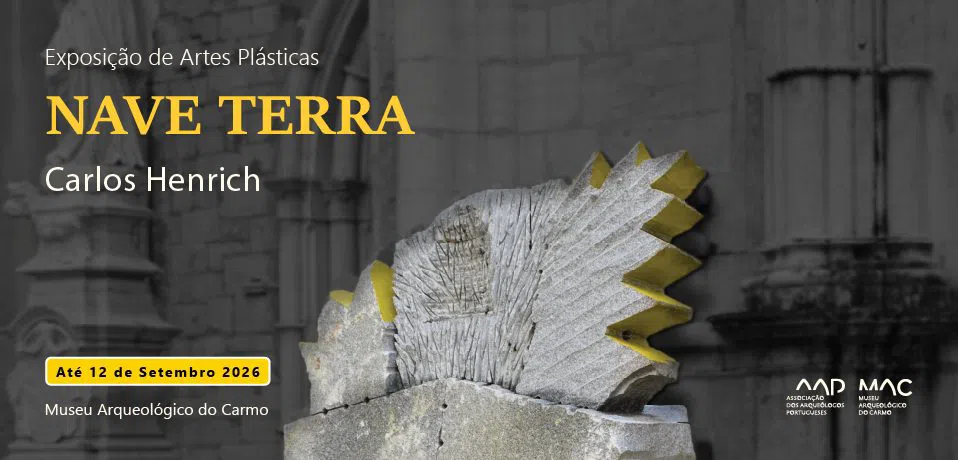
Just after nine the square belongs to a delivery van, a dozen pigeons and the sound of the fountain, which is the only hour you can actually hear it. Above the east side a church keeps its arches and has no roof at all. The 1755 earthquake took the roof off on All Saints morning and nobody ever rebuilt it. By half past eleven four walking groups are sharing the same patch of cobbles. Everything below is about arriving nearer the first state than the second.
What you are standing in
Largo do Carmo (Chiado) is a small, flat, tree-shaded square you can cross in about forty seconds, with the Chafariz do Carmo fountain in the middle and the roofless convent closing one end. It is free and always open, and for most visitors it is as much of the experience as the ruin is. Something specific happened here: on 25 April 1974 the crowd filled these cobbles around the barracks on the far side while the Prime Minister, Marcelo Caetano, was inside, deciding to surrender. Nothing on the square announces that. There are café tables, a fountain, and a lot of people walking through on their way somewhere else.
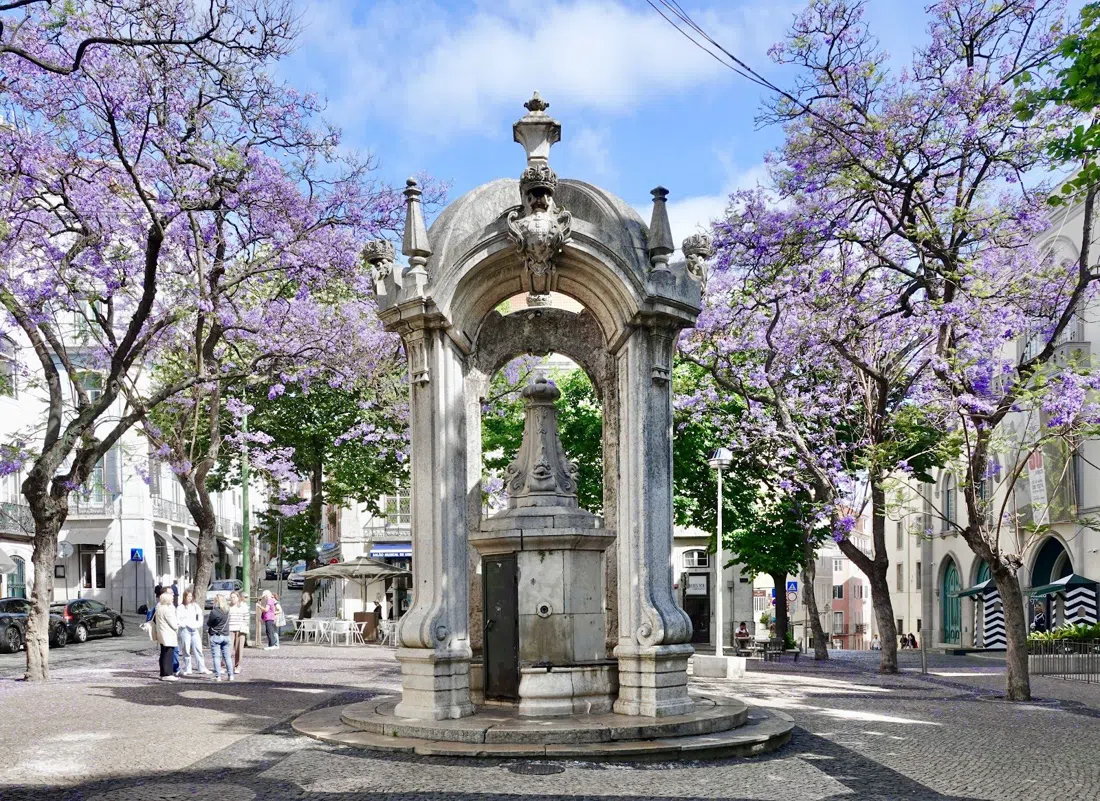
Sit on the fountain steps before 10:00 and the square is close to yours. From late morning, guided groups muster around that same fountain, the natural meeting point in this part of Chiado, and the open space tightens considerably.
The church with no roof
Convento do Carmo, now the Museu Arqueológico do Carmo (Chiado) is the anchor, and it earns the ticket even if you normally skip museums. You come in through the west door into a nave open to the sky: five bays of pointed arches, air where the ceiling should be, and the odd calm of a building that has stood half-finished for more than 270 years. The roofed rooms at the far end hold the archaeological collection, tombs and carved stone and inscriptions, fragments pulled out of the rubble and out of later digs. They are dense, old-fashioned and quite small, and most people spend longer in the open nave than among the cases.
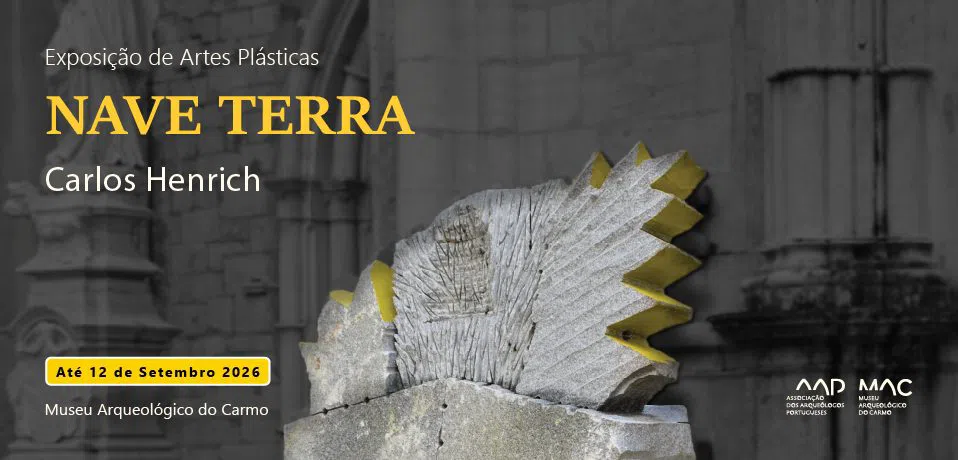
Budget 45 to 60 minutes. Under 30 and you have looked without reading anything; over 90 and you are lingering.
The door costs €7 adult, €5 student and 65+, free for under-14s and for visitors with reduced mobility. There is no online ticketing at all, so everyone pays at the desk, and that is the one queue of the day. In the first hour it is short. September falls in the summer schedule: Monday to Saturday 10:00 to 19:00, last entry 18:40. It is closed on Sundays. If your ship calls on a Sunday you see the outside only, and it is worth knowing that before you build a day around it.
The barracks across the cobbles
Museu da GNR at the Quartel do Carmo (Chiado) is the building Caetano surrendered in. It is open, it is free, and most people crossing the square have no idea they can walk in. Individuals go straight through the gate, Monday to Saturday 10:00 to 18:00, last entry 17:30, closed Sundays and public holidays. Give it 20 to 30 minutes.
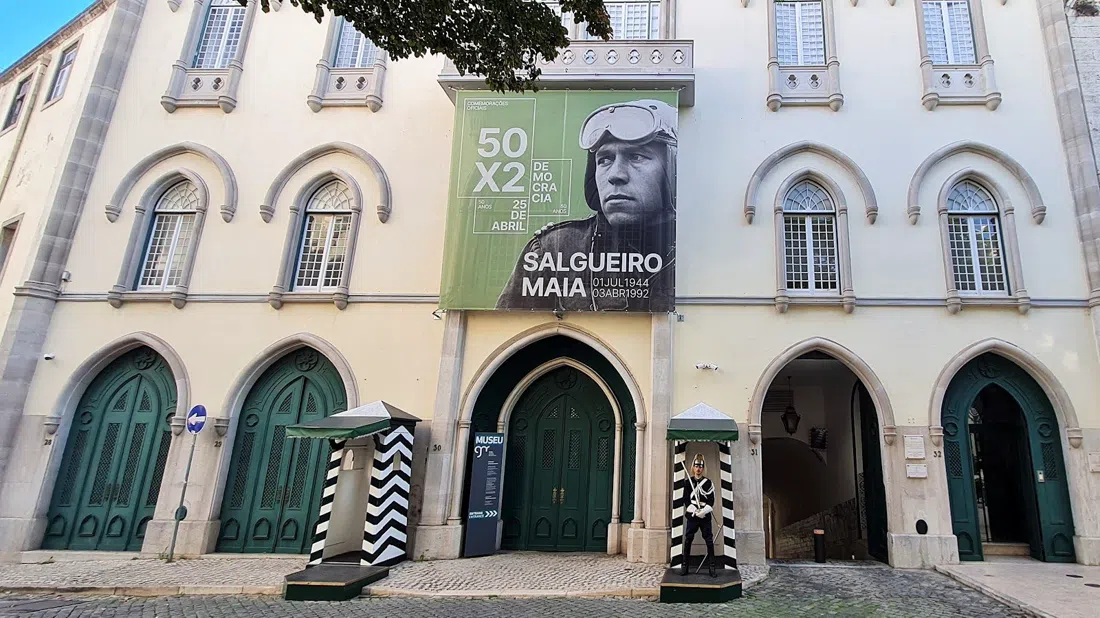
Two caveats. Organised and school groups are restricted and have to arrange a visit in advance by email ([email protected]), so a party of twenty cannot simply turn up. And the full route through the Salão Nobre and out onto the balcony, the one from the photographs, is normally opened only for the force's April anniversary. In September you get the museum, not the balcony.
Getting up the hill from the ship
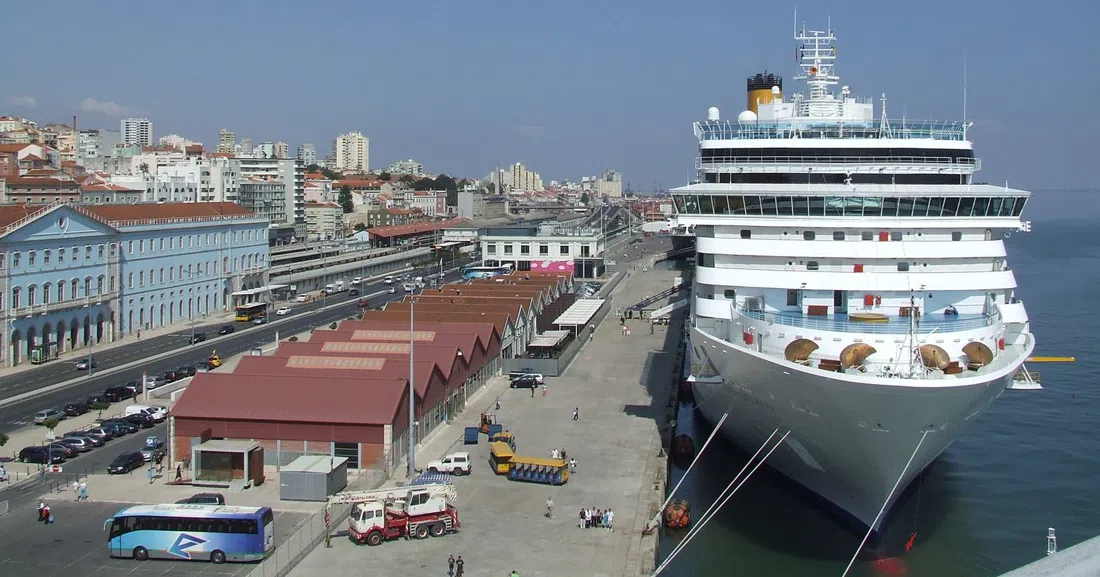
Santa Apolónia Cruise Terminal (Santa Apolónia, east of the low town) is why the timings here are tight. The metro station is a five to ten minute walk from the gate, the blue line runs two stops to Baixa-Chiado for about €1.80, and from that station it is five to eight minutes on foot to Largo do Carmo. Gangway to fountain, roughly twenty minutes. Coaches, taxis and panoramic buses also pick up at the gate.
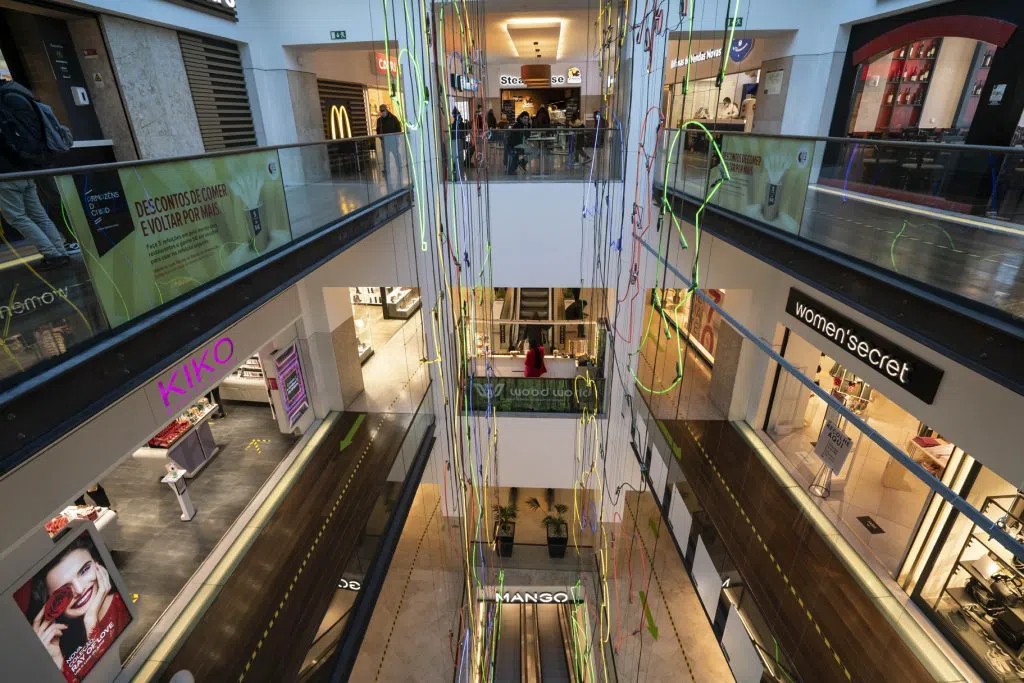
Those five to eight minutes are uphill, and Chiado is genuinely steep. This is not a flat old town. Leave Baixa-Chiado by the Chiado exit rather than the Baixa exit and the station lifts surface you at the higher level, which removes most of the climb. If you are already down in Baixa, Armazéns do Chiado (Chiado, at the hinge between the two levels) is the answer, and it belongs here as infrastructure rather than shopping. Its internal lifts, accessible entrance platform and adapted toilets are the practical step-free link from the low town up to Chiado, and with the Santa Justa lift out of service they are the difference between a walkable morning and a hard one. There is a food court inside as well, meals around €8 to €15, if the day goes sideways.
The Glória funicular that used to carry people up the other side of this hill has not run since the September 2025 accident. Wherever you are aiming on the upper level, assume you are walking.
A free terrace and the lift walkway
Terraços do Carmo (Chiado, off the north side of the square) is a public terrace you walk onto straight from Largo do Carmo without buying anything. It opens out over the low town and the river, and it connects on foot to the upper walkway of the Santa Justa lift, which matters in 2026: with the lift itself out of service this is how you reach that view with no fare and no line. Free to stand. There is an open-air bar up there, drinks roughly €6 to €14; it seats groups but does not take reservations on busy sunset evenings, so do not build an evening around securing six seats.
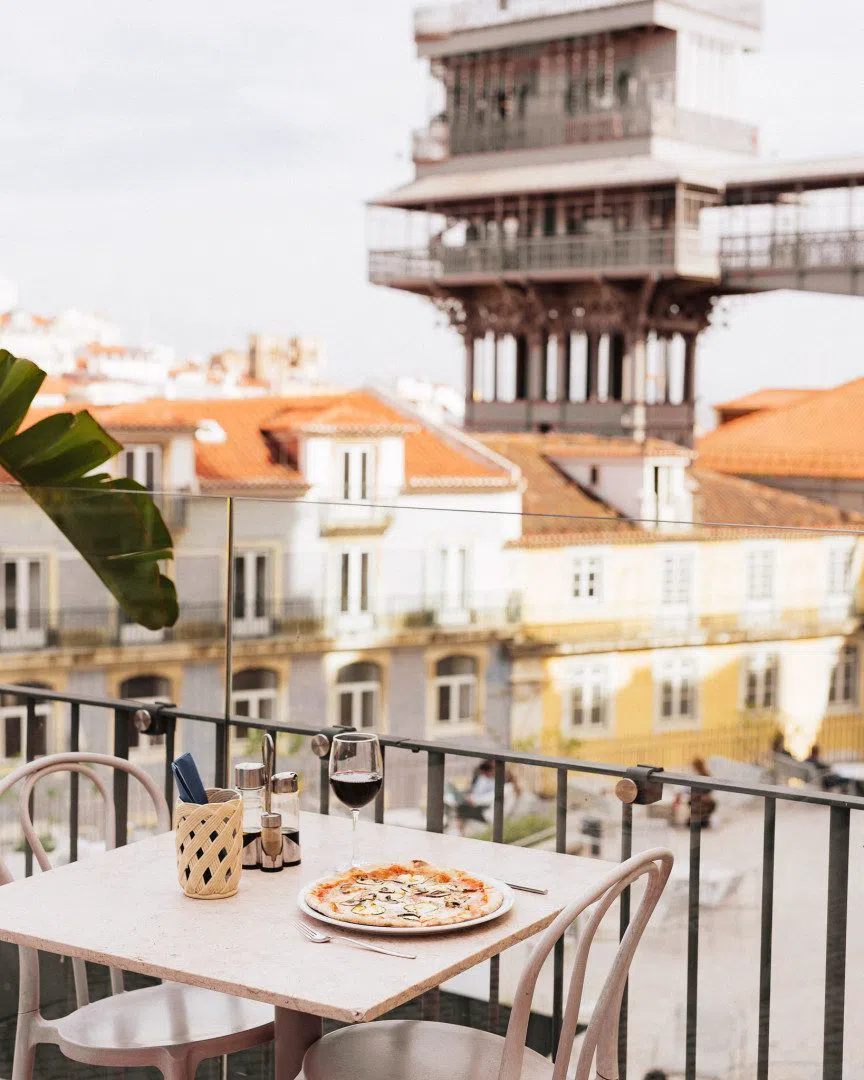
Two tables on the square itself
Leitaria Académica (Largo do Carmo) has been trading on this square since 1787 and still reads as a neighbourhood café rather than a visitor trap. It opens at 07:00, which is exactly how you get a terrace table before the groups land. Coffee runs €1 to €3, a plated lunch €10 to €16. It takes walk-in groups on the terrace but holds nothing at a busy lunchtime.

Quiosque do Carmo (Largo do Carmo) is the classic Lisbon kiosk-bar: outdoor tables only, first come, drinks €3 to €9 with light snacks, open daily from 11:00 to 02:00. A couple of listings show it dark on Sundays, so treat a Sunday drink there as uncertain. A party of six or more will end up split across two tables. It is the right place for the hour you are not spending in a queue.
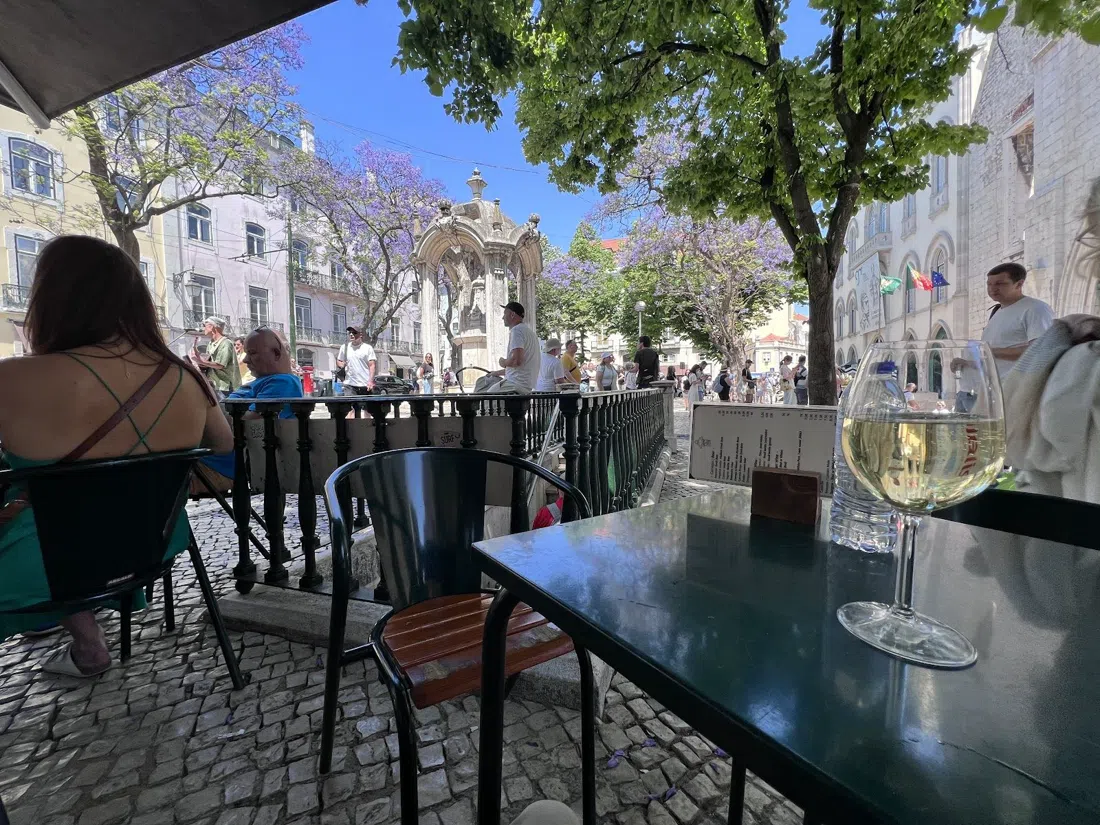
Food within five minutes
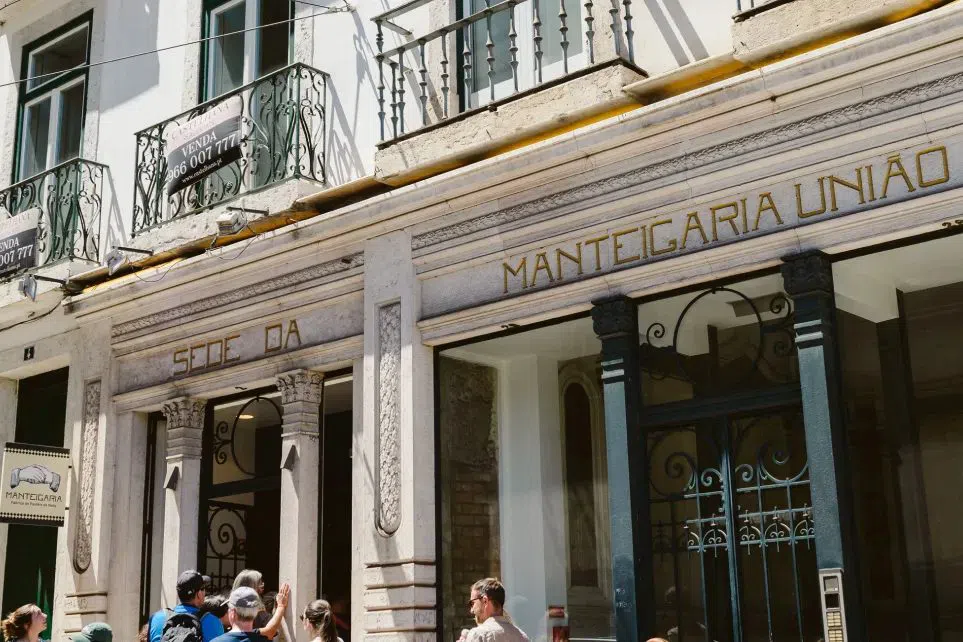
Manteigaria Chiado (Chiado) is a standing counter, about €1.50 for a pastel de nata, open 08:00 to midnight daily, and it serves a group in minutes rather than seating it. If your sailing time leaves no room for a sit-down lunch, this is the fix.
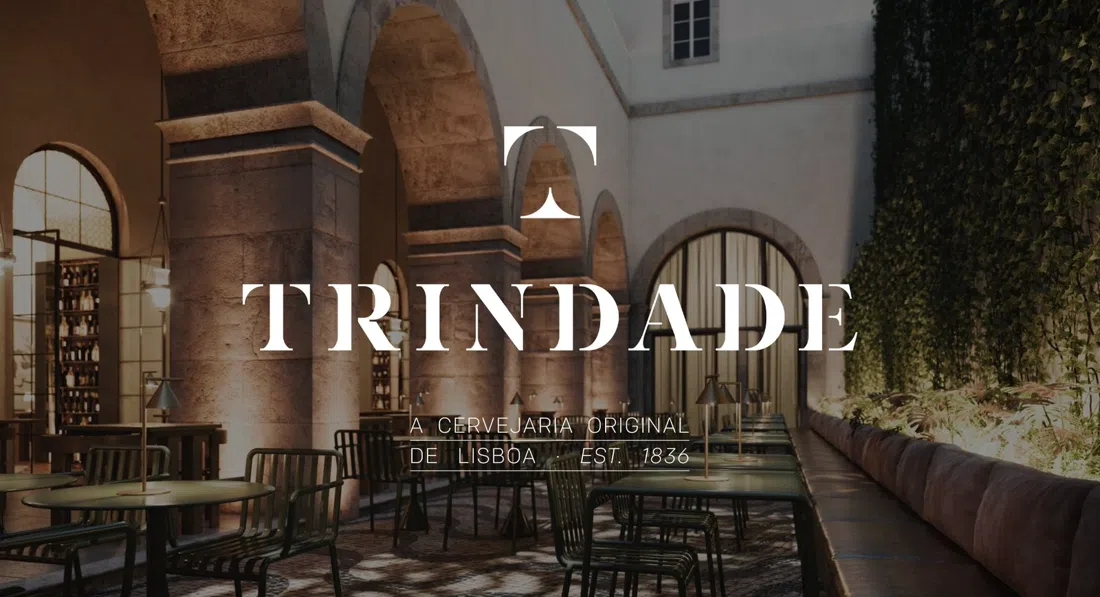
Cervejaria Trindade (Chiado, three minutes downhill) is the opposite. Another dissolved convent turned to secular use, brewing on the site since 1836, with a refectory, a cloister and tiled rooms built for large tables. €20 to €50 a head, open daily 12:00 to 24:00, book ahead for eight or more. It is the easiest place near the square to seat a whole group without splitting it.
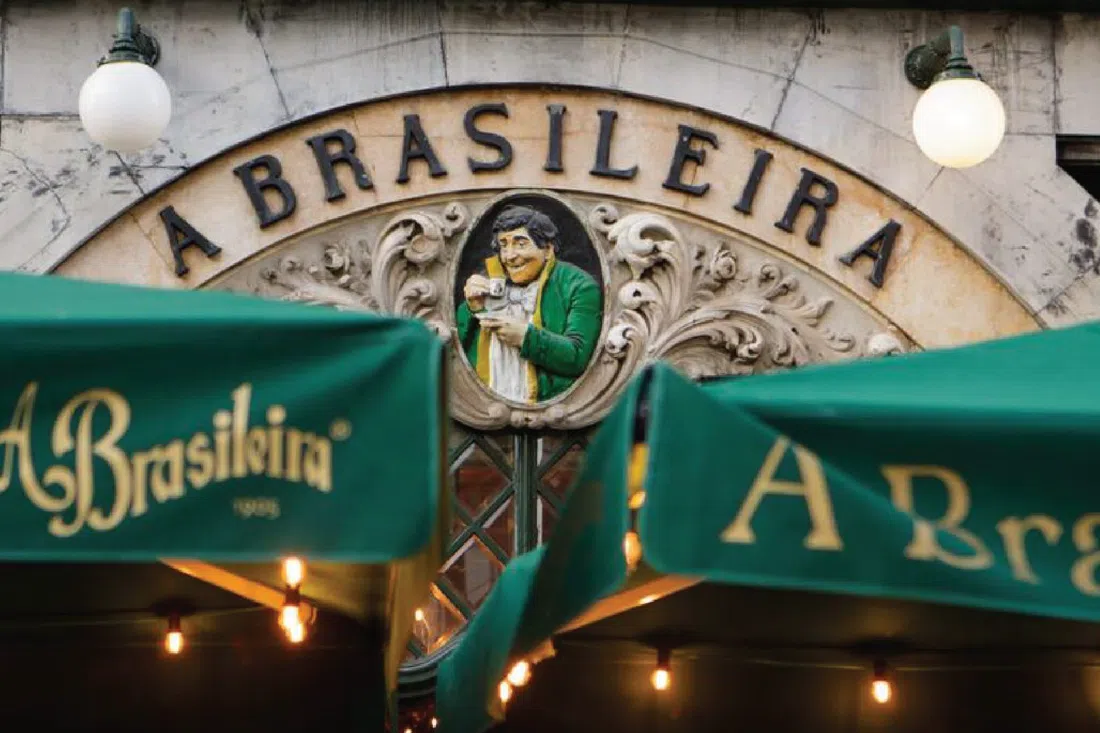
Café A Brasileira (Chiado, three minutes from the square) is the landmark with the Pessoa statue outside, and the bottleneck is the queue for a photograph beside him, not the door. Take it for what it is, and know the two-tier pricing before you sit down: a coffee at a table runs €3.50 to €5 and a meal €15 to €20, while standing at the counter costs a fraction of that.
Sundays, Mondays and rain
The two headline doors on the square are shut on Sundays, so build the backup before you need it.
Igreja e Museu de São Roque (Bairro Alto, ten minutes uphill) is the strongest wet-weather answer in the district, a plain façade over an interior of gilt and inlaid stone. The church is free and open to all; the museum is €8, free on Sundays until 14:00, and 40% off with a Lisboa Card. From April to September it runs Tuesday to Sunday 10:00 to 19:00 and closes on Mondays, the exact mirror of Carmo's Sunday closure, so between the two you always have one open.
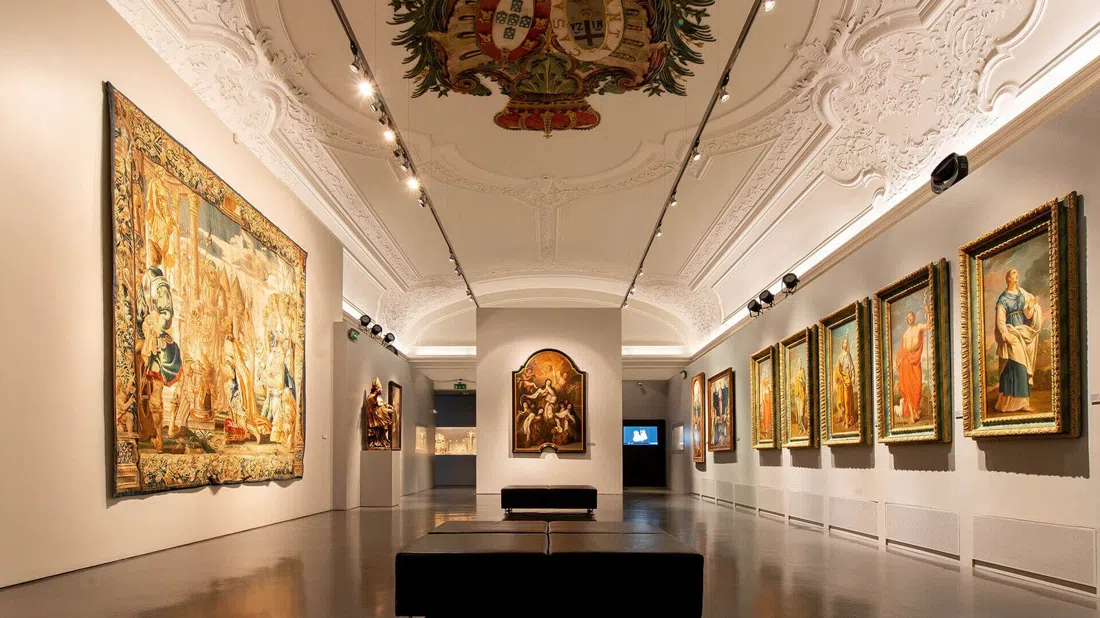
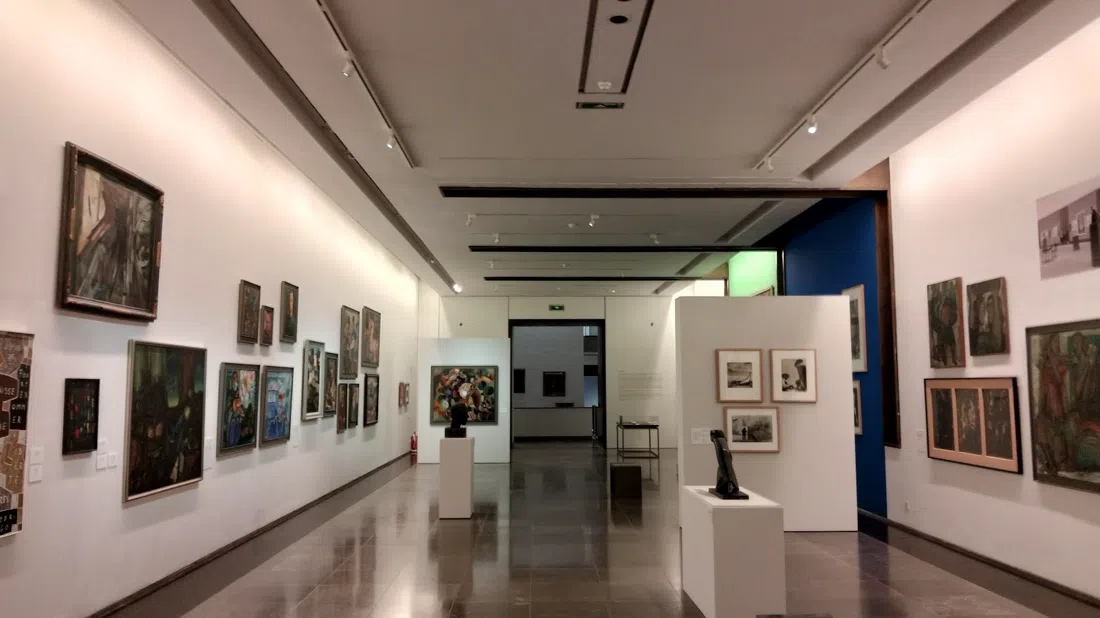
MNAC, the Museu Nacional de Arte Contemporânea do Chiado (Chiado, five minutes) opens Tuesday to Sunday 10:00 to 18:00 (€10 adult, €5 concession, free under 12) and covers both gaps. Be realistic about it, though: parts of the building are closed for renovation, so expect a shortened run of galleries. Groups can get a volume rate with 48 hours' notice.
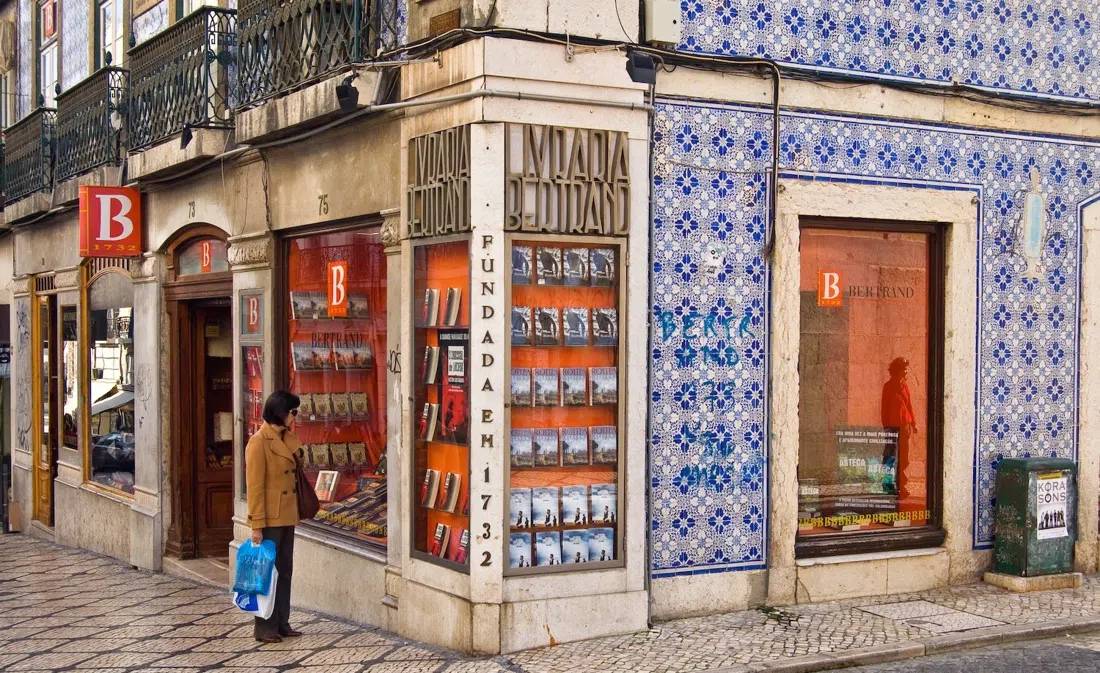
Livraria Bertrand Chiado (Chiado) is recognised as the world's oldest operating bookshop, trading on this street since 1773, free to browse, Monday to Saturday 09:00 to 22:00 and Sunday 11:00 to 20:00. It is a chain of small linked rooms, fine for two or three people, awkward for twenty.
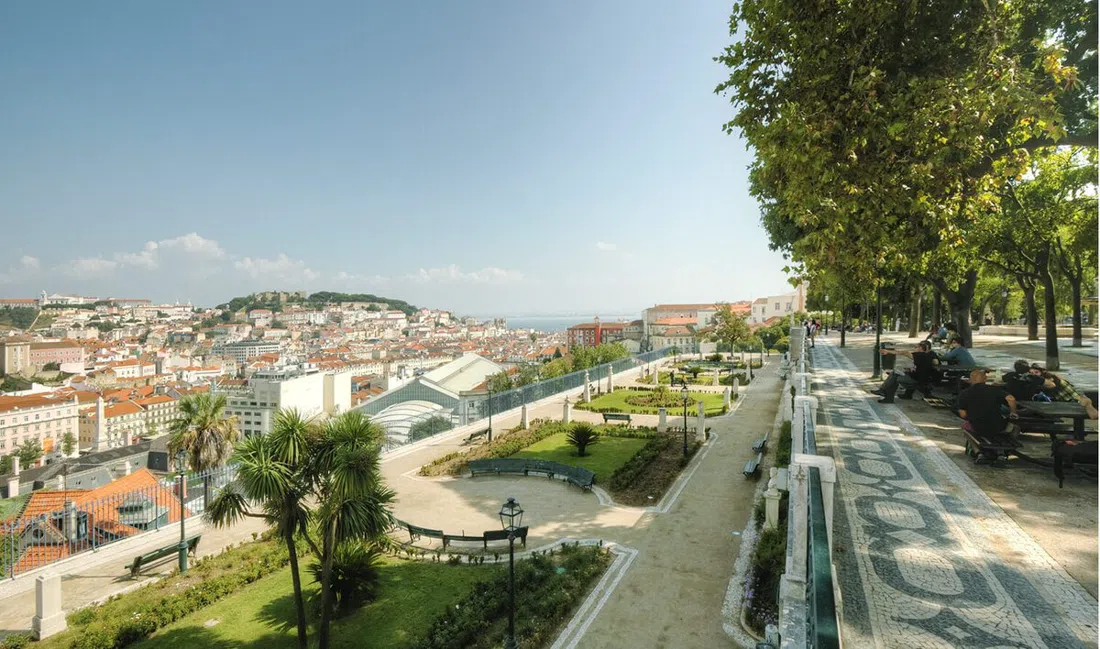
Miradouro de São Pedro de Alcântara (Bairro Alto edge, about ten minutes on foot) is the wide-angle counterpart to the Carmo terrace, a free public garden open day and night. With the funicular out, it is a climb either way.
The ruins after dark in September
Lisbon Under Stars (inside the Carmo ruins) is the seasonal reason to be on this square in the evening: a 45-minute projection show staged inside the unroofed nave, Monday to Saturday at 21:00 and 22:00, running from 20 August to 31 October, so the whole of September is live. From roughly €22 per person. Timed-entry sessions absorb groups easily and under-4s go free.
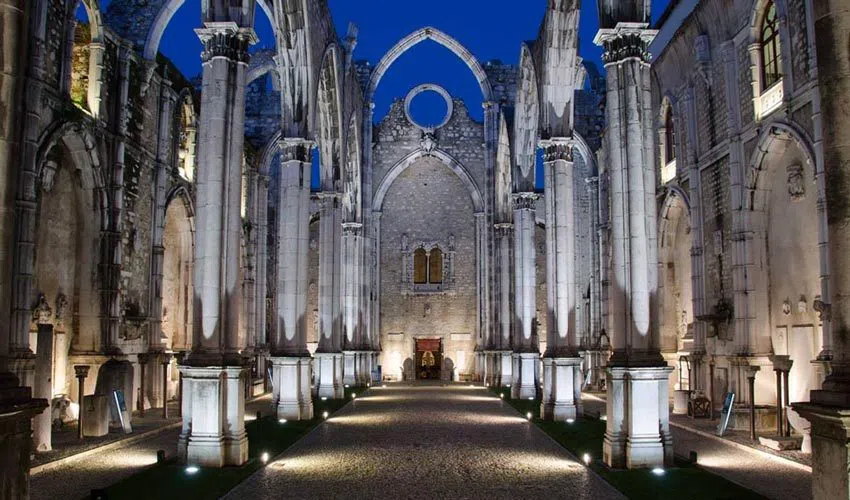
Two practical things. The nave has no roof, so you are sitting outdoors, and September evenings on this hill cool off quickly once the light goes. Bring a layer. And the ruin at night is a different building from the ruin at 10:00, so if you have the evening free, doing both is not a repeat.
When to go in September
Early morning, every time. Before 10:00 the square is quiet and the fountain is audible. At 10:00 the museum desk opens with almost nobody in front of it. By late morning the guided groups have arrived and the open space is at its tightest. September holds warm light well into the evening, but the mornings are already cooler than August, and that hour between 08:30 and 10:00 is the good one. It also costs nothing.
The day of the week matters more than the hour. Sunday closes the convent and the GNR museum. Monday closes São Roque. Tuesday to Saturday everything on this page is open at once, and Saturday is the busiest of those. If you get to choose your shore-call day, choose a weekday.
For the evening show, the 22:00 session suits anyone who wants a full dinner first, and the 21:00 one suits a group that wants to be back down the hill earlier. Either way, the light has long gone by then in September.
Tickets at the door or a guide
For Largo do Carmo itself there is nothing to buy in advance. The square, the terrace and the GNR museum are free, and the convent ticket is sold only at the desk, so there is no advance ticketing to miss and no queue-skip product that can move you past it.
A guided option is worth weighing for a different reason: if you are off a ship with a fixed all-aboard time and you would rather somebody else carried the schedule. Guided tours covering this square run seven days a week, start from about 105 USD per person for a private one, and the most-reviewed of them holds 5.0 out of 5 from 11,055 traveller reviews. That is the trade. You pay for logistics and commentary, not for access, because access here is a €7 desk ticket and an open gate.
Is it worth it
Yes, with one condition: get there before the square fills. Largo do Carmo is not a spectacle. It is a small square with a broken church, a working café or two, and a building where a dictatorship ended quietly on a Thursday afternoon. Taken in that order it makes for one of the more affecting hours in the city. Walked through at midday between two other sights, it is a photo stop.
It suits independent travellers, anyone with an interest in the 20th century, and cruise passengers on a tight window, because everything named here sits inside a 300-metre radius. It suits couples and small groups better than large parties, since the kiosk, the café terrace and the bookshop all get awkward above six. It is the wrong call for anyone who cannot manage a short steep climb without the Armazéns lifts, and it is a poor Sunday.
Practical notes
Getting there. Metro blue line from Santa Apolónia, two stops to Baixa-Chiado, about €1.80, then five to eight minutes on foot, uphill. Use the Chiado exit or the Armazéns lifts for the step-free version. The Santa Justa lift and the Glória funicular are both out of service.
Money. The convent ticket is sold at the desk only, so carry a card and a little cash for the kiosk. A full day (convent €7, a coffee, a pastel de nata, a terrace drink and the evening show at roughly €22) lands around €40 to €45 per person. Skip the show and it is comfortably under €20.
Timing. 45 to 60 minutes in the convent, 20 to 30 in the GNR museum, 15 on the terrace, an hour for lunch. A three-hour morning covers the square properly; a six-hour shore call covers it with São Roque and a sit-down meal as well.
Staying nearby. Chiado puts all of this within a five-minute walk and is quieter after 22:00 than the streets above it. Compare rates with a Lisbon hotel search, and the rest of the city is mapped in our Lisbon guide.
20 September 2026 · a first week before the flat: the Lisbon hotel directory