Gran Canaria · The weekend · 8 min
Fish, Ferries and Coffee: A Long Weekend in Agaete & Puerto de las Nieves, Gran Canaria
On Gran Canaria's quiet northwest shoulder, a working fishing harbour, three volcanic swimming pools and continental Europe's only coffee farm make the case for skipping the south coast entirely.

At half past nine, the Fred Olsen Express swings its bow away from the dock at Puerto de las Nieves and points at Santa Cruz de Tenerife — an hour and twenty minutes of open water, up to seven crossings a day in high season. Everyone on the harbour notices, and nobody stops what they're doing. Waiters keep laying tables on the Explanada. The swell keeps thumping into black volcanic rock with a sound like a door closing somewhere underground. By eleven the village has gone back to being what it is for the other twenty-three hours of the day: a small fishing harbour on the quiet northwest shoulder of Gran Canaria, with a whitewashed town a kilometre uphill and, above that, a green valley that grows coffee.
What Agaete & Puerto de las Nieves is known for
Two things anchor this corner of the island, and they're both about arrival. The first is the ferry. Puerto de las Nieves is the Fred Olsen Express terminal for Gran Canaria, which means this tiny harbour has a timetable most villages of its size could never justify — the Tenerife crossing running back and forth all day, foot passengers and cars funnelling down to the water and then away again.

The second is the fish, and the fish is the reason people stay longer than the sailing requires. Locals drive out from Las Palmas on a Sunday for no other purpose than to eat on a harbour terrace here, which tells you most of what you need to know about the quality-to-fuss ratio.
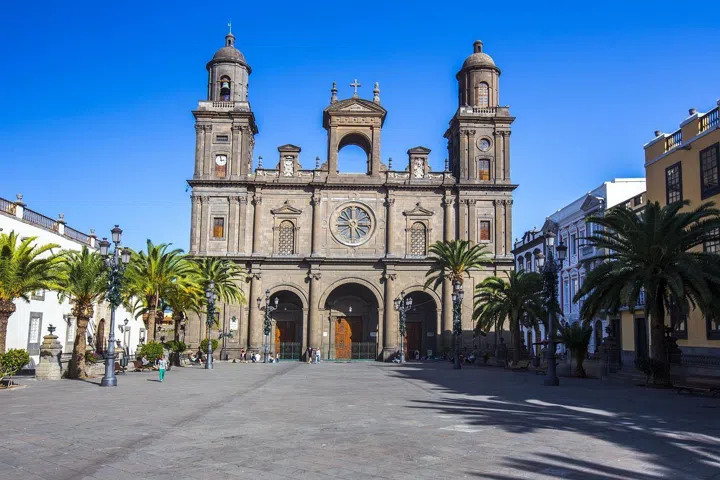
A kilometre inland, Agaete proper is a different proposition: whitewashed, steeper, more domestic, built around a church that dates from 1875. Keep going up into the Valle de Agaete and the landscape turns improbably lush — this is where you find continental Europe's only working coffee plantation, which sounds like a tourist-board flourish until you're standing among the plants. Closer to town, the Maipés necropolis holds pre-Hispanic burial mounds, some of them more than 1,300 years old. For a place with no nightlife to speak of, Agaete is unusually dense with things that are genuinely hard to see anywhere else.
And it does stay quiet, even in August. There's no strip of bars, no club nights, no hawkers. What you hear instead is the Atlantic against the rock and, at one in the afternoon, the clatter of plates. If you're a seafood obsessive who wants the catch off the boat rather than a resort buffet, or a hiker using the Agaete valley and Tamadaba as a base, or someone breaking a Tenerife crossing and discovering by accident that this is a better holiday than the one you booked — this is your corner. If you came to the Canaries for a long sandy beach on the doorstep and a pool bar, be honest with yourself: the swimming here is volcanic pools and small coves, not Maspalomas-style sand, and the nights end early.
Where to eat and drink
Eating in Puerto de las Nieves means harbourside seafood, almost without exception, and the cluster of terraces along the Explanada and the streets just behind it all compete on exactly one axis: freshness. That makes the local technique obvious. Walk the row first. Read the boards. Look at what's actually on the tables. Then sit.

The dishes repeat from kitchen to kitchen, which is a feature rather than a failing — caldo de pescado, the local fish soup, and whatever came off the boat that morning, grilled whole and served without ceremony. Mains across the harbour typically land somewhere between €12 and €25, so this is mid-range eating rather than bargain eating, and the premium is paid for proximity to the water in both senses.
If you want one reservation made in advance, make it at Ragù. It's the harbourfront's Italian-Canarian hybrid and the most carefully run room in the village: homemade pasta and bread arriving alongside standout fresh fish and a tuna tataki that has no business being this good two minutes' walk from a ferry terminal. It's rated 4.4, the highest of the harbour restaurants, and the consistency shows.

For the opposite experience — the one you'll describe to people later — there's Restaurante Cofradía de Pescadores, run by the local fishermen's association right on the Explanada. This is the day's actual catch, no frills, no styling, no soft lighting. Ratings for it are low, around 2.9, and I'd rather tell you that than pretend otherwise: people who arrive expecting a polished restaurant leave unhappy. People who arrive understanding that they're eating in the fishermen's own canteen, where the point is provenance and not presentation, tend to leave very happy indeed. Order simply and let the sea do the work.

Around the corner on Calle Nuestra Señora de las Nieves, Las Nasas puts tables near the shoreline and leans into rice: paella and, better, arroz caldoso — the souper, looser Spanish cousin, which is the right thing to order on a windy afternoon when the spray is coming over the rocks. It carries a 3.1 rating and the reports swing widely, so treat it as a place to go for the location and the rice rather than for precision service, and you'll calibrate correctly.

After dark
There isn't a going-out scene here, and any guide that invents one is lying to you. No club nights, no bar strip, nowhere to drift between at midnight. What exists instead is the long dinner: a terrace table on the Explanada, the harbour lights, a bottle that lasts two hours because nobody is waiting for your table. Treat dinner as the night out, let it run late, and walk back along the water. If you need more than that, the south coast resorts are an hour's drive away — which, locals would argue, is precisely the right distance.
What to do
The single best thing to do in Puerto de las Nieves costs nothing. Las Salinas is a set of natural swimming pools a short walk from the harbour — three volcanic basins linked by submarine tunnels, sheltered from the open Atlantic swell so the water inside stays flat while the sea outside misbehaves. Entry is free. There's a sunbathing area, public restrooms, and parking about 200 metres away, which is as close to civilised infrastructure as a lava pool gets. Go early, before the loungers on the flat rock fill up, and swim between the basins through the tunnels when conditions are calm.

Then drive up into the Valle de Agaete for Finca Los Castaños, the coffee plantation that makes this valley a minor pilgrimage site for anyone who takes their beans seriously. It's continental Europe's only working coffee farm, and the tour-and-tasting format — a modest fee, a walk through the plants, a cup at the end — is exactly the right length. The microclimate here does the work: shelter, altitude, water coming down off the ridge. It's rated 4.7, as is Las Salinas, and both deserve it.

Back on the edge of town, the Maipés necropolis is the quietest and strangest hour you'll spend in the area: roughly 645 tumuli built from volcanic stone across a lava field, pre-Hispanic burials, some more than 1,300 years old. It's free, it's rated 4.6, and the scale is what gets you — not one monument but hundreds of low stone mounds laid out across black ground, with the valley rising behind them.

Beyond that, the walking is the attraction. The Agaete valley trails and the pine forest of Tamadaba above it are the reason a certain kind of visitor books a week here rather than two nights, and the harbour makes an unusually comfortable base for it: swim off the salt at Las Salinas, eat fish, repeat.
Shopping
This is not a shopping destination, and you should plan accordingly — no mall, no retail strip, and almost everything that changes hands here is edible. The honest best buy is agricultural: the valley fincas sell their own coffee, marmalades, cheese and liquors directly after a tour, which travels well and means your souvenir came from the hillside you just walked across. Buy the coffee at the farm rather than hunting for it later.
Where to stay in Agaete & Puerto de las Nieves
Staying right on the water means Hotel Puerto de las Nieves, a small, calm property on Alcalde José de Armas, a few steps from both the ferry dock and the natural pools. There's a spa, an outdoor pool and sea views, and the whole operation is pitched at people who want quiet rather than a resort strip — which is to say, at people who chose Agaete on purpose. It suits anyone combining a few harbour days with hiking, or anyone building a trip around the Tenerife crossing who'd rather sleep two minutes from the terminal than drive in at dawn. Inland in Agaete town you trade the sea view for a more residential, more Canarian base and a 15-to-20-minute walk down to dinner.
Getting around
Puerto de las Nieves and Agaete town sit a comfortable 15-to-20-minute walk apart, or a couple of minutes by car, and most visitors handle both without a vehicle. Within each, everything is walkable: the harbour strip, the pools and the town centre are each only a few streets wide. Global bus line 103 connects the harbour to Las Palmas de Gran Canaria in roughly 45 to 50 minutes and runs about hourly on weekdays, which is enough for a car-free trip built around seafood and swimming. By car it's 35 to 40 minutes from Las Palmas and an hour-plus from the airport, and you'll want those wheels if the coffee-valley fincas or the more remote Tamadaba trailheads are on your list — the buses don't go up there.
One genuine caution in an otherwise very safe, very low-crime village: the risks here are aquatic rather than criminal. The sheltered basins at Las Salinas are calm, but the open Atlantic swell along this coast can turn serious fast. Check conditions before you enter the water anywhere beyond the pools, and if the sea is throwing spray over the rocks, take the hint and order the fish soup instead.
24 October 2026