Gran Canaria · Where to live · 7 min
Vegueta & Triana, Las Palmas: Five Centuries in a Ten-Minute Walk
Gran Canaria's capital began on these streets in 1478 — and the founding quarter still runs on markets, cathedral bells, Michelin-watched kitchens and one very good rooftop.

Columbus provisioned his ships a few streets from where Rêver now plates its tasting menu in a stone-walled room, and the cathedral bell he might have heard still rings over Plaza de Santa Ana. That proximity is the entire argument for this district. Vegueta is the 1478 founding core of Las Palmas de Gran Canaria — not a reconstruction, not a heritage zone drawn around three surviving façades, but the original streets, still in daily use. Triana, built across the old Guiniguada ravine, is its nineteenth-century shopping extension: adjacent, ten minutes on foot, and a completely different temperature.

The founding quarter, not a recreation of one
The men who laid this grid out had sailed from Seville, and they were homesick enough that when the city spilled across the ravine they named the new district Triana, after Seville's own riverside quarter. Five hundred years later the borrowed name has stuck harder than the original reference. Walk Vegueta and the building material tells you where you are before any plaque does: volcanic stone, dark and porous, in church walls and doorframes; dark wooden balconies leaning out over streets narrow enough to shade themselves at midday; and courtyards you only ever find by pushing open a door that looked shut.
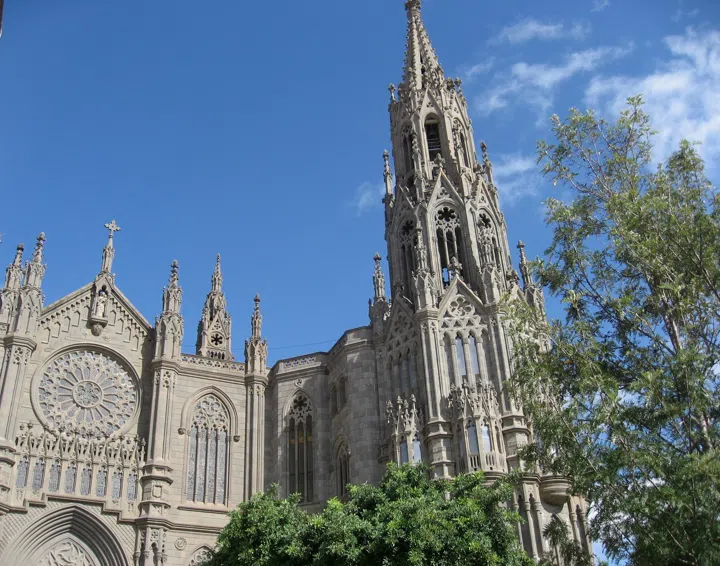
Santa Ana Cathedral anchors Plaza de Santa Ana, and the square anchors everything else. It is the kind of civic space that organises a neighbourhood without trying — distances here get measured from it, and so do moods.

Vegueta is quiet by day, and the quiet has a specific texture. Students from the nearby university campus cut through on their way somewhere. Retirees take the shade. Delivery vans reverse badly down streets built for mules. If you came to Gran Canaria for the island's actual history rather than only its coastline, this is where that history is still legible — cathedral, Columbus house, archaeology collection and modern art museum all inside a few blocks, which makes it an unusually efficient base for culture-first travellers and for couples or solo visitors who would rather walk everywhere than deal with a hire car.
It is also, in fairness, the wrong choice for some trips. Las Canteras beach is a twenty-to-thirty-minute bus or taxi ride away, not a stroll, and nothing in Vegueta resembles a resort with a pool and a buffet. Choose the old town knowing what you are choosing.
Market mornings, Michelin tables, Thursday pinchos
The food here runs an unusually wide span for such a small footprint: a 160-year-old produce market and two Michelin-recognised dining rooms, all within a few streets of each other.
Start with the market, and start early. Mercado de Vegueta has traded since 1863 and still opens Monday to Saturday, 7am to 2pm — fish on ice, produce in crates, and breakfast taken standing up among stallholders rather than tourists. At half past eight the place is doing its real work. Turn up at half past one and you are watching it pack away, which is its own kind of show but not the one worth setting an alarm for.

A short walk from there, on the pedestrianised Calle La Pelota, Triciclo has spent a decade building its reputation on plates designed to be pushed into the middle of the table. The braised octopus is what most tables arrive intending to order. The outlier — and the dish people describe to friends afterwards — is a cachopo made with truffle and Flor de Guía, which takes a mainland Asturian idea and gives it an island accent. Its 4.5 rating is earned the honest way, across years rather than a hype cycle.

For something more composed, Sorondongo on Calle Armas builds Canarian-focused tasting menus and is named, rather beautifully, after a traditional island folk dance. It holds a 4.9 — a number restaurants almost never sustain — and the kitchen's loyalty to Canarian produce is the reason. Reserve. This is not a room you walk into on a whim at nine o'clock.
Near Casa de Colón, Rêver works a different register: a stone-walled fine-dining room, an international menu, and the status of one of the area's newer Michelin-watched tables, sitting at 4.7. The contrast between the medieval walls and what arrives on the plate is part of the pleasure rather than a gimmick.

Reckon on €60–90 a head for a tasting menu at the area's Michelin-watched tables. Then reckon on under €3 for a pincho and a drink on a Thursday night, when Vegueta does its weekly tapas crawl and the old streets fill with people moving glass-in-hand from bar to bar. Few European cities offer that spread inside the same ten blocks. Budget-wise the district as a whole feels mid-range rather than resort-priced, which is to say you can eat extremely well here without a tasting-menu reservation.
A rooftop between the two districts, then a quiet old town
Let's be straight about the nights. Vegueta and Triana are not a nightlife district in the Santa Catalina or Las Canteras sense. Most streets go genuinely sleepy after dinner, and some side streets empty out entirely — the area is one of the safer, more watched-over parts of Las Palmas by day, with constant foot traffic around the cathedral and the market, but it changes register after dark on any night that isn't Thursday.
The standout exception is upstairs. La Azotea de Benito sits on the roof of the Monopol arcade, on the exact seam between the two neighbourhoods, with more than sixty gins behind the bar and the cathedral towers filling the view. Order something long, get there before the light goes, and you will understand the geography of these two districts better in twenty minutes than an hour of street-level walking teaches you.

Cathedral, Columbus house, modern art, all within a 10-minute walk
Climb Santa Ana Cathedral's tower first. It gives the best rooftop view of the old town, with the harbour spread out beyond it, and it rearranges your mental map of the district — all those tile roofs and hidden courtyards suddenly make sense as a plan rather than a maze.
Then cross the square to Casa de Colón. The former governor's residence is five hundred years old, tied to Columbus's Atlantic crossings, and now a museum covering the city's history and its long entanglement with the Americas. Entry is €4, open Monday to Saturday, 10am to 6pm, and the courtyard alone justifies the ticket before you have read a single caption.

A few streets on, CAAM — Centro Atlántico de Arte Moderno — threads contemporary art through a run of converted Vegueta townhouses, and reopened in mid-2026 after restoration. It is free, which makes it the easiest yes in the neighbourhood: twenty minutes or two hours, both work.

And for the island's deeper past, Museo Canario holds the pre-Hispanic Gran Canaria archaeology collection right in the heart of Vegueta — the people who were here long before 1478, and the context that the cathedral and the Columbus house quietly depend on. Four museums and a tower climb, none more than ten minutes' walk from the next.
Triana's pedestrian high street
Cross the old ravine and the mood flips from contemplative to commercial. Calle Mayor de Triana is the shopping draw — a pedestrianised strip that won Spain's Best Open-Air Shopping Area title in 2013 and has kept the crowds since. The retail is familiar: Zara, Mango, Bershka, Decathlon City, an Apple Store. What isn't familiar is what they occupy. The façades along here are genuinely old Modernist and Eclectic work, the 1930s Wiot Building among them, and the trick is to shop with your chin up — the interesting half of this street starts at first-floor level.
Where to stay in Vegueta & Triana (Las Palmas)
Staying inside Vegueta means restored Canarian townhouses on quiet, cobbled streets a few minutes from the cathedral and Casa de Colón — the quietest and most historic base on the island. It suits travellers who want to walk everywhere and don't need a beach on the doorstep, and it rewards the kind of visitor who enjoys coming home through empty old streets at eleven at night. Evenings here are calm by default, so if you want noise outside your window, book elsewhere. Triana puts you closer to the shops and the transport hub; Vegueta puts you inside the history. Both are ten minutes from each other, so the decision matters less than it sounds.
Walkable core, San Telmo is the transport hub, airport 20–30 minutes by bus
This is flat, compact, walking territory — cathedral to Calle Mayor de Triana is about ten minutes, crossing the old Guiniguada ravine on the way. San Telmo bus station, on the Triana side opposite Parque San Telmo, is the district's transport hub and its gateway to the rest of the island.
From Gran Canaria Airport (LPA), Global's direct route 60 runs to San Telmo in roughly 20–30 minutes depending on traffic, for around €2.30–2.95; a taxi covers the same ground in about 20–25 minutes. You do not need a car. Hire one only if you intend to go properly beyond the capital — the southern resorts, or the island's interior — and even then, pick it up on the day you leave rather than paying to park it in a district built before wheels mattered.
24 October 2026