Gran Canaria · Where to live · 8 min
Playa del Inglés, Gran Canaria: Concrete, Courtyards and Four Kilometres of Sand
Gran Canaria's biggest resort is a 1960s grid of apartment blocks and arcades that has spent a quarter of a century as the Canary Islands' main gay destination — and it ends in a desert.
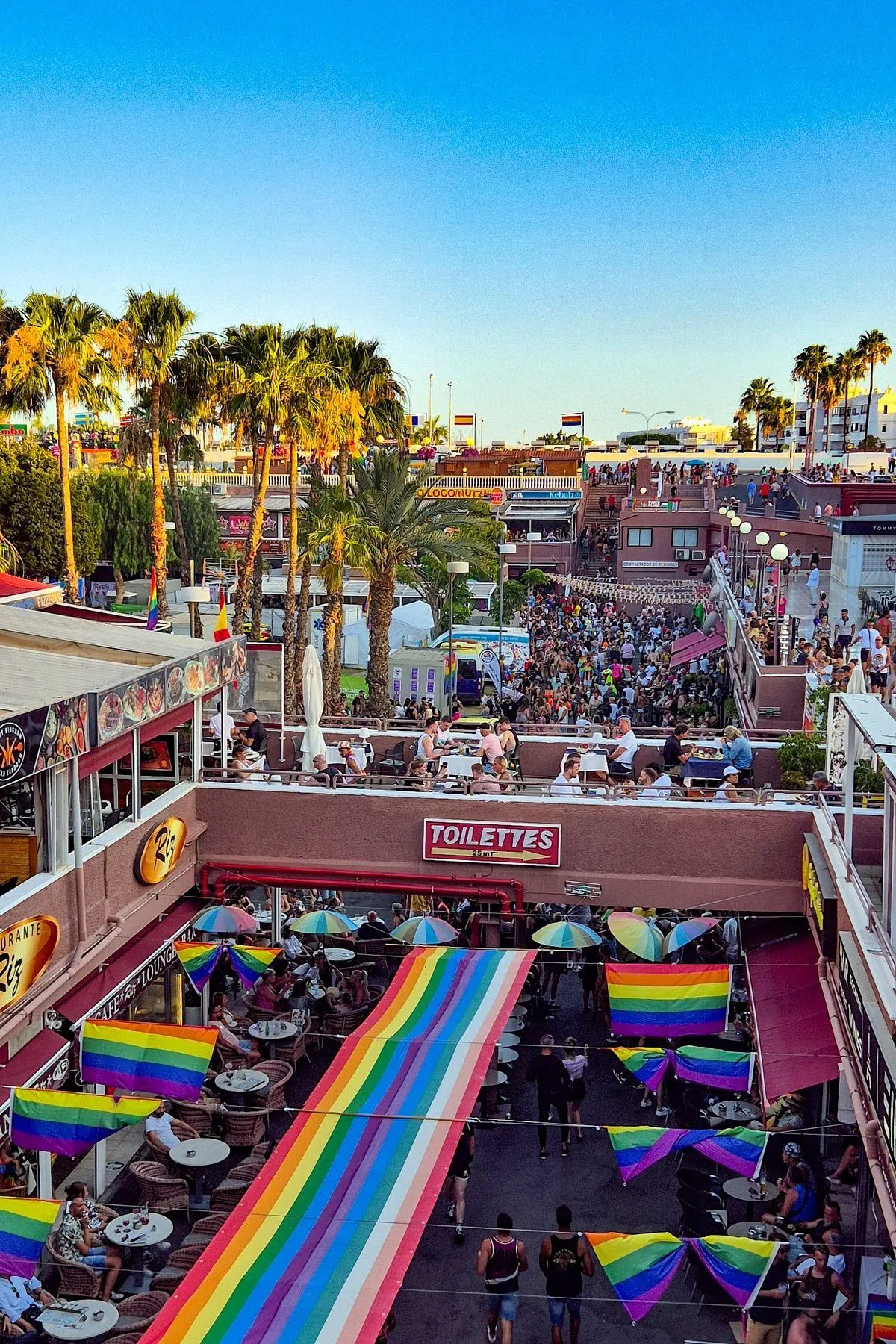
In 1961 there was no town here at all. The urbanisation plan was approved in 1962 under the name Llanos del Inglés, and what grew out of that paperwork is now the biggest resort on Gran Canaria: a low-rise grid of apartment blocks, all-inclusive hotels and shopping arcades stacked three storeys deep with bars, laid out flat a few streets back from the sand. The beach runs roughly four kilometres. At its eastern end it is a resort beach, busy and serviced. At its western end it stops being a beach at all and becomes the Maspalomas dunes, a protected desert that absorbs the noise of everything behind it. Playa del Inglés does not pretend to be anything other than what it is, and that lack of pretence is most of the appeal.

What Playa del Inglés is known for
Two things, well ahead of everything else. The first is sheer scale — this is the island's biggest resort, and it behaves like one, with a density of hotel beds, self-catering apartments and arcade units that no other corner of Gran Canaria matches. The second is that for more than twenty-five years it has been the main gay resort in the Canary Islands, with the Yumbo Centrum at its centre, and that reputation now reaches far beyond Spain.
It is worth being precise about what that means on the ground, because the two facts are often collapsed into one. Playa del Inglés is a large mixed package resort in which the Yumbo Centrum happens to be the biggest LGBTQ+ nightlife hub in the archipelago; an estimated 15 to 20 per cent of visitors identify as LGBTQ+. The rest of the arithmetic is made up of package-holiday regulars after guaranteed sun and a beach that requires no effort to reach, and a deeply loyal contingent of older German and Scandinavian visitors who have been coming every winter for decades and know exactly which terrace they want at which hour.
The texture of the place is best read on Avenida de Tirajana, the spine that runs through the middle of the action. Nothing about it is quaint. Three- and four-storey blocks, pharmacy signs, supermarkets selling factor 50 and chilled Dorada, the occasional palm — and a steady, unhurried flow of people walking between a hotel, a beach and a bar.
Where to eat and drink
Eating here is overwhelmingly a Yumbo Centrum story. Several floors of small kitchens feed the entire resort at once — German, Indian, Italian, Thai, British and Spanish, all within the same arcade, often within sight of each other across a stairwell. The quality varies block to block, sometimes unit to unit, which means this is not a place to wander hungry and take the first open door. It rewards knowing where you are going.
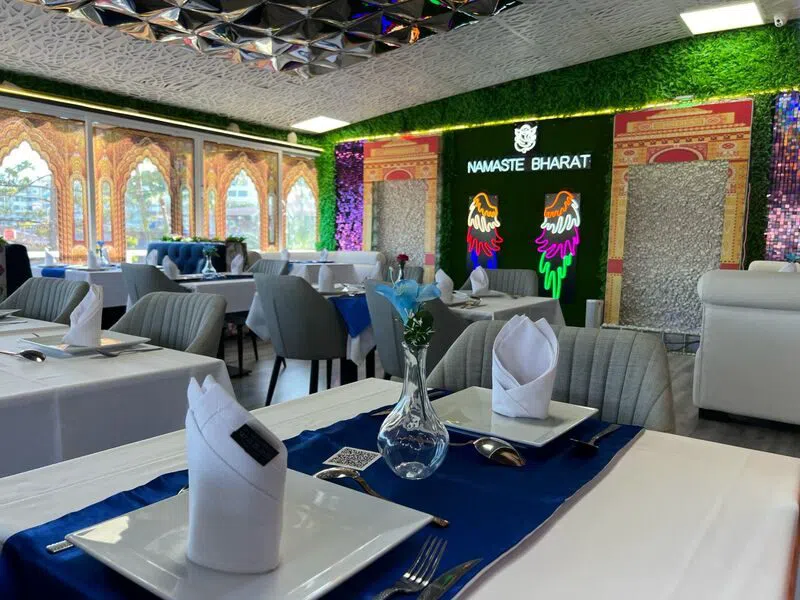
Namaste Bharat, inside the Yumbo, is the clearest argument for that approach: an Indian kitchen with a 4.8 rating and a reputation for generous, properly spiced cooking, with the heat adjusted to whatever you can actually handle rather than whatever the menu assumes.
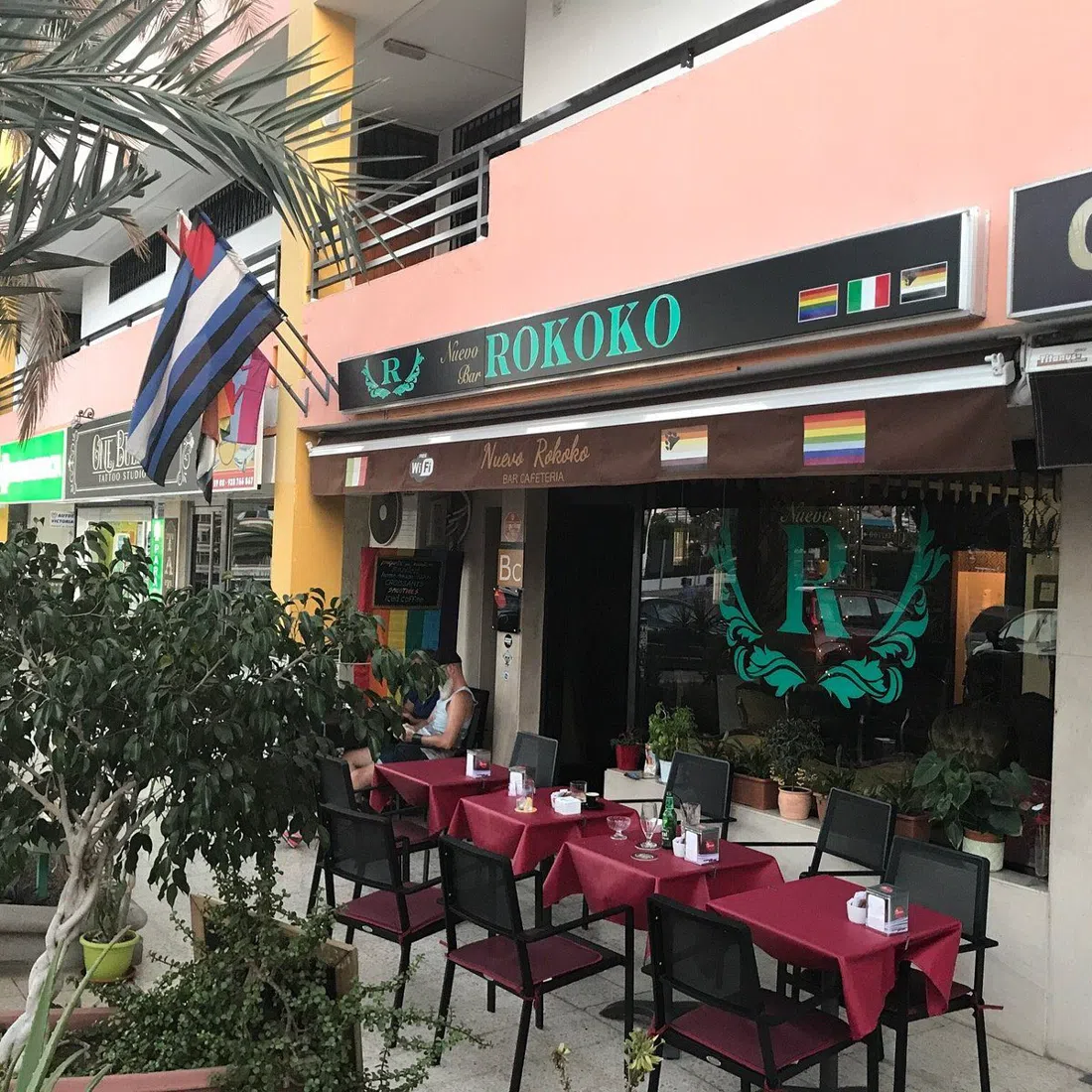
Mornings run on coffee, and the resort's best is at Nuevo Rokoko, rated 4.9 and the top-rated coffee and tea spot in Playa del Inglés — the kind of café where off-menu requests are met without a sigh and the welcome is warm enough that people build their day around the first cup.
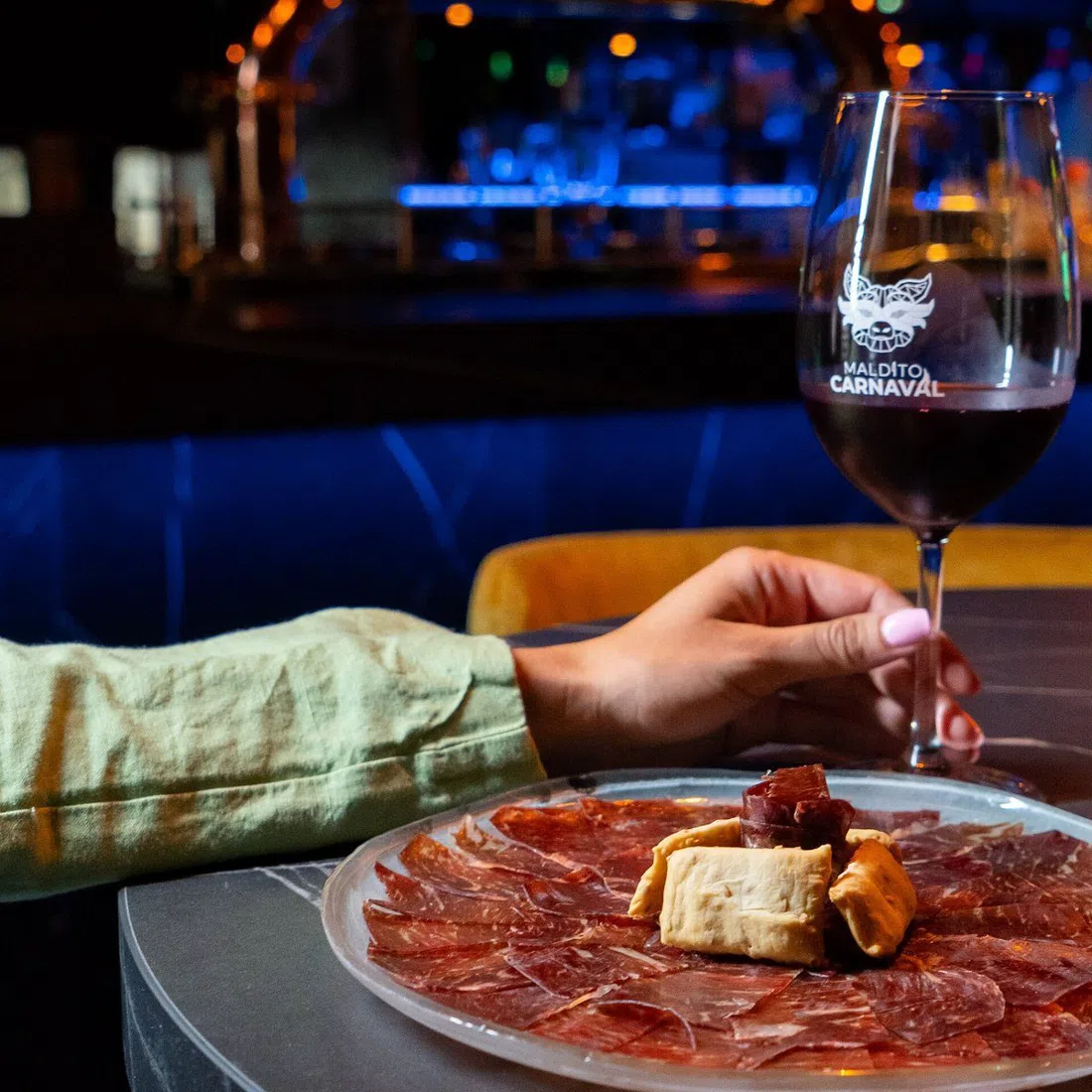
For dinner with more volume to it, Maldito Carnaval is the resort's standout: carnival-themed, loud in the best sense, and rated 4.4 — among the best in town for both food and service. It is a useful corrective to the assumption that a package resort can only do beige buffet food at scale. Eat early if you want to talk; eat late if you want the room at full tilt.
Budget-wise, expect mid-range package-resort pricing throughout. All-inclusive hotels and self-catering apartments dominate the accommodation, which drags the whole eating-out market towards value, and it is generally cheaper than equivalent beachfront on the Spanish mainland.
Nightlife
This is the reason most people choose Playa del Inglés over anywhere else on the island, and it is concentrated to an almost absurd degree. The Yumbo Centrum is a multi-storey complex built around an open-air courtyard, holding more than thirty bars and clubs — relaxed terrace drinking on one level, cabaret on another, dance floors deeper in. By day it is a shopping arcade with shuttered units and a few cafés. As the evening builds, the shutters go up in waves, the courtyard fills, and the whole building changes function around you. It is rated 4 overall, and the number barely captures it: Yumbo is less a venue than a vertical neighbourhood with its own timetable.
That timetable runs late. Strong Construction, a long-running cruise club on Yumbo's ground floor, opens nightly from 10pm to 6am and draws a younger crowd than much of the complex; it is rated 3.8 and knows precisely what it is. Away from the Yumbo, Pacha Gran Canaria sits on Avenida Sargentos Provisionales and has been open since 1984, part of the Ibiza-founded brand and rated 4.1 — proof that the resort's club culture predates most of its current clientele.
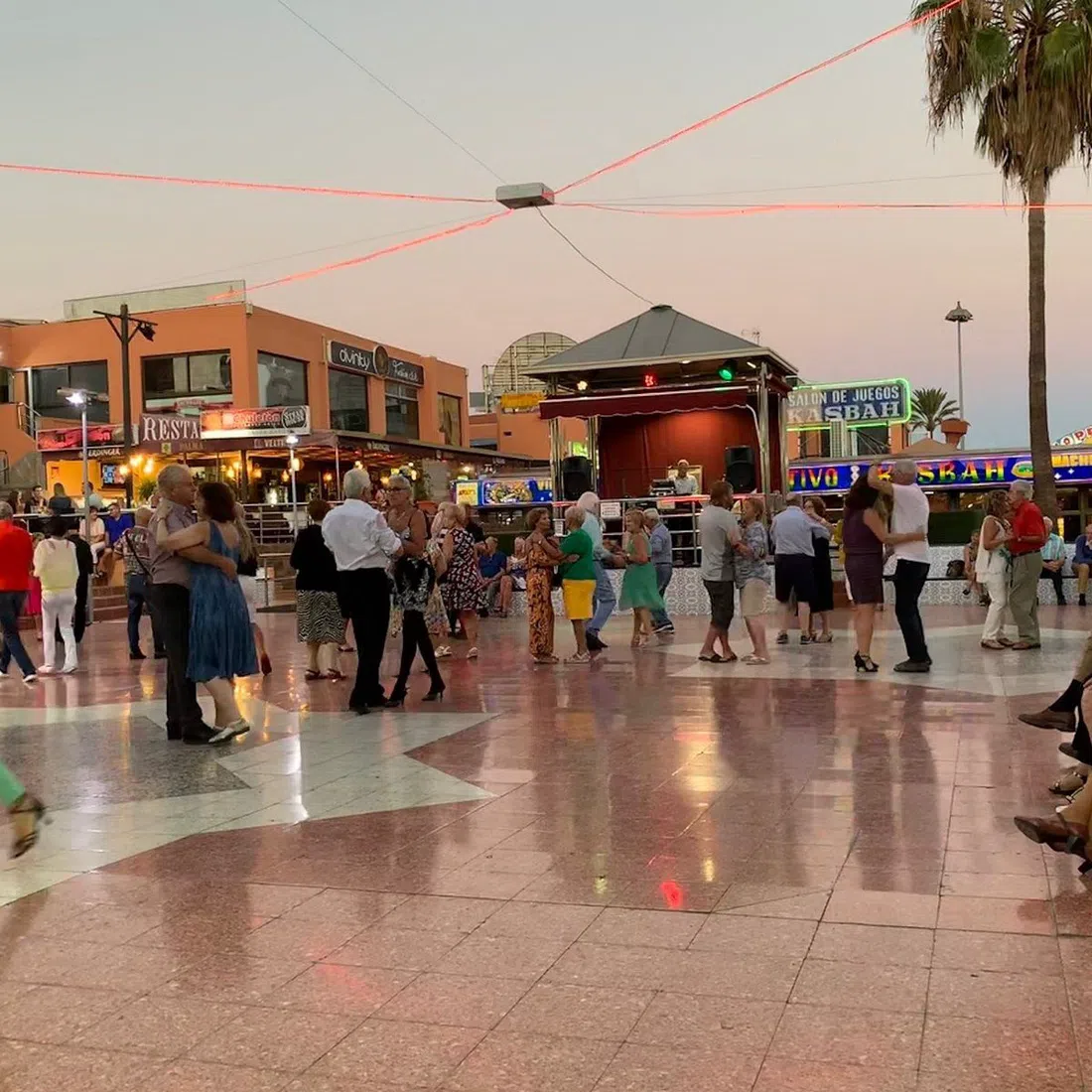
The counterweight to all of this is the Kasbah shopping centre, which has nightly live Latin music and open-air dancing from 6.30pm in its central courtyard. It is rated 3.3, it is firmly mixed, and it starts at an hour that suits people who have spent the day on a beach rather than in bed. Couples dance properly. Nobody is performing for a phone.
One practical note, because it matters in a resort this dense: keep an eye on your drinks in both Yumbo and the Kasbah late at night. The area is generally safe and heavily geared to tourism, but a thirty-bar building at four in the morning deserves the same ordinary caution you would apply anywhere.
Things to do
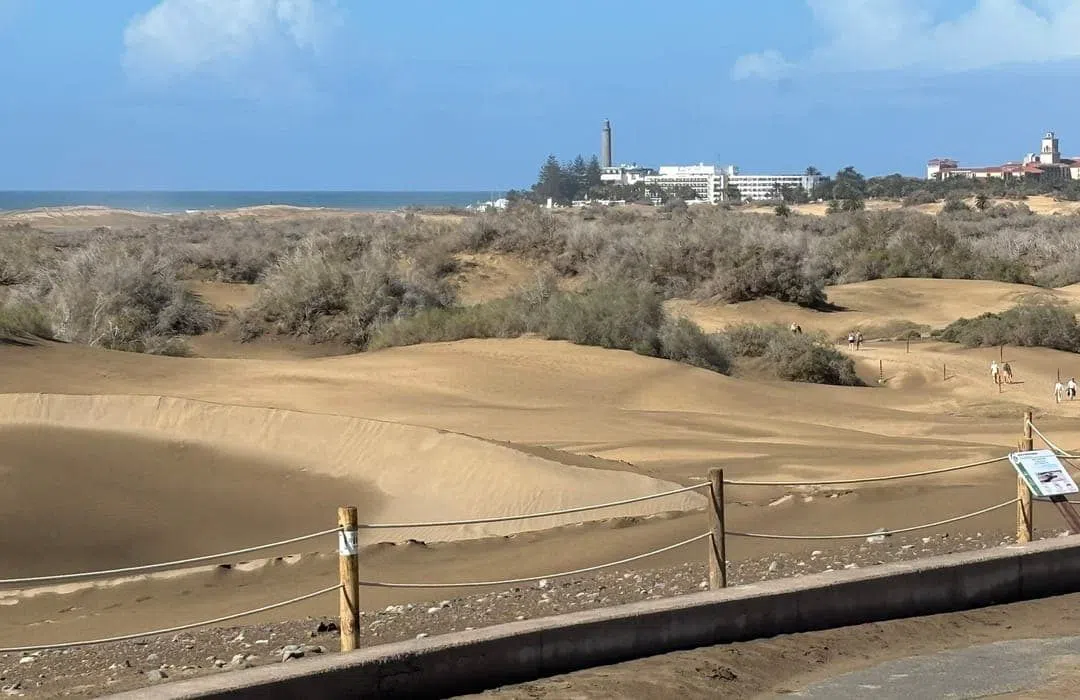
The beach is the main event — around four kilometres of open sand running from the resort's eastern edge straight into the Maspalomas Dunes Special Nature Reserve. There is no transition, no gatehouse, no bus. The sunbeds thin out, the buildings fall away behind you, and the sand starts to rise.
The reserve is rated 4.8 and is the single best reason to leave the resort grid without leaving it at all. Marked paths cross the dune system to the Faro de Maspalomas lighthouse, a walk of roughly 45 to 75 minutes each way depending on the route you take and the conditions underfoot — soft sand and wind both tax the legs more than the distance suggests. Go outside the midday heat, carry water, and stay on the signed paths: this is a protected system, fenced and patrolled, and the dunes themselves are the fragile part.
For a different kind of morning, San Fernando Market sets up at Parque Europeo on Wednesdays and Saturdays with around 145 stalls — rated 3.7, more everyday than artisanal, and a reliable reminder that people actually live here rather than merely holiday here.
Shopping
Shopping in Playa del Inglés is arcade-style rather than high-street, and understanding that saves disappointment. The Yumbo Centrum and the Kasbah are both multi-storey complexes of small independent units: souvenirs, sunglasses, leather goods, electronics, and duty-free-style perfume and tobacco, sitting alongside the same bars that take over the buildings after dark. There is no boulevard of flagship stores, no restored merchant street. What there is instead is volume and bargaining room, best browsed in the cooler part of the day when the units are open and the courtyards are still quiet. The San Fernando stalls cover whatever the arcades do not.
Where to stay in Playa del Inglés
Avenida de Tirajana is the easiest answer for a first visit. It is the spine of the resort, lined with hotels and apartments, and it puts both the Yumbo Centrum and the beach within walking distance — so you are never far from either the bars or the sand, and you can decide which one you want at the moment you step outside.
The trade-off is noise. The streets immediately around the Yumbo are the loudest in the resort, and if constant late nightlife wears on you, that is a block to choose deliberately rather than by accident. A few streets back gets you most of the convenience and considerably more sleep. Accommodation skews to all-inclusive hotels and self-catering apartments at mid-range package pricing; boutique charm and architectural interest are not on the menu here, and anyone who wants them should look at Las Palmas or Agüimes instead. Families after a quieter beach with the identical climate are better served by San Agustín next door.
Getting around
Once you are in it, Playa del Inglés is flat and entirely walkable. The beach, the Yumbo Centrum and the Kasbah all sit within 10 to 15 minutes of each other on foot from most hotels, which is the quiet genius of a 1960s grid — everything was planned to be reached without a car.
For anything beyond the resort, Gran Canaria's Global bus network covers the island well, and a hire car is simply not necessary for a resort-based stay. Gran Canaria Airport is roughly 30 to 40 minutes by road: bus line 66 runs direct, with lines 04, 05, 36 and 90 as slower alternatives, and a taxi takes about the same time as the bus for considerably more money. Rent a car only if you genuinely intend to explore the north and the interior — otherwise it will spend the week parked while you walk.
24 October 2026