El Hierro · Where to live · 8 min
Under a Thousand Metres of Cliff: Frontera and Tigaday, El Hierro's El Golfo Valley
A collapsed volcano flank left El Hierro with a nine-kilometre amphitheatre of banana terraces, lava pools and one four-room hotel — this is how to read it.

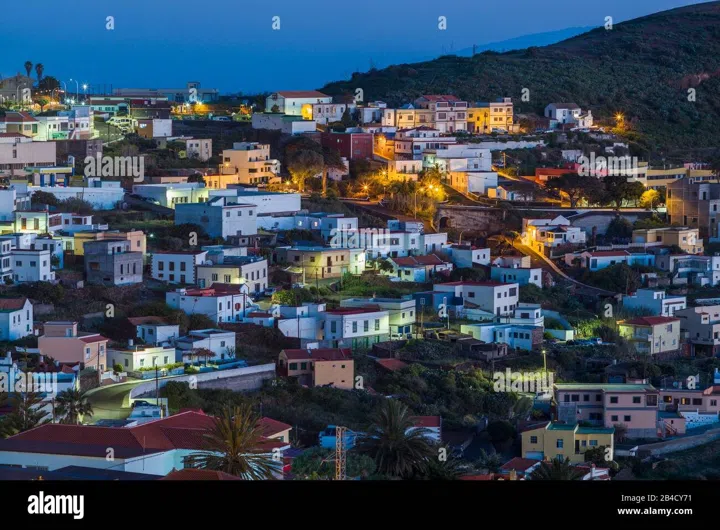
The tunnel is the overture. You leave Valverde, drop through a bore of raw basalt with the headlights on, and come out the other side onto a road that hangs above something that doesn't read as a valley at all — it reads as the inside of a bowl someone broke and never finished. Nine kilometres of horseshoe. A wall of cliff standing a thousand metres over banana terraces. The Atlantic closing the open end, flat and grey-blue, with nothing on it at all. Frontera is less a town than that scar, and Tigaday is the village pooled at the warm bottom of it, where the sun collects and the trade winds, having tripped over the escarpment, simply give up.
What Frontera and the Golfo valley are known for
The geology comes first, because everything here is downstream of it. Roughly 15,000 years ago the entire northern flank of El Hierro let go and slid into the Atlantic — somewhere between 150 and 180 cubic kilometres of rock in a single catastrophic movement, one of the largest collapses known on any volcanic island anywhere. What it left is the El Golfo embayment: a horseshoe of cliff rising as high as 1,000 metres, about nine kilometres from horn to horn, with a lower, younger valley floor built out of the lava that came afterwards.

Seen from the top, the scale is abstract — a diagram of a disaster. Driven into, it turns agricultural. The valley traps heat the rest of El Hierro never gets, and the result is the one corner of the island that feels tropical rather than volcanic-bleak: bananas in long green ranks, mangoes, pineapples, terraces stepping down almost to the lava-rock shoreline, and the Viña Frontera cooperative's vines climbing the lower slopes where the cliff begins to let go of the light. Before the tunnel, the way in and out was the Camino de Jinama, an eight-kilometre packhorse route that zigzags straight up the escarpment; islanders carried crops on their backs along it. It remains the valley's signature hike. It has also closed before for rockfall, so treat it as a trail to check on rather than one to assume.
Where to eat and drink
Eating in the Golfo valley runs on two things: what the terraces actually grow and what the boats actually land. The old-school Canarian comedores have been joined, in the last few years, by a run of younger kitchens along Calle Tigaday — which is still a quiet valley high street, and all the more startling for what's now on it.
Start with Restaurante Frontera, the long-running local choice on Calle Tigaday and the one everyone names first. This is straightforward island cooking done properly: bacalao, and roast cheese that arrives blistered and faintly sweet. It is at its best on a Friday night, when the room fills with people who clearly all know each other and the volume climbs by a third.

A few doors along, Warapu Street Food is the genuine surprise — an Asian-fusion kitchen turning out ceviche, bao, ramen and tacos within sight of banana plants, which shouldn't work on an island of 11,000 people and absolutely does. Next to it, El Capricho Gastrobar plays a broader hand, with a varied menu built on local produce and, usefully for a valley this remote, clearly marked vegan, vegetarian and celiac options. If you are self-catering in Tigaday and have had three nights of your own cooking, this short stretch of street is your whole dining scene, and it is better than it has any right to be.
Then there is the coast. Down at Las Puntas, Restaurante Garañones puts fresh fish on a terrace facing the Roques de Salmor, those two sea stacks standing off the valley's western end like punctuation. The fish is whatever came in; the view does the rest. Bring notes — it's cash only, and the nearest bank is back up in Tigaday.

For the valley's one genuinely architectural meal, climb to the Mirador de la Peña restaurant, set inside César Manrique's cliff-edge building on the rim. Order the egg-and-cheese soup, sit by the glass, and time it for sunset, when the light comes in low across the whole embayment and the terraces below go from green to bronze to nothing.
Nightlife
There is no nightlife strip here, and nobody in Frontera is pretending otherwise. This is early-to-bed farming and fishing country; the high street closes while there's still a glow behind the Roques. What exists is low-key and attached to places people are already sitting. Kiosco Las Bolas in Frontera is the honest version of an evening out — a casual boules terrace where you have a drink, watch a game, and talk. Nothing resembling a club, no door policy, no soundtrack beyond conversation.

The other option is simply to dine late. Restaurante Frontera's terrace will keep going on a Friday past the hour when most of the valley's lights have gone out, and that counts as a night out here. Factor in the drive home: these roads are narrow, often cliff-edge, and unlit once you leave the village.
Things to do
Most of what there is to do in El Golfo is the landscape itself, experienced at walking pace. There's no sand, so the valley's natural pools stand in for a beach — and they're better company than sand. Charco de los Sargos and Charco Azul are both cut into black volcanic rock near Las Puntas, open to the swell on one flank and sheltered enough on the other to actually swim in. Go on a calm day and the water is glass over basalt; go on a big day and stay out, because the Atlantic here has 4,000 kilometres of run-up and no manners.

La Maceta, the third of the set, is the family choice: showers, grills and a kids' pool, which makes it the one place in the valley where an afternoon can be organised rather than improvised.
Above all this sits the Mirador de la Peña, Manrique's 1989 lookout, now a protected Canarian heritage monument — a building that works by withholding the view and then handing it over all at once, the whole nine-kilometre horseshoe laid out below the glass. It is the single best fifteen minutes on the island for understanding where you are.

West along the coast road, in Sabinosa, the Pozo de la Salud spa is the valley's strangest proposition: the Canary Islands' only spa resort, built over a mineral well dating to 1702 whose water islanders have credited with cures for three centuries. Day visitors are welcome, which means you can finish a morning on the Jinama escarpment with an afternoon in the water.

Shopping
There's no retail strip, and anyone arriving with a shopping list will have to recalibrate. Shopping in Frontera means producers and one very good market. The Mercadillo de La Frontera fills Tigaday's Plaza Benito Padrón every Sunday from 8am to 2pm — around 22 stalls, with tropical fruit grown on the terraces you can see from the square, alongside the other things valley families make. Arrive near opening; by late morning the best of it has gone home with locals.

The other errand worth making is wine. The Viña Frontera cooperative works the vines on the lower slopes behind the village, and buying a bottle here is less a souvenir than the obvious drink to have with that roast cheese.
Where to stay in Frontera and Tigaday (El Golfo valley)
Tigaday is the practical base. Everything functional in the valley is here — the bank, the health centre, the restaurants on Calle Tigaday, the Sunday market — and all of it within walking distance of each other. Accommodation skews to self-catering apartments rather than hotels, places like Apartamentos Frontera, and it's the cheapest feel in the valley. For a week of hiking and cooking your own market fruit, it's the right call.
Las Puntas, down on the coast, is the scenic alternative: closer to the pools, closer to the fish, further from the shops. It also holds the valley's one piece of true lodging folklore — Hotel Puntagrande, four rooms built into a lava promontory with water on three sides, Guinness-listed as the world's smallest hotel. It is a short stay rather than a base, and it is the kind of night people remember for years.
Budget-wise, the valley is inexpensive by Canarian standards — simple apartments, simple comedores — with Hotel Puntagrande and the Pozo de la Salud spa as the two deliberate splurges.
Getting around
El Hierro has no trains and no trams. Everything moves by TransHierro bus, by hire car, or on foot, and because the Golfo valley is a scatter of hamlets rather than one settlement, a car is the realistic answer for most visitors. Line 3 links Valverde, the island capital, to Mocanal and on to La Frontera and Tigaday roughly six to eight times a day — fine for a day trip into town, useless for reaching the coast pools, the Mirador de la Peña or Sabinosa on your own schedule, and thin to non-existent after dark.
Getting here means El Hierro Airport (VDE) near Valverde, or the Fred Olsen Express ferry from Los Cristianos in Tenerife, about two and a half hours. From either, budget 20 to 40 minutes of driving, most of it through the tunnel and down the valley's switchbacks. The area is very safe and very quiet; the genuine risks are the roads — narrow, cliff-edge, no streetlights once you're out of the village — and the trails, which the island closes when the rock says so. Drive it slowly. The valley was 15,000 years in the making, and it rewards time rather than a flying day trip.
24 October 2026