El Hierro · Where to live · 8 min
Sabinosa and La Dehesa, El Hierro: A Village at the Edge of the Old Map
Spain's forgotten zero meridian, a juniper forest bent double by the Atlantic, and one restaurant that depends entirely on what the boats bring in.
For two and a half centuries, the world's maps began at a cliff on El Hierro's western shoulder. In 1634, under Louis XIII and Cardinal Richelieu, France fixed its zero meridian at the westernmost point of the Canaries, and the line it drew ran straight through the headland where the Faro de Orchilla stands today. Greenwich took the title in 1884. The cliff stayed exactly where it was. Above it spreads La Dehesa, a wind-pressed plateau of juniper and old lava; above that, folded into the hillside at the top of the Valle del Golfo, sits Sabinosa — fewer than 400 people, lanes too steep and narrow to be anything but walked, and a wind that almost never lets up.

The end of the old world's map
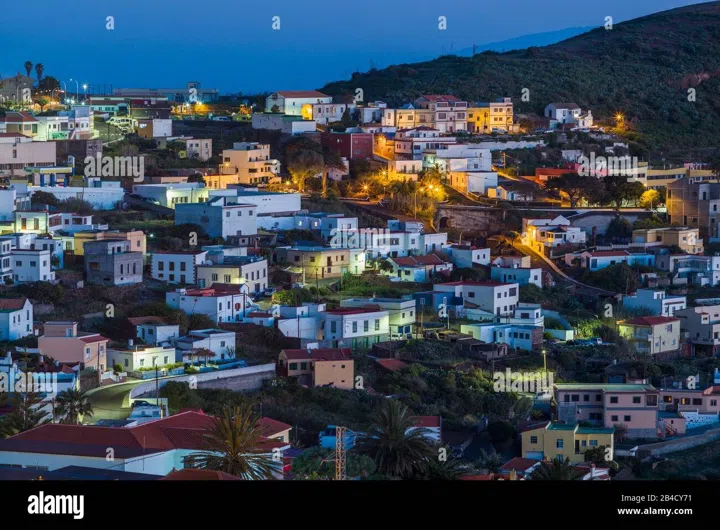
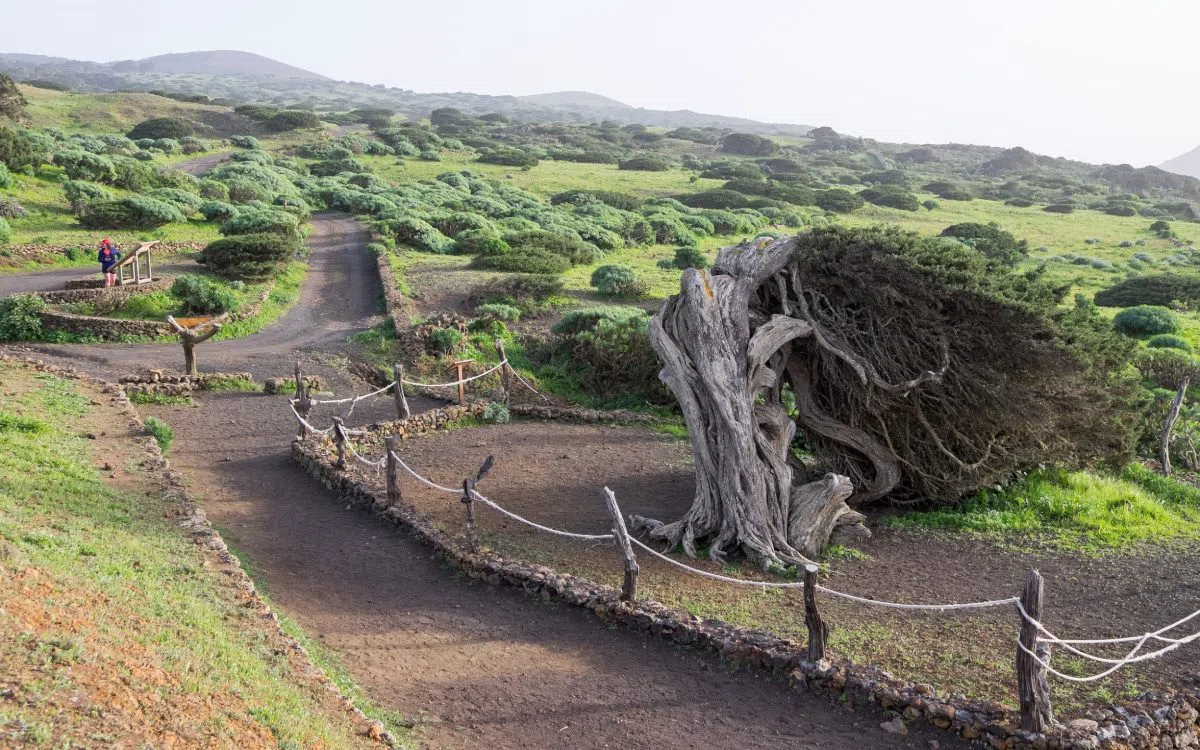
Sabinosa calls itself the most isolated village on El Hierro, and on an island already treated as Spain's afterthought, that is saying something. It earns it. The houses are stone with tiled roofs, stacked up the slope in a way that leaves the lanes feeling like stairwells with sky, and the Atlantic arrives over the lip of the land with almost no interruption. You feel the wind before you notice anything else, and once you've felt it you understand the landscape: the junipers up on the plateau grew bent because this is what they've been pushed by, every day, for centuries.
The meridian is the thing people come for, even if most of them only half-know the story. Before transatlantic flights made the Atlantic a corridor rather than a wall, this really was the place where European cartography ran out of certainty — the last fixed point before the blank. The lighthouse that marks it was built in 1933, low and white on the black rock, with nothing west of it but water the whole way to the Americas. It is rated among the best sunset spots in Spain, and the rating is deserved for a reason that has nothing to do with the building: there is simply nothing in the way.

What Sabinosa and La Dehesa are not is a destination that bends to the visitor. There is no promenade, no café row, no evening to stroll into. The quiet here is structural, not seasonal. That makes it magnificent for some travellers and genuinely frustrating for others, and it's worth deciding which you are before you book.
One restaurant, and the island's westernmost wine
Sabinosa has exactly one restaurant, and honesty serves you better than enthusiasm here. El Pozo de la Salud sits on the coast road, attached to the spa of the same name, and it lives or dies on what the day's boats land. Reviews are mixed on service and consistency — some evenings it hums, some evenings it clearly doesn't — but when the fish is right, it is the reason you drove 35 kilometres west. Order what the locals order: peto, the dark-fleshed wahoo that comes in firm and faintly smoky off the plancha, or cabrillas, the small rock-dwelling comber that's all sweet flake and crisp skin. Ask what came in that morning rather than reaching for the menu. The answer is the menu.

The other half of eating and drinking out here isn't a venue at all, in the way cities mean the word. It's wine. The terraces of the Valle del Golfo are volcanic, steep and awkward to work, and Bodegas Quintero is the family operation that keeps working them — bottling under the Quintero, Simancas and Valle de Naos labels from malvasía and listán grapes, all within the D.O. El Hierro. This is one of the westernmost wine villages in Spain, a fact that sounds like trivia until you taste what the wind and the ash do to a malvasía: saline, a bit austere, nothing like the soft tropical thing the mainland sometimes sells under the same grape name.

Prices, across the board, are inexpensive by Canary standards. That's less a bargain than a consequence — there's barely any competition to push them up, and barely any choice either. Stock the car in Tigaday or Los Llanillos before you come up, especially if you're self-catering. On a Sunday evening in Sabinosa, a bag of groceries is worth more than a reservation.
Juniper forests, a dead meridian, and the island's wildest beach
Sabinosa's real draw is everything around it, and the best of it begins on foot. The trail that climbs from the La Dehesa chapel to the Sabinosa viewpoint is the easiest honest way into El Sabinar, the juniper forest that has quietly become El Hierro's emblem — every tree torqued into a different posture by the same prevailing wind, some crouched almost flat, some corkscrewed, all of them holding on. Photographs of El Sabinar are everywhere on the island; standing in it is a different experience entirely, because you hear it. The wind in those low branches is a constant dry rush, and the Valle del Golfo drops away below you while it happens.
Keep going and the same route feeds into the Mencáfete nature reserve, where the character changes completely: laurel forest, damp, green, mossy, the Atlantic cloud caught and wrung out by the ridge. It's the best reminder available that El Hierro is not one landscape but several stacked within a few hundred metres of altitude.
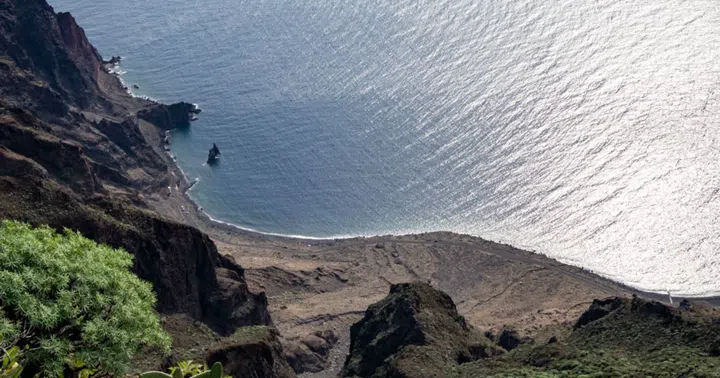
Down on the coast, Playa del Verodal is the island's largest beach and comfortably its strangest-looking — a long sweep of sand in a red-black register you won't have seen on a beach before, the colour of rust and basalt arguing. Go. Photograph it. Do not swim. The Atlantic swell and currents here have caught out people who should have known better, and the sensible approach is to treat Verodal as a viewpoint that happens to be made of sand.

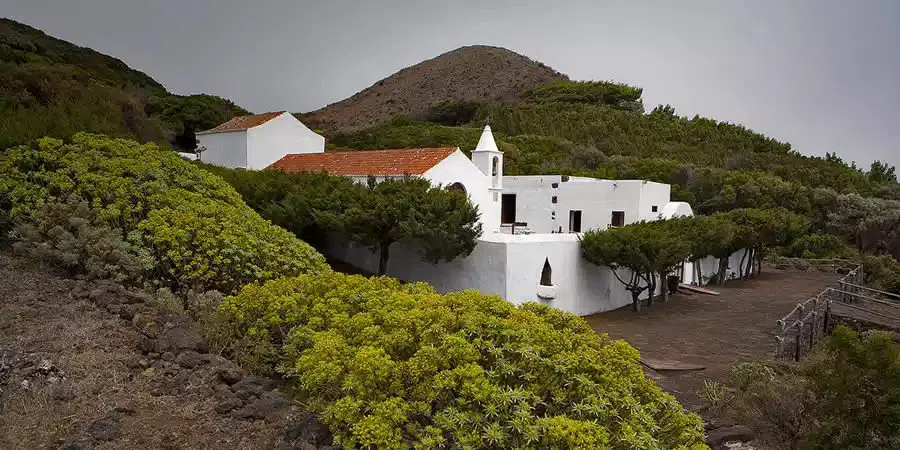
On the La Dehesa plain itself stands the Santuario de Nuestra Señora de los Reyes, the island's sanctuary and the spiritual centre of a place with almost no population. Once every four years it becomes the starting point of the Bajada, the pilgrimage that carries the island's patron across El Hierro — and in the years between, it sits alone on the plateau with the wind working at it, which is arguably the more affecting way to meet it.
Time the Faro de Orchilla for last light and you'll understand why people make the drive down. There is no infrastructure, no ticket, no interpretation panel worth the name — just a working lighthouse, a cliff, and the sun going into the water at the place where the maps used to stop.
Wine, and not much else
There is no shopping street in Sabinosa, and pretending otherwise would be a disservice. This is a wine village, not a market town, and that really is the whole story. What passes for retail is buying direct: Bodegas Quintero and the handful of other small family wineries scattered around the village will sell you bottles on request, though "on request" is doing real work in that sentence — call ahead, turn up at a civilised hour, and accept that someone may be out on the terraces rather than behind a counter. It's a better souvenir than anything a gift shop could sell you, and the Valle de Naos and Simancas labels travel home well.

Where to stay in Sabinosa and La Dehesa
Sabinosa and La Dehesa aren't set up as a hotel base in the usual sense. There's no strip of options to weigh against each other, which means what you book more or less decides what kind of trip you have. The Balneario Pozo de la Salud, run by the island council down on the Sabinosa coast, is the obvious choice if the mineral water is part of the appeal — and after a long day on the El Sabinar and Mencáfete trails, with the wind still ringing in your ears, a soak is not a frivolous idea. Staying out here also buys you the two hours that matter most: sunset at Orchilla and the walk back to a bed that isn't 35 kilometres away.
The alternative is pragmatic. Base yourself in Frontera or Valverde, where there's restaurant choice and some semblance of an evening, and drive out to La Dehesa for full days. Nobody will tell you that's the wrong call. But you will miss the thing Sabinosa does better than anywhere else on El Hierro, which is darkness and silence at the same time.
Getting around Sabinosa and La Dehesa
The R12 is the only public transport that genuinely reaches Sabinosa, running a short loop between La Frontera/Tigaday, Los Llanillos, the village and the Pozo de la Salud spa — roughly seven runs a day on weekdays, five at weekends, operating somewhere between 6:30am and 10pm. That covers the village and the spa, and nothing else. The lighthouse, the sanctuary and Verodal are beyond it. If you arrive without a car, you have arrived in a village and not in a region.
So: hire a car. Fly in with Binter Canarias or Canaryfly to El Hierro Airport, 40 minutes from Tenerife North or 55 from Gran Canaria, or come across on the Naviera Armas ferry, then drive the 35 kilometres west. Crime is effectively a non-issue here. The road is the risk. The route into La Dehesa is narrow with sheer drop-offs and very little margin for error, so take the hairpins slowly, use the horn on blind bends the way locals do, and don't attempt the descent toward Orchilla in the dark if you can avoid it. Drive down for the sunset, by all means — just allow enough light to get back up.
24 October 2026