Lanzarote · Where to live · 8 min
Arrecife, Lanzarote: The Capital That Doesn't Perform
Two pirate-era forts, a lagoon full of fishing boats and €4 tapas — why Lanzarote's working capital deserves more than a coach stop.
The coaches from the resorts come into Arrecife for two things — the small castle on its islet and the lagoon in the middle of town — and then they leave again, usually before lunch. What they leave behind is the actual place: Lanzarote's seat of government and its only real port, a town of roughly 60,000 people that has never had to earn its living by being charming. Arrecife doesn't perform for visitors, and that is exactly the reason to give it two or three days rather than two or three hours. The volcanic rock shelf that gave the town its name — arrecife, reef — still runs along the shoreline. The ferries still dock. And the tapas still cost €3–6 a plate, which on this island is its own kind of headline.
Two castles, a lagoon and a working harbour
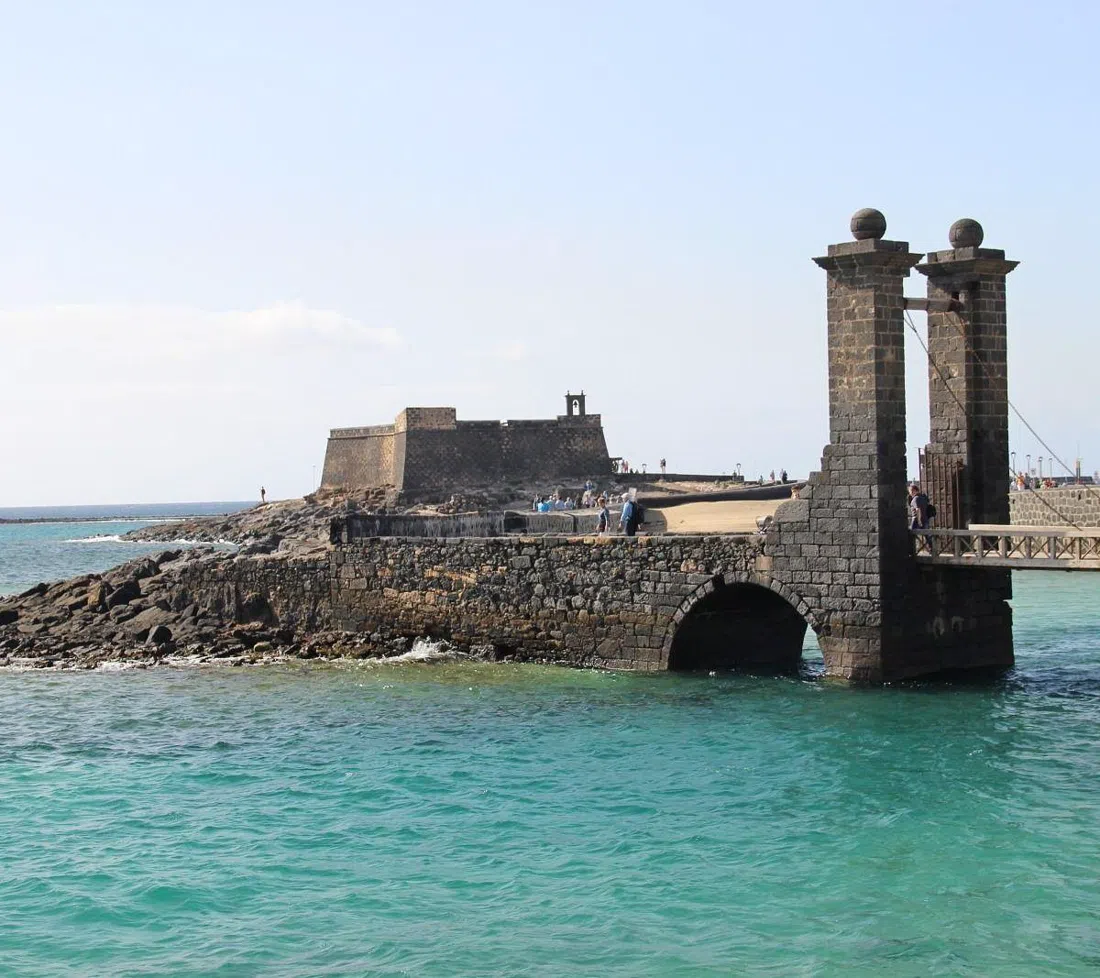
Arrecife grew up defensively. Pirate raids pushed the town into building two small forts, one in the 16th century and one in the 18th, and both are still standing at opposite ends of what is now a very flat, very easy walk. Castillo de San Gabriel is the older and the more theatrical: a squat sea fortress on its own islet a few metres offshore, close enough that you can see people moving on its ramparts from the promenade. Castillo de San José, further round the bay, had the stranger second life — an 18th-century gun battery that César Manrique talked into becoming a contemporary art museum.
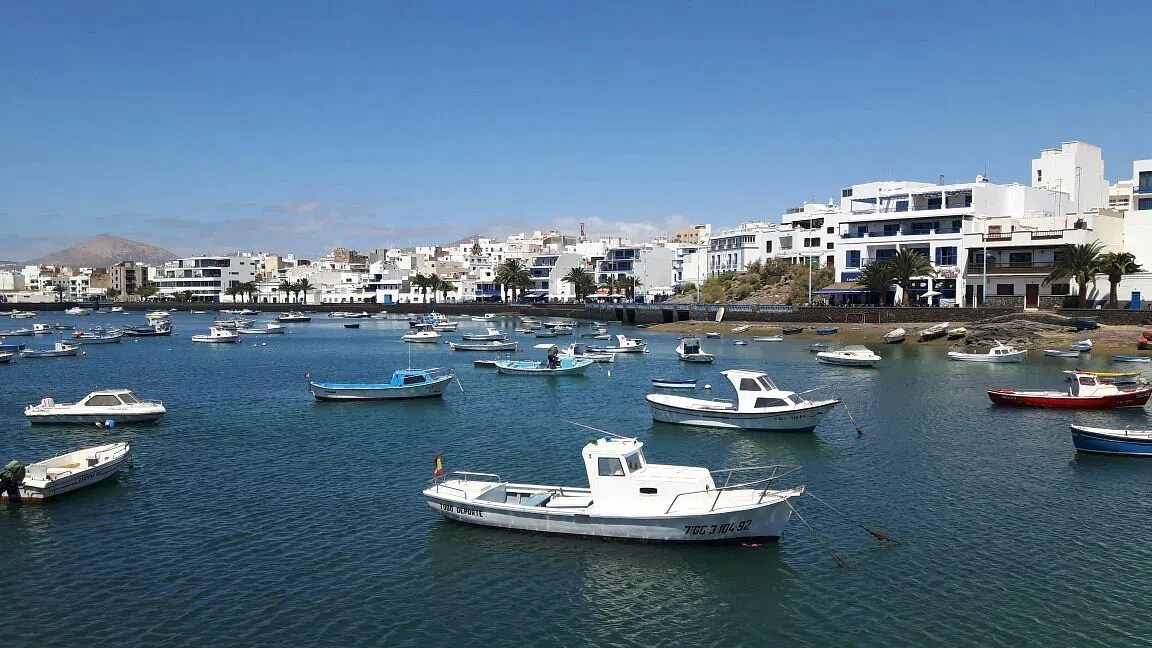
But the thing locals would name first isn't a building at all. It's a body of water. The Charco de San Ginés is a shallow tidal inlet that reaches right into the middle of the street grid, ringed by low whitewashed fishermen's cottages, and it still has working boats sitting in it rather than a marina's worth of chartered fibreglass. Walk the full circuit — it takes about as long as a coffee — and you understand the town's whole proposition in one lap: domestic, unhurried, salt-stained, entirely unbothered by you.
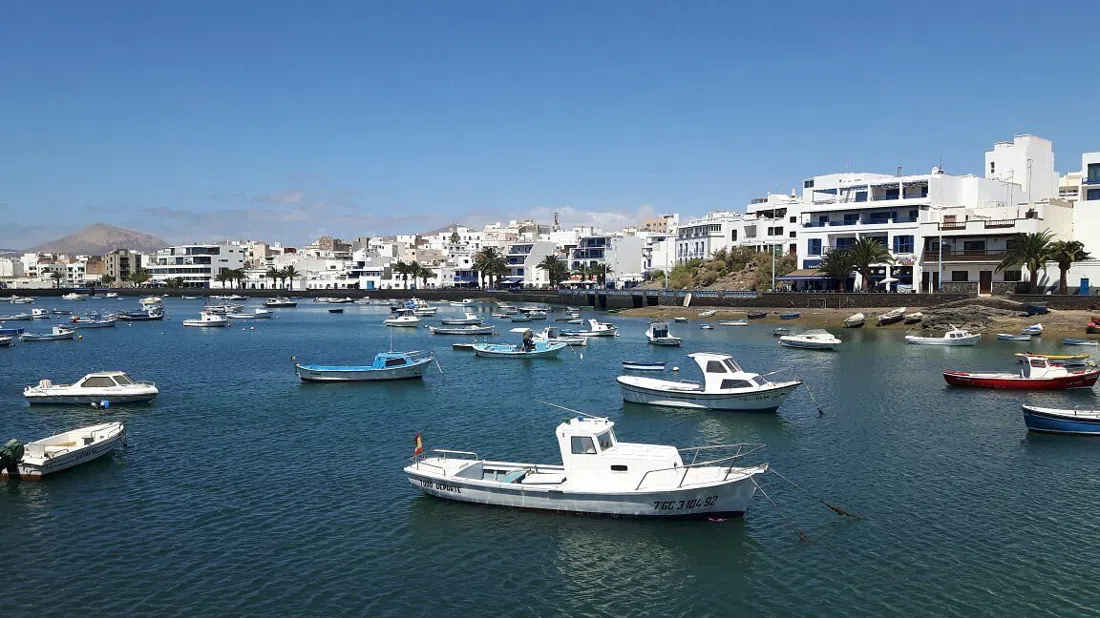
The third ingredient is the harbour, and it's the least photogenic and most consequential. Arrecife is the island's only real port. Naviera Armas ferries dock here from Las Palmas on Gran Canaria, cargo comes and goes, and the working waterfront gives the capital a weight that the resort towns simply don't have. Lanzarote's postcard is elsewhere — the vineyards in their black lapilli pits, the volcano road through Timanfaya. Arrecife is where the island does its paperwork and unloads its freight.
Where to eat and drink in Arrecife
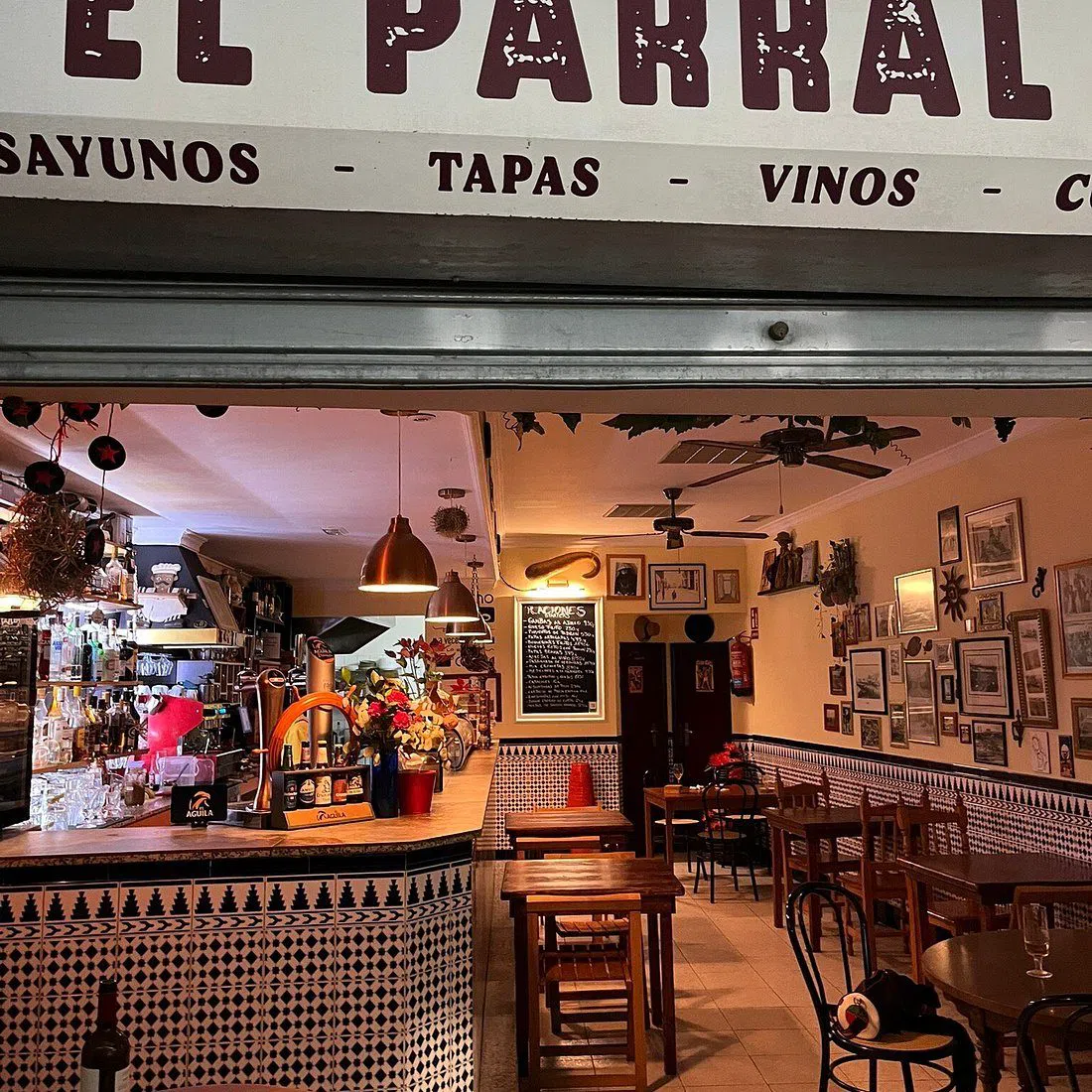
Arrecife's best food is not looking for you. The clearest proof is El Parral, a family-run bar near the centre with no printed menu — just three blackboards listing whatever came in that morning. Scallops, snails, a seafood paella: the roster shifts with the catch, which means the only reliable way to order is to point and trust. Reviewers come back again and again to the same two observations, generous portions and fair prices, and the place holds a 4.7 rating on the back of them. Go hungry and go early-ish; a blackboard kitchen runs out of its best line at some point in the evening.
For red meat rather than shellfish, the address is Calle Ginés de Castro y Álvarez, where Barbacana Bar & Grill runs an Uruguayan-style steakhouse built around its fillet steak. At 4.8 it's the highest-rated of the three restaurants I'd send anyone to in town, and it is also the one most likely to catch you out: it closes Sunday and Monday, so a weekend arrival needs to plan around it rather than wander up hopefully on a Sunday night.
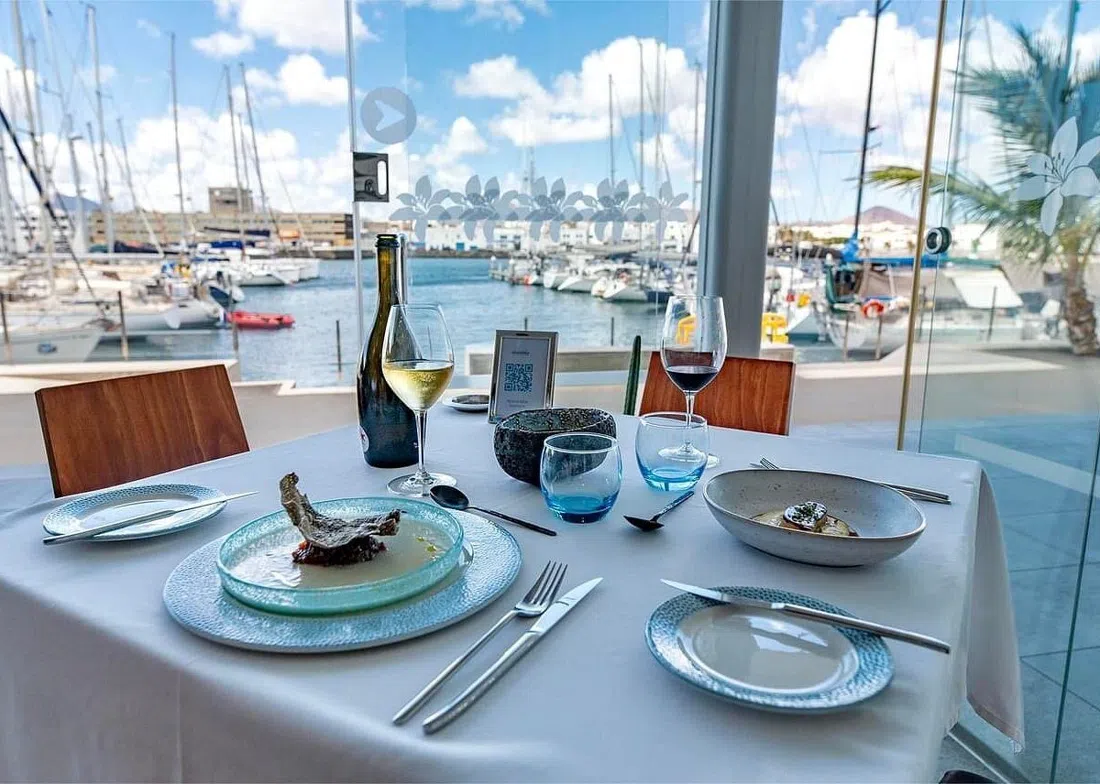
The third option is the dressed-up one. Restaurante Lilium has been cooking in Marina Lanzarote since 2006 and holds a Michelin Bib Gourmand — the guide's marker for good value rather than grand gesture — for a kitchen that puts Canarian ingredients through contemporary technique. It rates 4.6, and it is where you go when you want the island's produce taken seriously and plated with intent, rather than fried and set down in front of you with a wedge of lemon.
Across all three registers, the arithmetic is the real story. Arrecife is noticeably cheaper than Puerto del Carmen or Playa Blanca: tapas land at €3–6 a plate and mid-range mains sit around €12–18. Eat here for a week and the difference against a resort menu is not a rounding error — it's a day trip.
Nightlife: two speeds, lagoon and strip
Arrecife's evening runs at two tempos, and the better one is the slower one. Around the Charco de San Ginés, tapas bars and terraces start filling in the early evening with people who live here, drinking out past the lagoon while the light goes orange and then grey on the whitewash. The mood stays civilised well into the night — conversation rather than volume, tables rather than queues.
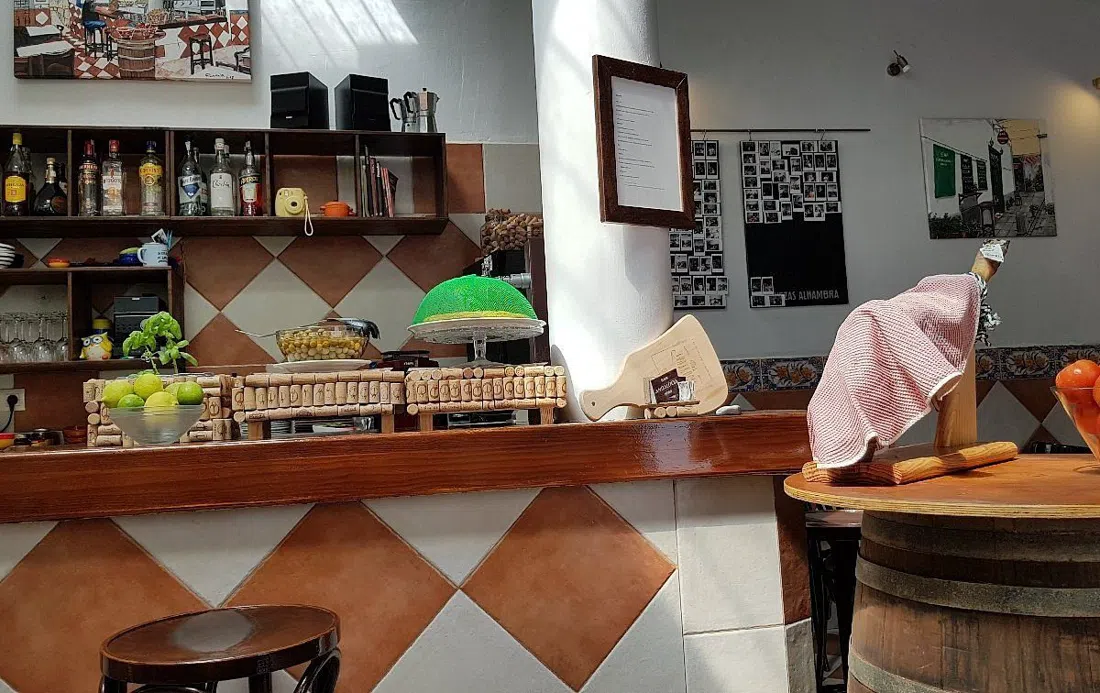
The anchor of that scene is Bar Andalucia 1960, which has been open since the year in its name and keeps a properly Andalusian tapas-bar repertoire: stuffed peppers, sirloin cooked in sherry, ham-and-cheese croquettes. It rates 4.7, and it rewards the patient approach — order two or three things, drink slowly, order two or three more.
Here's the honest caveat, because you should hear it before you book and not after: if you want nightlife on the scale of Puerto del Carmen's strip, this isn't it and won't pretend to be. Arrecife's after-dark pleasures are a long dinner and a longer terrace. That is a feature for some travellers and a dealbreaker for others, and it's worth knowing which one you are.
The castles-and-lagoon walking loop
The good news for anyone arriving without a car: almost everything worth seeing in Arrecife joins up into one flat loop you can do on foot in a morning.
Start at Castillo de San Gabriel. You reach it across the Puente de las Bolas, a 175-metre stone footbridge out to the islet, and the fort now holds the Museum of the History of Arrecife — free entry, which makes the 4.3 rating look like even better value. The exhibits do the useful job of explaining why a town would fortify a rock in the first place; the better pleasure is standing on the walls afterwards with the whole low white skyline of the capital in front of you and open Atlantic behind.
From there, follow the harbourfront round to Castillo de San José and the Museo Internacional de Arte Contemporáneo it contains. This is Manrique's intervention: an 18th-century fort reworked into a museum whose collection runs to Picasso, Miró and Tàpies. It is also, at 3.8, the most divisive thing in town — a small collection in a building that some visitors find more compelling than the art inside it. I'd argue that's the point. The thrill is the collision of a gun battery's stone with white gallery walls and a plate-glass view back over the industrial harbour, which is a very Lanzarote idea about what to do with the past.
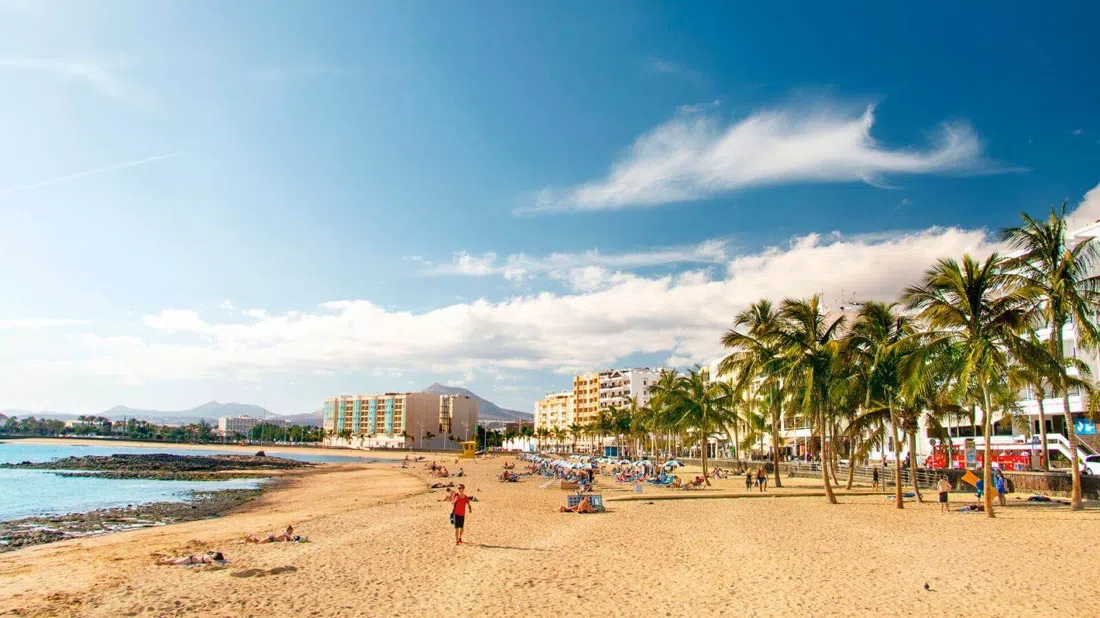
Then there's the beach, and it needs a careful paragraph. Playa del Reducto is Arrecife's town beach: 500 metres of white sand, a Blue Flag, lifeguards year-round, a 4.1 rating, and a position that makes it absurdly convenient. It has also been closed repeatedly during 2025 and 2026 after sewage contamination pushed E. coli levels well above the legal limit. Treat it as a place to walk, sit and read rather than a reason to come, and check the Arrecife council's current bathing status before you get in the water. If a beach week is the whole objective, the better sand is at the resorts and you should base yourself there instead.
Calle Real and the two weekly markets
Calle León y Castillo is the pedestrian spine through the centre, though nobody calls it that — it's Calle Real, and it's where Arrecife is most itself. On a Tuesday morning the crowd is overwhelmingly local: office workers out for a coffee break, pensioners doing the rounds of the fruit stalls, schoolkids cutting through. The shops are clothes, shoes, jewellery and the odd bookshop, and the commercial logic is entirely domestic — this is a street for buying school trousers, not souvenirs.
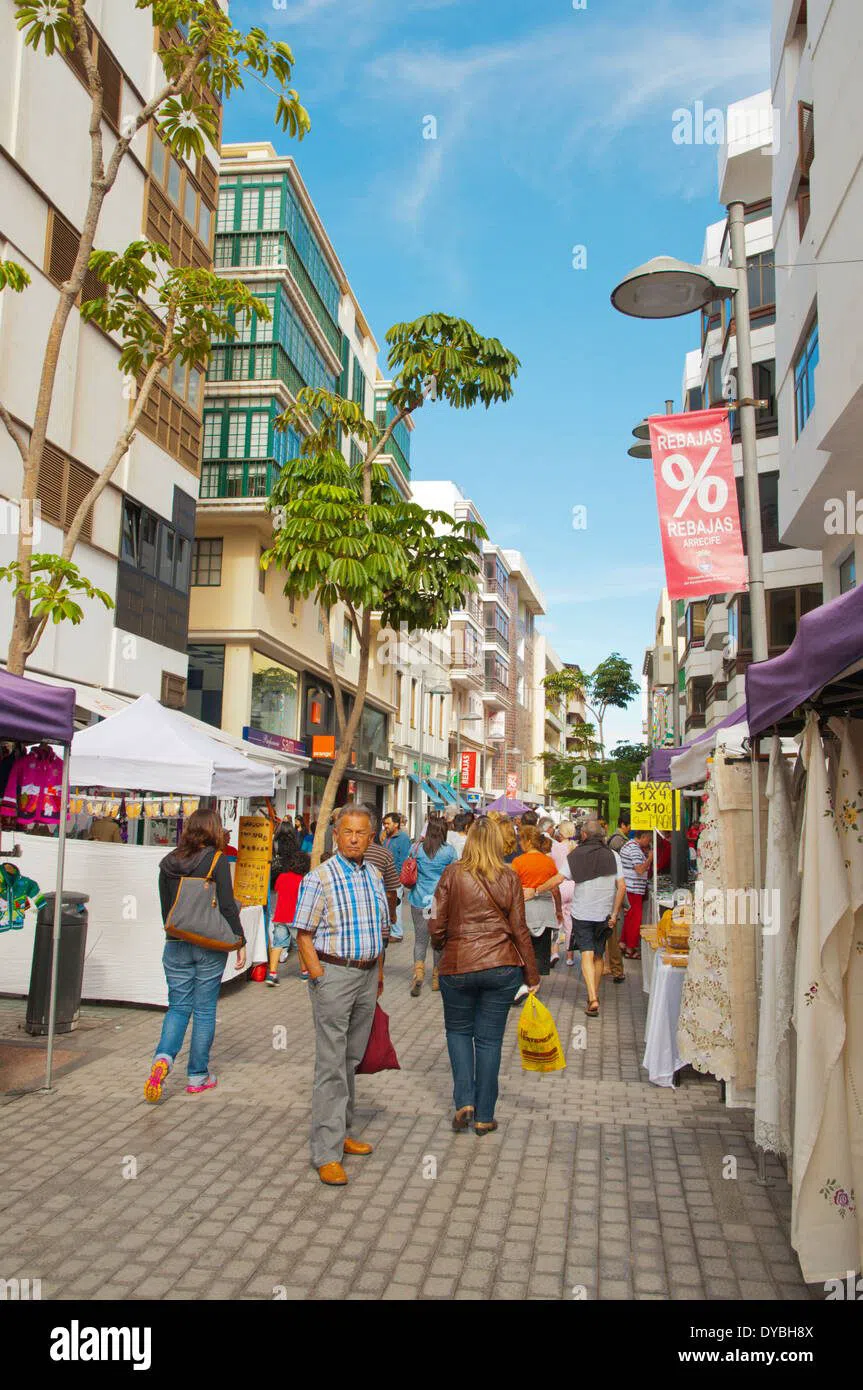
Come back in the evening and the same street turns into the town's promenade, which is the cheapest entertainment in the capital: take a café terrace, order something, and watch everyone walk past everyone they know. For anything food-related, time your visit around the two weekly markets — the Wednesday one is the fixture to aim for if you're self-catering or just want to see what the island actually grows and lands.
Where to stay in Arrecife
Arrecife splits into a few distinct pockets, and the choice matters more than the small size of the town suggests. Around the Charco de San Ginés and Calle Real you're in the old fishing quarter: walkable, atmospheric, a short stroll from the tapas bars, with Castillo de San Gabriel a few minutes further on. That's the pick if you're prioritising character and car-free access over resort facilities. On safety, the straight answer is that this is a working town rather than a resort and it feels fine to walk day or night around the centre and the lagoon; the one genuine caveat in Arrecife isn't crime, it's Playa del Reducto's water quality.
Getting around Arrecife, and off the island
Arrecife is Lanzarote's transport hub as well as its capital, and that makes it the easiest base on the island if you'd rather not hire a car. Lanzarote Airport (ACE) is about 5km south — roughly a 10-minute taxi, or 20–25 minutes on Intercity bus line 22, which runs every 25–30 minutes on weekdays and costs €1.40 into the Intercambiador bus station in the centre. At weekends, line 23 covers the same ground hourly. From that one station, the island's bus network fans out to the resorts and the villages; from the Port of Arrecife, Naviera Armas ferries connect to Las Palmas on Gran Canaria. Within the town itself you won't need any of it. The centre is flat, the loop is short, and the only real decision each day is which blackboard to read first.
24 October 2026