Tenerife · Where to live · 8 min
Harbour Town, Neon Strip: Inside Los Cristianos & Playa de las Américas, Tenerife
A fishing port welded to a purpose-built resort — one flat seafront walk linking La Gomera ferries, pilot whales, a Michelin-starred dining room and 300 metres of nightclubs.

The queue for the Fred Olsen Express builds at Los Cristianos harbour before the seafront cafés have finished putting out their chairs — rucksacks, walking poles, a hire-car map being folded the wrong way, everybody waiting on the fifty-minute crossing to San Sebastián de La Gomera.
A few berths along, the whale-watching boats idle, crews coiling hoses and chalking up the day's departures. Walk five minutes north along the promenade and the port smell of diesel and wet rope thins out, the sand widens, and you are among the sunbed rows of Playa de las Vistas. Keep going. The hotels get taller, the bars get louder, and you arrive in Playa de las Américas. It is one continuous, flat, twenty-minute walk — and it crosses two completely different ideas of what a holiday is for.
What Los Cristianos & Playa de las Américas is known for
Los Cristianos grew up as a fishing town, and the harbour still does a day's work: fish landed at the port, and the same quay serving as the island's main gateway to the western Canaries. Fred Olsen Express boats leave several times a day — roughly 50 minutes to San Sebastián de La Gomera, around two hours twenty to La Palma and El Hierro. That single fact shapes the place more than any hotel does. People pass through here en route to somewhere else, and plenty more base themselves here precisely because leaving is so easy.
The rest of the reputation is sand. The beaches are flat, calm and lifeguarded, strung along the coast like beads: Playa de los Cristianos down by the town, the broad middle sweep of Playa de las Vistas, Playa del Camisón further north, Los Tarajales out at the edge of the market ground.

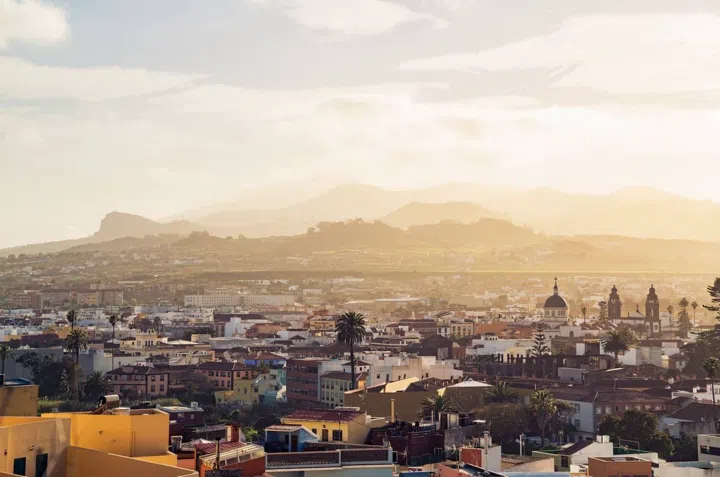
What makes the area genuinely interesting, though, is the seam. This is a working fishing harbour fused to a purpose-built resort strip, and you can feel the join underfoot. Los Cristianos still has a town centre — a Tuesday and Sunday street market, pharmacies, bakeries, old men playing cards on plastic chairs in the morning shade. A kilometre north, Playa de las Américas is a different proposition entirely: towers, neon, and a built-for-purpose logic.
Be clear-eyed about it. Nobody should arrive expecting a quiet, authentic Canarian village; this is the island's most built-up tourist zone and it has never pretended otherwise. What it delivers instead is convenience of a very specific, very reliable kind — flat beaches, shops, pharmacies, restaurants and a harbour, all within walking distance of your room.
Where to eat and drink
Honesty first, because the brochures won't give it to you: most of this strip is pizza, full-English breakfast and tapas-for-tourists. If you are chasing a serious food scene, you will spend your week circling a handful of standouts. The good news is that the handful is worth circling.
The one genuine fine-dining stop is Taste 1973, tucked inside the Hotel Europe Villa Cortés on the Playa de las Américas seafront, holding a Michelin star in the 2026 guide under chef Diego Schattenhofer. Two tasting menus, both built around Canarian culinary history, with dry-aged fish doing a lot of the heavy lifting. It is the sort of restaurant that reframes an archipelago you thought you'd understood from a sunbed.

For something older and plainer, walk the pedestrian streets behind the harbour to El Ventorrillo, where the cooking is traditional Canarian: papas arrugadas with mojo, rabbit braised with garlic and paprika. This is the food the island eats, served without ceremony.

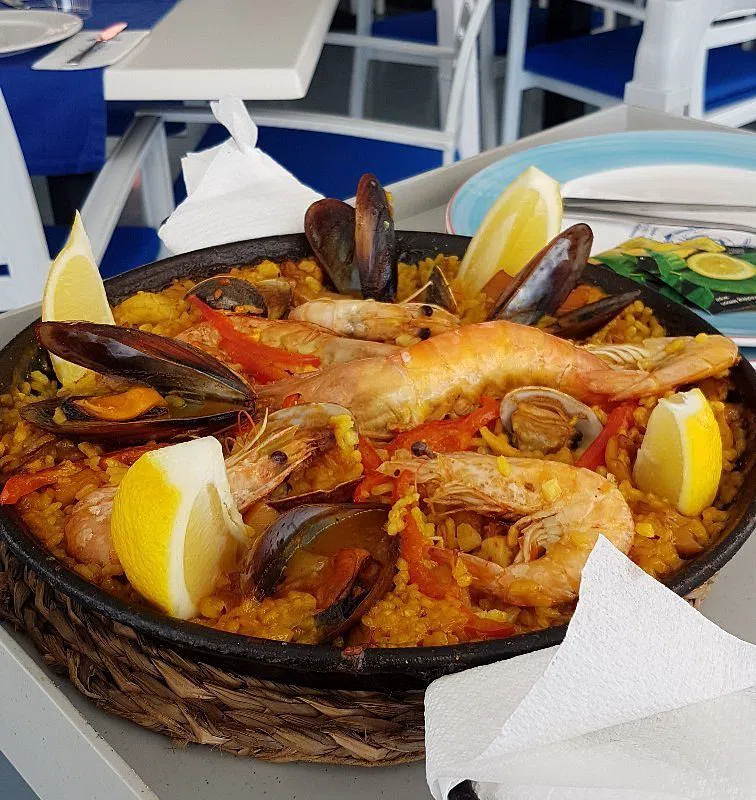
Pescaito, a short walk from Los Cristianos beach, opens for lunch only and specialises in fried fish off a Canarian-Andalusian menu — plan your day around it rather than hoping to wander in at nine at night. On the promenade between the two main beaches, Rincón del Marinero sells harbour-caught seafood by weight, which is the most honest way to buy fish: you choose, it's weighed, you pay for what you eat.
Two more worth knowing. Sal Fina does modern Mediterranean and Italian plates and sits off the main strip, which makes it the sensible answer when you want dinner without a soundtrack. And in the CC Pasarela, Zoco cooks North African and Middle Eastern food — a slow-cooked lamb tagine among the reasons people book it for anniversaries and last nights.
For the hour before dinner, Loro Blanco runs a 6–8pm happy hour and will put a tapas and charcuterie board in front of you to go with the cocktails.

Budget, broadly: a sit-down seafood dinner runs €20–40 a head across the area, with Taste 1973 the one genuine splash-out.
Nightlife
After dark, all roads lead to the Veronicas strip — officially CC Veronicas 1 to 4, four adjoining shopping-and-nightlife blocks standing right on the Playa de las Américas seafront. By day it is a scruffy shopping centre, shutters half-down, the kind of place you walk through without noticing. After midnight, roughly 300 metres of it becomes the loudest concentration of clubs and bars on Tenerife.

Jumping Jacks is the long-running fixture, playing R&B and Afrobeats with table and bottle service for groups who want somewhere to put their drinks and their coats. Oasis and Revolution are the other anchors — Oasis one of the three original clubs that made the strip's name, Revolution still part of the core late-night run. The honest way to describe a Veronicas night is a loop: you will end up walking the same 300 metres three or four times, and that is rather the point.
Two practical notes. The area is generally safe and heavily touristed, but the main risks here are late-night opportunistic theft and the odd aggressive tout after midnight — keep bags zipped and phones out of back pockets. And if none of this appeals, the solution is geography: stay at the Los Cristianos end and the noise simply never reaches you.
Things to do
The best thing to do here involves leaving the land. The Teno-Rasca strip, the stretch of water between Tenerife and La Gomera, is home to Europe's largest resident population of short-finned pilot whales, with bottlenose dolphins turning up regularly alongside them. Boats leave Los Cristianos harbour daily, most running two-hour trips with a swim stop, and several operators take a 'no-chase' approach — cutting the engines and letting the animals decide how close the encounter gets. Morning departures tend to find calmer water and better sighting odds, so take the early boat and have lunch afterwards.
Beyond the water, the pleasures are simple and walkable. The Tuesday and Sunday street market on Avenida Juan Carlos I, opposite Los Tarajales beach, is a genuine event rather than a tourist set-piece. The promenade itself is the other one: a flat 20–30 minute walk that strings the harbour, Playa de los Cristianos, Playa de las Vistas, Playa del Camisón and the Veronicas blocks onto a single line, and which rewards doing twice — once in the morning for the swimmers, once after dark for the lights.
What you cannot do from here, without planning, is mountains. Mount Teide, the Anaga hills and Masca all need a hire car or an organised tour; none of them is a sensible day trip on public transport from this coast.
Shopping
Shopping splits exactly the way everything else in this area splits. The Los Cristianos street market on Avenida Juan Carlos I, running Tuesdays and Sundays opposite Los Tarajales beach, is the better stop for souvenirs with some actual local grounding — aloe vera products, honey, handmade crafts — and a Tuesday morning is far less frantic than the weekend version, when half the south coast turns up at once.

The alternative is the commercial centres, which are functional rather than charming: the CC Veronicas blocks in daylight, sunglasses and sliders and phone cases, and CC Pasarela, worth a look mostly because Zoco is upstairs. Nobody comes to this coast to shop. But if it rains — and occasionally, briefly, it does — these are the places you'll end up.
Where to stay in Los Cristianos & Playa de las Américas
Choose your end of the promenade and you've made nearly every other decision for yourself.
Los Cristianos itself — the streets around the harbour and Playa de los Cristianos — is the calmer, more local-feeling pocket: closer to the ferry port and the Tuesday and Sunday market, with a real town centre of pharmacies, bakeries and small supermarkets rather than hotel towers. This is the right base for older and long-stay visitors, for anyone catching a boat to La Gomera, La Palma or El Hierro, and generally for families, who get a proper town rather than a resort.
The middle stretch, around Playa de las Vistas and Playa del Camisón, is the compromise that works: flat lifeguarded sand on the doorstep, the harbour in one direction and the bars in the other, both walkable. The Playa de las Américas seafront proper is where the big-name hotels sit — the Hotel Europe Villa Cortés among them — and where nightlife groups should book, since staggering distance from Veronicas is a genuine amenity at 3am.
Pricing across the area is mostly mid-range package-holiday territory, with aparthotels and all-inclusive resorts dominating the supply.
Getting around
Tenerife South Airport (TFS, Reina Sofía) is the nearest airport, roughly 17–20km east along the coast. TITSA bus line 111 runs from the airport through Los Cristianos to Playa de las Américas every 20–30 minutes, from around 6am until just before midnight, taking 30–45 minutes depending on traffic. A taxi covers the same ground in 20–45 minutes. Arriving by sea is just as easy: Fred Olsen Express boats from La Gomera, El Hierro and La Palma dock directly in Los Cristianos harbour, which is the rare case of stepping off a ferry and already being on holiday.
Once you're here, you don't need a car. The seafront promenade connects the whole area in a flat 20–30 minute walk, and everything — shops, pharmacies, restaurants, the market, the clubs — sits along it. You only need wheels for the island beyond: Teide, Anaga, Masca. Hire for the days you want them, walk the rest.
24 October 2026